
If you work in El Monte and your employer failed to provide a legally compliant 30-minute, duty-free meal period, California law may entitle you to one hour of premium pay for each workday a required meal period was not provided. You have the right to enforce that pay through the Labor Commissioner or a private lawsuit, and California United Law Group, including attorney Michelle Rapoport, regularly evaluates claims like these for local workers.
TL;DR:
- Employers often violate meal laws through scheduling pressure, understaffing, and workplace culture that discourages taking duty-free breaks, not through explicit policies.
- Premium pay for meal-period violations is generally one additional hour of pay at the employee’s regular rate for each workday a required meal period was not provided; because these premiums are treated as wages, unpaid premiums may also raise wage-statement or final-pay issues.
- Evidence such as schedules, time records, witnesses, and personal logs are critical to proving violations, especially when violations happen repeatedly over time.
- Defenses based on claimed availability, waivers, or interruptions may fail if the evidence shows the employee was not actually relieved of all duty during the meal period.
- Routine violations interact with overtime, potentially creating separate claims for unpaid premiums and missed overtime hours, with premiums reflecting the true regular rate.
Table of Contents
- Understanding El Monte Meal Period Violations and Employee Rights Under State Law
- Common Ways Employers Violate Meal Period Rules in El Monte Workplaces
- Meal Period Premium Pay and How to Enforce It
- What Your Rights Look Like in Practice, and When to Consider Next Steps
- California United Law Group’s Experience With El Monte Meal Period Claims
- Examples of Recent El Monte-Specific Meal Period Violation Cases and Outcomes
- Common Employer Defenses and How Employees Can Counter Them
- Impact of Meal Period Violations on Overtime Calculations
- The Role of Worker Advocacy in El Monte Meal Period Disputes
- What Actually Moves These Cases Forward
- Talk to California United Law Group About Your El Monte Meal Period Claim
- Sources
Understanding El Monte Meal Period Violations and Employee Rights Under State Law
California’s meal period rules apply the same way in El Monte as anywhere else in the state, because they come from the Labor Code and the Industrial Welfare Commission wage orders rather than any city ordinance. generally requires employers to provide a first 30-minute, off-duty meal period when an employee works more than five hours in a day. If the employee works more than 10 hours, a second 30-minute meal period is generally required, subject to limited exceptions and waiver rules.
The break has to be duty-free. That means you’re relieved of all responsibilities. Simply being told you can step away, while your manager still expects you to answer calls or watch the register, doesn’t satisfy the law. The key question is whether the employer actually relieved the employee of all duty and did not deter or discourage the employee from taking the meal period. Simply pointing to a theoretical opportunity to step away may not be enough if workplace conditions or supervisor expectations effectively prevent a real, duty-free break.
There are two narrow exceptions worth knowing:
- Waivers for shorter shifts. A second meal period may also be waivable in limited circumstances, including when the total workday is no more than 12 hours, the first meal period was not waived, and the waiver is by mutual consent.
- On-duty meal periods. These are only permitted when the nature of the work genuinely prevents you from being relieved of duty, such as a lone employee running a small kiosk, and only with a signed written agreement you’re free to revoke at any time.
Rest breaks run on a separate clock. You’re entitled to a 10-minute paid rest period for every four hours worked, and those rest breaks often get violated alongside meal periods in the same shift. A worker who misses both a compliant meal period and required rest breaks may have separate premium claims, generally up to one meal-period premium and one rest-period premium per workday.
Quick reference: A full eight-hour shift in El Monte should include one 30-minute unpaid, duty-free meal period and typically two paid 10-minute rest breaks, unless a valid waiver or on-duty agreement applies.
Common Ways Employers Violate Meal Period Rules in El Monte Workplaces
Meal period violations rarely look like a deliberate policy on paper. They usually show up as scheduling pressure and workplace culture that makes taking a real break impractical.
- Understaffing that leaves no one to cover the floor. When a shift is scheduled too thin, taking 30 minutes off the clock can feel impossible, even when the employer never explicitly forbids it.
- Compressed shift structures. Some schedules pack tasks so tightly that supervisors implicitly discourage stepping away, or breaks get pushed so late they no longer satisfy the timing requirement. In general, the first meal period must begin before the end of the fifth hour of work.
- Continued employer control during the break. Requiring you to keep a radio on, stay in uniform on the sales floor, or remain reachable by phone during your “break” defeats the duty-free requirement, even if you’re technically off the clock.
- Interrupted meal periods. A supervisor pulling you back to handle a customer or delivery, even briefly, may show that the meal period was not truly duty-free.
- Coerced or informal waivers. Some employers ask workers to sign a blanket waiver at hire and never revisit it, even when shifts later stretch well past the six-hour threshold where waivers stop applying.
These patterns show up across retail counters, warehouse floors, and restaurant kitchens throughout the region, often without any single business intending to violate the law. It’s frequently a byproduct of lean staffing decisions.
Pro Tip: Keep a simple personal log of the actual time you started and ended each meal break, even a note on your phone. Employer time records are the primary evidence in a wage claim, but your own contemporaneous notes can corroborate gaps or contradictions if the official records look incomplete.

Time sheets, scheduling emails, text messages from supervisors, and statements from coworkers who witnessed the same scheduling pressure are the evidence categories that typically matter most once a claim moves forward.
Meal Period Premium Pay and How to Enforce It
The remedy for a missed meal period is straightforward in amount, even though the surrounding law is not: one additional hour of pay at your regular rate for every workday a required meal period wasn’t provided. The meal-period premium generally applies per workday, not per missed meal break. Separate rest-break violations may support a separate rest-period premium for the same workday.
That one-hour premium is not a penalty in the everyday sense. The California Supreme Court in Murphy v. Kenneth Cole Productions, Inc. held that meal and rest premiums are wages, not a separate fine. That classification matters because it affects how long you have to bring a claim.
California courts have clarified several important meal-period rules. In Brinker Restaurant Corp. v. Superior Court, the California Supreme Court explained that employers must provide compliant meal periods, but they do not have to police meal periods to ensure no work is performed after employees are relieved of duty. In Murphy v. Kenneth Cole Productions, Inc., the court held that meal and rest break premiums are wages rather than penalties. In Donohue v. AMN Services, LLC, the court rejected rounding practices that shorten or delay meal periods and recognized a rebuttable presumption when time records show missed, short, or late meal periods. In Naranjo v. Spectrum Security Services, Inc., the court confirmed that unpaid meal-period premiums can implicate final-pay and wage-statement obligations.
Wage claims generally carry a three-year statute of limitations, giving you meaningfully more time to act than you might assume if you’d been told the premium was a “penalty” subject to a shorter deadline.
Because the premium is treated as wages, unpaid or unreported premium pay may create wage-statement issues, depending on the facts and the employer’s defenses. CalChamber’s guidance for employers notes that failing to report premium pay accurately on wage statements can expose an employer to additional liability under Labor Code §226, separate from the missed break itself.
You generally have two enforcement paths:
- File a wage claim with the Labor Commissioner (DLSE). This administrative process doesn’t require an attorney and can be a lower-friction starting point, particularly for a single employee with a straightforward claim.
- Bring a private civil action under Labor Code §218. Employees may also pursue meal-period premium claims through court. That route may be considered when the claim involves multiple workers, related wage issues, or potential retaliation or termination facts, but the right forum depends on the specific circumstances.
Two related issues may arise alongside a meal-period case: waiting-time penalties if premium wages were willfully unpaid at termination, and retaliation claims if discipline followed protected wage-related complaints.
What Your Rights Look Like in Practice, and When to Consider Next Steps
You have a few concrete protections worth naming plainly. You’re entitled to a duty-free meal break under the timing rules above, entitled to premium pay when that break doesn’t happen, and free to revoke any on-duty meal agreement in writing at any time, even if you signed one previously.
If you’re weighing what to do about a pattern of missed breaks, a few informational steps are worth considering:
- Preserve what you already have. Pay stubs, posted schedules, texts or emails referencing coverage during your shift, these often become the backbone of a claim later.
- Request a copy of your own time records. California employers are generally required to maintain these, and asking for your own records is a neutral, low-friction step.
- Note the retaliation protections that apply. California law protects employees who file a wage claim, ask HR about missed breaks, or otherwise raise the issue in good faith. Termination or discipline that follows closely after a complaint can itself become a separate legal issue.
- Watch for signals that a pattern exists. A single missed break might be an isolated scheduling mistake. Months of unpaid premiums, a termination shortly after you raised the issue, or the same violation affecting several coworkers are the kinds of patterns that often warrant a conversation with an employment attorney.
None of this requires you to confront your employer directly or file anything before you’re ready. Understanding what the law entitles you to is the starting point, not an obligation to act immediately.
California United Law Group’s Experience With El Monte Meal Period Claims
California United Law Group focuses on California wage-and-hour disputes, including meal and rest period violations, and handles many matters on a contingency-fee basis, meaning attorney’s fees are owed only if the firm recovers on your behalf. Depending on the fee agreement, clients may still be responsible for litigation costs or expenses. Attorney Michelle Rapoport is among the attorneys who evaluate these claims for the firm.
A typical consultation covers:
- A review of your schedule, pay stubs, and any records showing when breaks were or weren’t taken
- An assessment of whether a viable premium pay claim exists based on your specific facts
- An explanation of whether an administrative filing or civil action fits your situation better
Every case turns on its own facts, and outcomes vary.
Common El Monte Meal Period Fact Patterns
Meal period disputes involving El Monte employers tend to follow recognizable fact patterns rather than isolated incidents. Warehouse and logistics workers, common throughout the San Gabriel Valley’s industrial corridor, frequently raise claims tied to compressed shift schedules where breaks get pushed past the fifth hour of work. Retail and food-service workers raise a different but related pattern: being asked to stay near a register or workstation during an unpaid break.
Because these disputes are resolved through settlement, administrative determination, or litigation, and the details of individual cases are generally confidential or not independently reported for public review, no specific case outcome can be cited here as representative. The same basic legal framework applies across industries: when an employer fails to provide a required compliant meal period, the remedy is generally premium pay for each affected workday. A worker at a Rio Hondo-area warehouse and a worker at a small retail shop on Valley Boulevard have the same entitlement under the same statute. If you believe your own situation resembles these patterns, the relevant question isn’t whether your employer is a large or small operation. It’s whether the break you were given actually met the duty-free, properly timed standard the law requires.
Common Employer Defenses and How Employees Can Counter Them
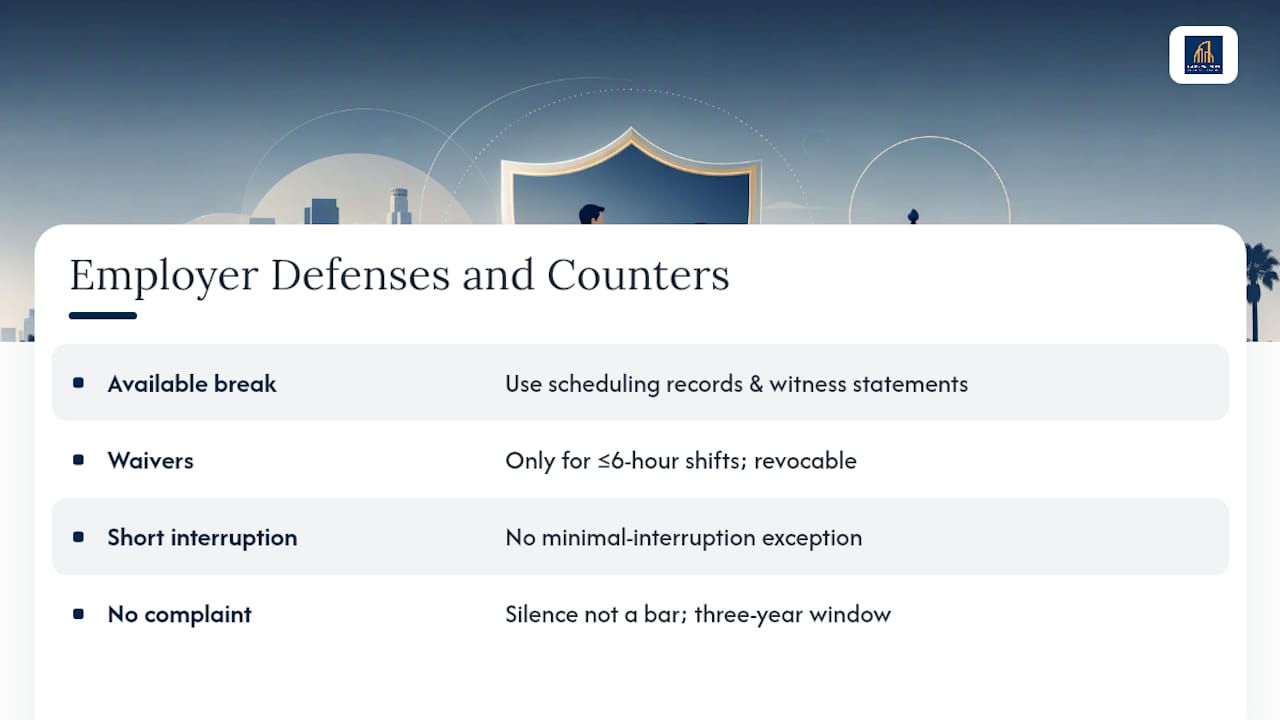
Employers facing a meal period claim tend to rely on a handful of recurring defenses. Recognizing them helps you understand what evidence actually matters.
The most common defense is that a break was “made available” even if it wasn’t taken. Courts focus on whether the employer actually relieved the employee of all duty and refrained from deterring or discouraging the break. Evidence of practical or supervisory pressure can undercut a defense that the break was genuinely provided. Scheduling records and witness statements about staffing levels are often the counter here.
A second defense involves waivers, employers sometimes argue a broad, one-time waiver covers every shift indefinitely. First-meal waivers generally apply only when the total workday is no more than six hours. Second-meal waivers have different limits, and on-duty meal agreements must meet separate requirements and be revocable, so a broad form signed at hire may not answer whether a later shift was handled lawfully.
A third defense claims the break was simply “too short to count” as a violation, arguing a five-minute interruption doesn’t matter. Even short interruptions can matter because the legal question is whether the employee received a full, duty-free meal period. Any interruption that puts you back under the employer’s control during what should be a duty-free period can invalidate the break.
Finally, some employers argue the employee never complained at the time. Silence during employment is not necessarily a legal bar to a later claim, and meal-period premium claims generally fall under a three-year limitations period because the premium is treated as a wage rather than a penalty.
Impact of Meal Period Violations on Overtime Calculations
Meal period violations and overtime pay are calculated separately, but they interact in ways that catch a lot of employees off guard. The one-hour premium for a missed meal period is paid at your regular rate of pay, not your overtime rate, even if the missed break happened during a shift that otherwise triggered overtime.
Where the two issues genuinely intersect is scheduling. A shift compressed to avoid a meal break sometimes also crosses into overtime territory, since skipping a break to “get done faster” can push total hours worked past the eight-hour daily or 40-hour weekly overtime thresholds. When that happens, you may have a claim for unpaid overtime on the hours actually worked, plus a separate premium claim for the missed break itself. These are two distinct violations with two distinct remedies, and one doesn’t offset the other.
There is a subtler wrinkle too: if your regular rate of pay includes nondiscretionary bonuses, commissions, or shift differentials, the meal premium calculation should reflect the legally required regular rate, not just the base hourly wage. Workers paid on a piece-rate or commission basis in particular should watch for premiums calculated using an artificially low base rate rather than the true regular rate the law requires.
The Role of Worker Advocacy in El Monte Meal Period Disputes
El Monte doesn’t have its own local labor enforcement agency separate from the state system, so most protections for meal period violations flow through the same statewide channels available to workers anywhere in California: the DLSE and the civil courts. That said, worker advocacy plays a real role in how these claims surface and get pursued.
Employees in industries with union representation, particularly warehouse, logistics, and food-service workplaces common in the San Gabriel Valley, often have contractual grievance procedures that run alongside, rather than instead of, their statutory rights under the Labor Code. A union contract can supplement Labor Code protections, and meal-period rights are generally treated as nonnegotiable statutory rights, although specific statutory exceptions may apply in certain industries or covered collective bargaining settings.
For non-union workers, community and legal aid organizations serving the San Gabriel Valley sometimes provide initial guidance on wage claims, though capacity and scope vary by organization and case type. Whether you’re weighing a union grievance, a community resource, or a direct legal claim, the statutory floor set by Labor Code §512 and §226.7 remains the same regardless of which path you pursue first.
What Actually Moves These Cases Forward
The conventional advice on meal period violations tends to focus almost entirely on the math, one hour of premium pay per missed break, as if the hardest part is calculation. It isn’t. The harder problem is that most employees don’t realize a violation occurred in the first place, because “you can take a break whenever” sounds like compliance even when it isn’t.
What actually determines whether a claim holds up is documentation of the pattern, not the theory behind it. A single missed break may create a legal issue, but recurring violations across weeks or months usually provide stronger evidence and may make the claim more practical to pursue. A consistent pattern across weeks or months, especially one affecting multiple coworkers, is what tends to separate a viable case from a frustrating but isolated incident.
We’d also push back on the instinct to wait until you’ve left the job to raise these issues. The three-year limitations period that generally applies to meal-period premium claims gives you time, but evidence degrades. If you suspect a pattern, start preserving records now, not after the fact.
— California United Law Group
Talk to California United Law Group About Your El Monte Meal Period Claim
California United Law Group represents El Monte employees in wage-and-hour disputes, including meal and rest period violations, and handles many matters on a contingency-fee basis. That means attorney’s fees are owed only if the case results in a recovery, although clients may still be responsible for litigation costs or expenses depending on the fee agreement. The firm’s work spans claim evaluation, representation in DLSE administrative filings, and private civil litigation when that route better fits the facts of your case.
If you’re considering a consultation, it helps to have your recent pay stubs, any posted work schedules, and copies of messages referencing coverage or breaks during your shifts. None of that is required to reach out, but having it on hand tends to make the initial evaluation more productive.
You can request a case evaluation directly with the firm to discuss whether your El Monte meal period situation warrants further action.
This article is general information, not a substitute for advice from a qualified lawyer. Consult a qualified legal professional about your own circumstances before acting on anything here. Reading this article or contacting the firm through the website does not, by itself, create an attorney-client relationship.
Sources
- California Labor Code §512
- Meal periods — Division of Labor Standards Enforcement (DLSE)
- Murphy v. Kenneth Cole Productions, Inc. (California Supreme Court)
- Premium pay for break violations — CalChamber HR Library
Recommended
- El Monte Meal Period Violations: Your Rights in 2026 – California United Law Group –
- Off-the-clock work in El Monte warehouses: Know your rights – California United Law Group
- El Monte Failure to Reimburse Employee Expenses – California United Law Group –
- Long Beach Retail Meal Break Violations – Worker Rights – California United Law Group