
Yes. If you work in Inglewood, California’s Fair Employment and Housing Act protects employees, applicants, unpaid interns, volunteers, and persons providing services under a contract from sexual harassment at work. You generally have three years from the last unlawful act to file with the California Civil Rights Department, and California United Law Group offers free consultations if you are weighing your options.
Here’s what to know right now:
- Who’s covered: employees, applicants, interns, volunteers, and independent contractors, regardless of company size.
- What to do next: start documenting what happened and consider whether internal reporting or a CRD complaint fits your situation.
- Where to turn: California United Law Group can walk through your facts in a free case evaluation if you’re unsure how to proceed.
Key Takeaways
Inglewood employees are protected from sexual harassment under FEHA, and the strength of a claim usually comes down to documentation, timing, and knowing applicable deadlines.
| Point | Details |
|---|---|
| Broad FEHA coverage | Protections extend to employees, applicants, unpaid interns, volunteers, and persons providing services under a contract, regardless of employer size for harassment claims. |
| Two harassment categories | Quid pro quo and hostile work environment both qualify as unlawful harassment under FEHA. |
| Strict filing deadlines | You generally have three years to file with CRD and one year from a right-to-sue notice to sue in court. |
| Document everything early | Dates, messages, and witness names strengthen a claim far more than memory alone. |
| Free case evaluation available | California United Law Group offers a free consultation and works on contingency, so attorney’s fees are owed only if there is a recovery. Case costs, if any, are addressed in the written fee agreement. |
Table of Contents
- Inglewood Sexual Harassment Rights for California Employees Under FEHA
- What Must Inglewood Employers Do to Prevent Harassment?
- What Remedies Can You Recover From a Sexual Harassment Claim?
- How Do You Report Sexual Harassment in Inglewood?
- What Should You Do Right Now to Protect Yourself?
- How Can California United Law Group Help With Your Claim?
- How Long Do You Have to Sue After Receiving a Right-to-Sue Notice?
- What Happens During a CRD Investigation?
- When Should You Hire a Sexual Harassment Attorney in Inglewood?
- Are You Protected From Retaliation for Reporting Harassment?
- What Local Resources Are Available to Inglewood Employees?
- A Note From California United Law Group
- Talk to California United Law Group About Your Situation
- Frequently Asked Questions
- Sources
Inglewood Sexual Harassment Rights for California Employees Under FEHA
FEHA’s protections against workplace sexual harassment apply broadly, and that scope surprises a lot of people. The law covers not just full-time employees but also applicants, unpaid interns, volunteers, and persons providing services under a contract. For harassment claims, it applies whether you work for a five-person retail shop near Market Street or a large employer near Century Boulevard.
The law recognizes two main categories of sexual harassment. Quid pro quo harassment happens when a supervisor or someone with authority conditions a job benefit, like a raise, a promotion, or continued employment, on submission to sexual advances. A manager tying a better schedule to acceptance of sexual attention may support a quid pro quo theory, depending on the specific facts and evidence. Hostile work environment harassment is broader and covers unwelcome conduct severe or pervasive enough to alter working conditions, even without any direct threat to your job. Repeated sexually charged comments, unwanted touching, or explicit images left in a shared workspace can all qualify.
California cases show how fact-specific these claims can be. In Fisher v. San Pedro Peninsula Hospital, the court described hostile-environment sexual harassment as requiring unwelcome sex-based harassment that is sufficiently pervasive to alter working conditions and create an abusive environment. CACI’s sources quote Fisher for the prima facie hostile-environment elements, including unwelcome sexual harassment based on sex and conduct sufficiently pervasive to alter the conditions of employment. In Miller v. Department of Corrections, the California Supreme Court recognized that widespread sexual favoritism can support a FEHA hostile-work-environment claim when it is severe or pervasive enough to alter working conditions. CACI quotes Miller for the rule that widespread sexual favoritism may be actionable under FEHA when severe or pervasive enough to alter working conditions and create a hostile work environment.
California courts have long described sexual harassment claims as including quid pro quo and hostile work environment theories. In Fisher v. San Pedro Peninsula Hospital, the court recognized those two categories, and CACI identifies separate jury instructions for quid pro quo sexual harassment and work environment harassment. For hostile environment claims, CACI requires proof that the harassing conduct was severe or pervasive and that a reasonable person in the plaintiff’s circumstances would have considered the environment hostile, intimidating, offensive, oppressive, or abusive.
Prohibited conduct falls into a few buckets:
- Verbal: sexual jokes, comments about someone’s body, repeated requests for dates after being turned down.
- Visual: sexually explicit materials, gestures, or images displayed at work.
- Physical: unwanted touching, blocking someone’s path, or physical intimidation.
FEHA also protects against harassment tied to pregnancy, gender identity, gender expression, and sexual orientation, not just biological sex. Employer liability depends on who committed the harassment and what the employer knew or should have known. Supervisor harassment can create direct employer liability, while coworker, customer, or other nonemployee harassment generally turns on whether management knew or should have known about the conduct and failed to take prompt, appropriate corrective action.
What Must Inglewood Employers Do to Prevent Harassment?
California doesn’t just prohibit harassment. It requires employers to actively work to prevent it, and those obligations matter to your claim even if you never read your employee handbook.
Under California regulations, employers must maintain a written anti-harassment policy that lists protected categories, explains a complaint process, and states that confidentiality will be kept to the extent possible. That policy must be distributed to employees, often in the language they primarily speak.

Employers with five or more employees must provide sexual harassment prevention training: two hours for supervisors and one hour for nonsupervisory employees, repeated every two years. New employees and newly promoted supervisors generally must be trained within the statutory timeframe after hire or promotion.
When a complaint comes in, employers should respond promptly, conduct a fair and thorough investigation appropriate to the circumstances, document the process, and take corrective action when warranted. Serious or complex allegations may justify using an outside investigator.
- Written policy distributed to all employees
- Timely training on the statutory schedule
- Prompt, documented investigation of complaints
Pro Tip: If your employer never trained you, never gave you a written policy, or ignored your complaint for weeks, that gap may support a separate failure-to-prevent theory or help show the employer did not take reasonable steps to prevent harassment. It does not automatically prove the harassment claim by itself.
What Remedies Can You Recover From a Sexual Harassment Claim?
If your harassment claim succeeds, California law offers several forms of relief, and the Attorney General’s guidance outlines the main categories.
- Back pay for wages lost because of harassment, retaliation, resignation, or termination.
- Reinstatement or front pay when legally available and appropriate.
- Emotional distress damages for proven psychological harm.
- Punitive damages in qualifying cases involving malice, oppression, or fraud.
- Attorney’s fees and costs when authorized by law.
Outcomes vary widely. Some cases resolve through settlement, sometimes paired with changes to a company’s harassment policy or training program. Individual harassers can also face personal liability, but a non-harassing supervisor is not automatically personally liable simply for failing to stop someone else’s harassment.
How Do You Report Sexual Harassment in Inglewood?
You generally have two paths, and they aren’t mutually exclusive. Internal reporting alerts your employer and starts their obligation to investigate. Filing an intake with CRD starts a formal state process and preserves your legal rights, including the option to sue in court.
Under California’s complaint process, you generally must submit an intake or complaint to CRD within three years of the last unlawful act. CRD can mediate, investigate, or in some cases pursue the matter itself, but you can also request an immediate right-to-sue notice if you want to proceed directly to court after evaluating your options. Because CRD and EEOC filing rules can affect state and federal claims differently, it is wise to get advice about which agency filing strategy fits your facts and deadlines.
A simple way to think through your options:
- Make an internal report to HR or a designated contact, creating a documented record.
- File a CRD intake, which can be done online, by mail, or in person.
- Request a right-to-sue notice and consult an attorney if you want to pursue litigation directly.
Time limit to remember: you generally have three years from the last unlawful act to file with CRD, and one year from the date of a CRD right-to-sue notice to file a FEHA lawsuit in court. Calendar these dates the moment you decide to act.
What Should You Do Right Now to Protect Yourself?
Before anything else, start writing things down. Contemporaneous notes, meaning records made close to when the incident happened, carry real weight later because they’re harder to dismiss as an afterthought.
- Note dates, times, locations, and exactly what was said or done.
- Save texts, emails, voicemails, and screenshots without editing or deleting anything.
- Write down names of coworkers who witnessed the conduct.
- Keep a private backup of your own notes and communications you are allowed to access, stored somewhere your employer cannot access, like a personal email or cloud folder. Do not take confidential, privileged, trade secret, or unrelated company records without legal advice.
- Avoid confronting the harasser alone if you feel unsafe.
If you are not comfortable speaking with HR directly, ask about a designated complaint contact, and do not hesitate to request a translator if language is a barrier. Retaliation for reporting harassment in good faith or opposing conduct you reasonably believe is unlawful is itself illegal, so raising a concern does not waive your protections.
Pro Tip: A single detailed note written the same day an incident occurred is often more persuasive than a polished summary written months later. Corroborating witness accounts, even brief ones, add credibility your own memory can’t provide alone.
How Can California United Law Group Help With Your Claim?
If you’re trying to figure out whether your situation rises to the level of unlawful harassment, or you’ve already filed and aren’t sure what comes next, California United Law Group offers free consultations to walk through your facts.
- Case evaluation to assess whether your experience fits FEHA’s legal definitions
- Assistance navigating a CRD complaint or requesting a right-to-sue notice
- Representation in negotiation, mediation, or litigation if your case moves forward
The firm works on a contingency-fee basis, meaning attorney’s fees are owed only if there is a recovery. Case costs, if any, are addressed in the written fee agreement. That structure can make it easier to have your situation reviewed without paying attorney’s fees upfront.
How Long Do You Have to Sue After Receiving a Right-to-Sue Notice?
Once CRD issues a right-to-sue notice, the clock starts on a separate and stricter deadline than the three-year window for filing your initial CRD complaint. In most FEHA employment cases, you have one year from the date of the right-to-sue notice to file a civil lawsuit in court. Missing that window can bar the FEHA court claim, even if the underlying facts are strong.
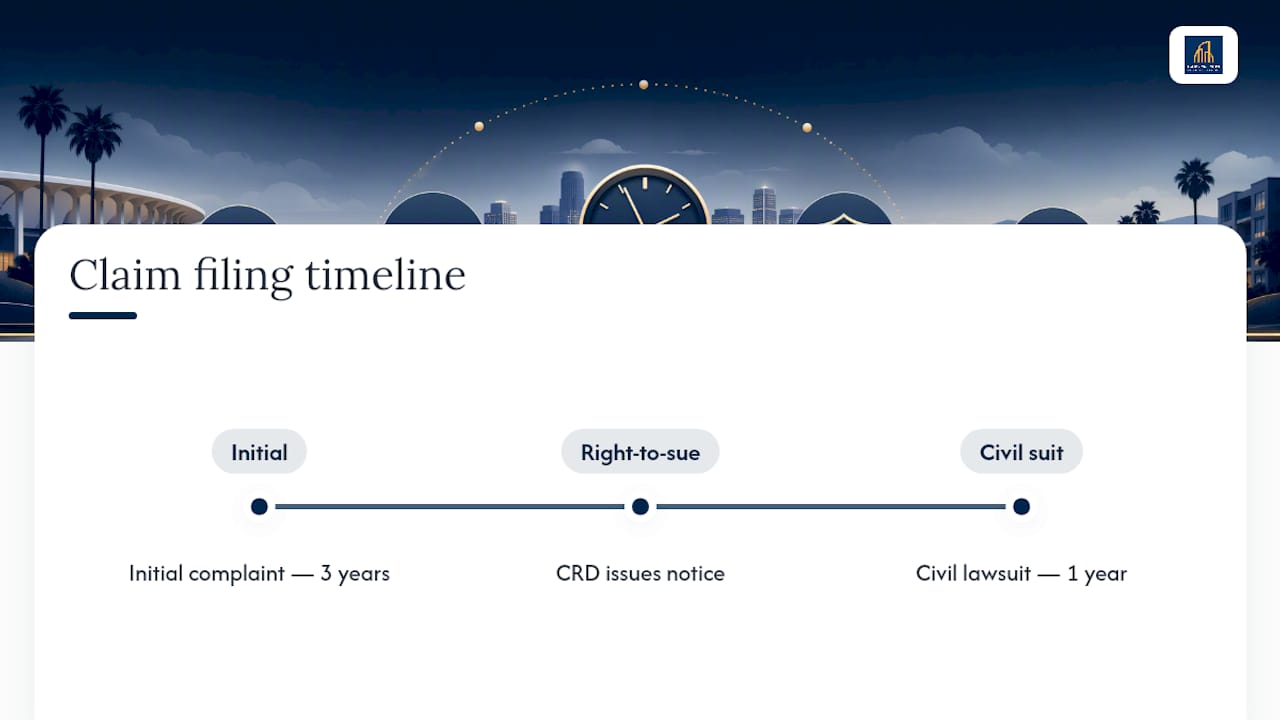
This is one of the more common ways strong harassment claims get lost, not because the facts were weak, but because a deadline slipped by unnoticed. If you requested an immediate right-to-sue notice specifically to preserve your ability to litigate quickly, that one-year clock is already running the moment CRD issues it, so don’t wait to consult an attorney if you’re leaning toward filing suit.
Some claims involve overlapping deadlines, particularly if federal protections under Title VII also apply through EEOC cross-filing. Those timelines can differ from the state deadline, which is another reason to get a professional read on your specific dates rather than relying on general rules of thumb. An employment lawsuit process overview can help you understand what filing in court actually involves once the right-to-sue period begins.
Because these deadlines are strict and rarely extended, mark the date the notice is issued the moment you receive it. Waiting even a few months to “figure things out” can eat into time you can’t get back.
What Happens During a CRD Investigation?
Once you’ve filed a CRD intake, the agency has several possible paths forward, and understanding the general shape of that process can ease some of the uncertainty.
CRD will first review your intake to determine whether it has jurisdiction and whether the allegations, if true, would violate FEHA. If the complaint moves forward, CRD may attempt mediation between you and your employer, conduct its own investigation, or, in some cases, allow you to request an immediate right-to-sue notice so you can pursue the matter privately instead.
If CRD investigates, that typically involves gathering documents, interviewing witnesses, and requesting a response from your employer. Investigations can take time, sometimes many months, depending on case complexity and CRD’s caseload. During this period, your employer is generally prohibited from retaliating against you for filing, participating in, or supporting the CRD process.

Not every CRD investigation results in formal findings against the employer. CRD may close a case without a finding of a violation, which doesn’t necessarily mean the underlying facts were weak. It can also reflect resource constraints, insufficient evidence at that stage, or a decision that mediation or a right-to-sue letter is a more practical path. That’s part of why some employees choose to request a right-to-sue notice early, particularly if they already have legal representation ready to evaluate the evidence independently.
Whichever path your complaint takes, staying responsive to CRD’s requests and keeping your own documentation organized makes the process considerably smoother, whether it resolves administratively or heads toward litigation.
When Should You Hire a Sexual Harassment Attorney in Inglewood?
There’s no single moment that’s “too early” to talk with an attorney, but certain signs suggest it’s worth doing sooner rather than later: your employer isn’t taking your complaint seriously, you’re facing retaliation, the harassment involves a supervisor or executive, or you’re approaching a filing deadline and unsure how to proceed.
When evaluating representation, a few questions are worth asking directly:
- Does the attorney focus on California employment law, specifically FEHA and Labor Code claims, rather than general litigation?
- What is the fee structure? Contingency-fee arrangements, where attorney’s fees are owed only if there is a recovery, are common in this area. Ask whether you may be responsible for case costs.
- What does the initial consultation cover, and is it free?
- How will the attorney communicate with you throughout the process, and how often should you expect updates?
An attorney familiar with local employers and the Los Angeles County court system that handles many Inglewood-based claims can also help you understand realistic timelines. If your situation intersects with other issues, such as wrongful termination following a complaint, resources like California employee termination rights or guidance on how to prove workplace harassment can round out your understanding before a consultation. California United Law Group offers free case evaluations specifically so you can ask these questions without financial commitment upfront.
Are You Protected From Retaliation for Reporting Harassment?
Yes. A retaliation claim can exist even if the underlying harassment claim does not ultimately succeed, as long as the employee reported, participated in an investigation, or opposed conduct they reasonably believed was unlawful and then suffered retaliation because of that protected activity.
Retaliation can take many forms beyond outright termination: a sudden demotion, a schedule change that cuts your hours, exclusion from meetings you used to attend, or a manufactured performance review after years of positive feedback. Courts and CRD may consider timing, and negative treatment soon after a complaint can be one piece of evidence, especially when supported by documents or witness testimony.
If you believe you’re facing retaliation, the same documentation habits that support a harassment claim apply here too: dates, specifics, and any written communication that shows a shift in how you’re treated after speaking up. Retaliation claims can be filed alongside your original harassment complaint or, in some cases, as a standalone matter if retaliation is the primary issue. For a deeper look at how these protections work in practice, see workplace retaliation in California and what steps employees can take after reporting misconduct at Los Angeles employee rights after reporting misconduct.
Retaliation protections exist precisely because the system depends on employees feeling safe enough to come forward. Without them, the reporting structure FEHA relies on wouldn’t function.
What Local Resources Are Available to Inglewood Employees?
Beyond state agencies like CRD, Inglewood employees may have additional local resources. CRD remains the primary California agency for FEHA sexual harassment complaints. The Los Angeles County Department of Consumer and Business Affairs and community legal aid organizations serving the South Bay and greater Los Angeles area may also help employees identify relevant county resources, referrals, or low-cost guidance.
Inglewood’s proximity to Los Angeles also means employees often have access to nonprofit worker advocacy groups that provide support groups, translation assistance, and referrals for employees navigating harassment complaints, particularly for those in industries like hospitality, retail, and warehousing that are common in the area given SoFi Stadium and the broader Hollywood Park development’s employment footprint.
Employees dealing with harassment tied to other protected characteristics, such as race, color, sexual orientation, gender identity, disability, or other protected traits, may have overlapping claims worth evaluating together because FEHA does not require intersecting forms of mistreatment to be treated as isolated problems.
For employees who want a starting point beyond self-research, California United Law Group’s Inglewood employment practice provides a local point of contact for evaluating whether a formal complaint or legal claim makes sense given your specific facts.
A Note From California United Law Group
We’ve worked with employees across Inglewood navigating FEHA harassment claims, and no two cases look alike. Outcomes depend entirely on your specific facts, documentation, and timing. This article is educational, not legal advice. If you’re facing a harassment situation, we encourage you to reach out for a case-specific evaluation. Past results, if discussed anywhere on this website, do not guarantee or predict the outcome of any future case.
Talk to California United Law Group About Your Situation
California United Law Group offers Inglewood employees a way to get case-specific guidance from a legal team that regularly handles California employment matters, including FEHA and Labor Code claims.
Consultations are free, and representation is handled on contingency, so attorney’s fees are owed only if there is a recovery. Case costs, if any, are addressed in the written fee agreement. If you are dealing with harassment, retaliation, or uncertainty about a looming deadline, reach out to California United Law Group to schedule a consultation and find out where your case stands.
Consultations are free, and representation is handled on contingency, so there’s no upfront cost tied to getting your situation evaluated. If you’re dealing with harassment, retaliation, or uncertainty about a looming deadline, reach out to California United Law Group to schedule a consultation and find out where your case stands.
Frequently Asked Questions
Does FEHA protect part-time and temporary Inglewood employees?
Yes. FEHA’s workplace sexual harassment protections apply regardless of whether you work full-time, part-time, or as a temporary employee, and they also extend to applicants, unpaid interns, volunteers, and persons providing services under a contract.
How long do I have to report sexual harassment in California?
You generally have three years from the last harassing incident to file an intake with CRD. Waiting too long can jeopardize your ability to pursue a claim.
Can I sue my employer directly without going through CRD first?
For FEHA claims, you generally need a CRD right-to-sue notice before filing a private lawsuit. You can request one immediately if you would rather proceed without waiting for an administrative investigation.
What if my employer retaliates after I report harassment?
Retaliation for reporting harassment in good faith is illegal under FEHA. Document any negative treatment that follows your complaint and consider raising it as part of your claim.
Do I need a lawyer to file a CRD complaint?
No, you can file an intake on your own. Many employees consult an attorney beforehand, though, especially if the situation is complex or a deadline is approaching.
This article is general information, not a substitute for advice from a qualified lawyer. Consult a qualified legal professional about your own circumstances before acting on anything here.
Sources
- California Civil Rights Department — Employment
- Workplace Sexual Harassment | State of California – Department of Justice – Office of the Attorney General
Recommended
- Santa Monica Sexual Harassment Laws: Employee Rights – California United Law Group
- How to Prove Workplace Harassment in California: A Legal Guide for Employees – California United Law Group
- Long Beach Sexual Harassment in the Workplace: Know Your Rights – California United Law Group –
- Sexual Orientation Discrimination: West Hollywood Employee Rights – California United Law Group