
If you work in Culver City and you are 40 or older, California law gives you strong, enforceable protections against age discrimination at work. Under the Fair Employment and Housing Act (FEHA), covered employers may not treat workers or applicants less favorably because of age in hiring, pay, promotions, layoffs, or day-to-day working conditions, unless a legally recognized defense applies. These protections generally apply to California private employers with five or more employees and to public employers.
Here is a quick summary of your core rights as an older worker in California:
- You are protected starting at age 40. FEHA covers both current employees and job applicants.
- Discriminatory pay is prohibited. Employers may not pay workers 40 and older less because of age.
- Promotions and training must be age-neutral. Denying you a promotion or refusing to train you on new technology because of your age violates the law.
- Forced retirement is generally illegal. Private employers generally may not require retirement simply because an employee reaches a specific age over 40, subject to limited exceptions.
- Harassment based on age is unlawful. Repeated comments, jokes, or insults about your age can create an illegal hostile work environment.
- Retaliation is forbidden. If you complain about age discrimination, your employer may not demote you, cut your pay, fire you, or otherwise materially retaliate because of that protected activity.
- You have three years to file a complaint with the California Civil Rights Department (CRD).
This article is for general educational purposes only and does not constitute legal advice. Employment law issues are fact-specific, and outcomes vary.
What counts as age discrimination in a Culver City workplace?
Age discrimination is not always obvious. It can show up in a job posting, a performance review, or an offhand comment in a team meeting. Knowing what to look for is the first step toward protecting yourself.
Discriminatory hiring practices are among the most common forms. Under California’s age discrimination protections, employers cannot use job ads that imply a preference for younger candidates. Language like ‘looking for a recent college graduate,’ ‘digital native,’ or ‘young and energetic’ may signal an age preference and can create legal risk, even when the word ‘age’ never appears.
Beyond hiring, workplace bias against older workers can take many forms:
- Unequal pay. Paying workers 40 and older less than younger colleagues in the same role, based on assumptions about their financial needs or career stage, is unlawful.
- Promotion denials. Passing over a qualified older employee for advancement while promoting less experienced younger workers, when age is the deciding factor, violates FEHA.
- Exclusion from training. Refusing to include older employees in new technology training or professional development programs because of their age is a recognized form of discrimination.
- Age-based harassment. Repeated comments such as “Okay, Boomer!,” jokes about someone working there since the “dark ages,” or mocking a colleague’s style as “old-fashioned” can rise to the level of a hostile work environment when they are severe or happen often enough to affect working conditions.
- Pretextual layoffs. Using a company downsizing as cover to eliminate older, higher-paid workers while retaining younger, lower-cost employees is a well-documented pattern that California courts have addressed directly.
- Asking about age during hiring. Employers should avoid age-related screening questions during hiring, including questions about age, date of birth, or graduation year, unless the information is requested for a lawful, job-related, or post-offer administrative reason.
Subtle forms of discrimination, such as consistently assigning older workers less desirable projects or excluding them from key meetings, can also support a legal claim when they form a pattern tied to age.
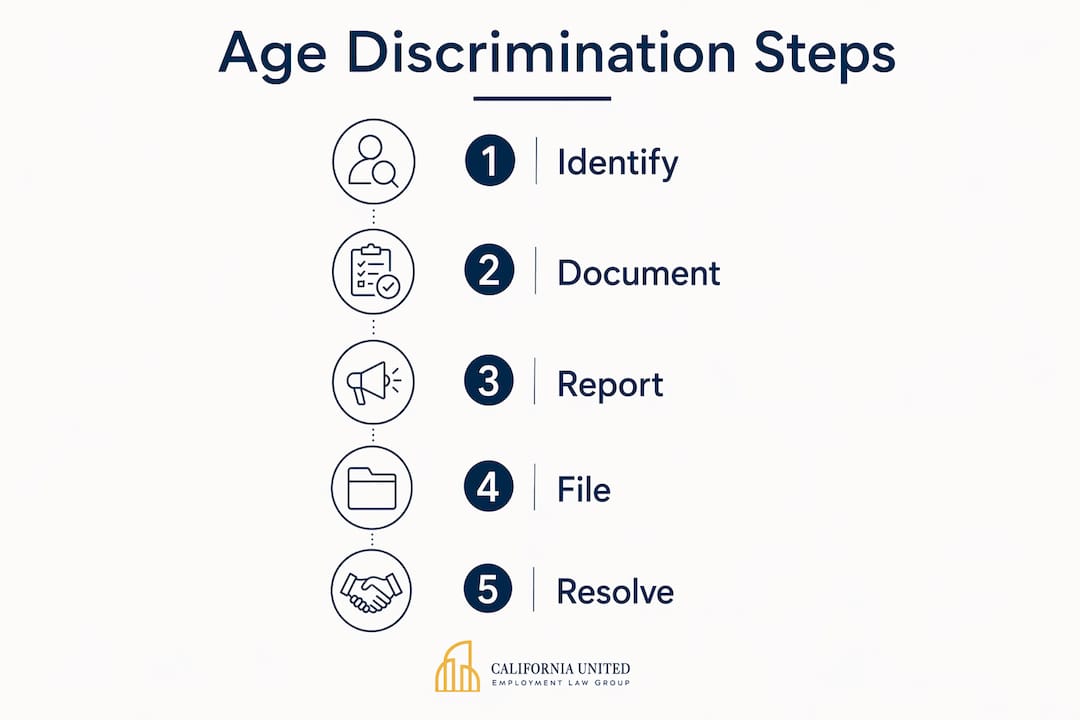
How California’s FEHA protects workers aged 40 and older
FEHA is the primary legal framework protecting Culver City employees from age discrimination, and it is deliberately broad. Government Code § 12940 makes it unlawful for an employer to refuse to hire, discharge, or discriminate against any person in compensation or in terms, conditions, or privileges of employment because of age. That language covers a wide range of employment decisions, from the initial job offer through termination.
California’s Legislature has declared that courts should interpret statutes prohibiting age discrimination in employment ‘broadly and vigorously, in a manner comparable to prohibitions against sex and race discrimination,’ with the goal of protecting older workers ‘as individuals’ and ‘as a group.’
— California Government Code § 12941
A few key provisions are worth knowing in detail:
Disparate impact claims are available. Under Government Code § 12941, even a facially neutral policy can constitute age discrimination if it disproportionately harms workers 40 and older as a group. For example, a layoff policy that relies heavily on salary level may create age-discrimination risk if that criterion disproportionately affects workers 40 and older as a group.

Salary-based termination decisions carry risk. The Legislature specifically rejected the reasoning in Marks v. Loral Corp. (1997) 57 Cal.App.4th 30 and clarified that using salary as the basis for termination decisions may constitute age discrimination when that criterion adversely impacts older workers as a group. This matters in Culver City workplaces where layoffs are framed as cost-cutting measures.
Harassment protections apply to all employers. While the anti-discrimination provisions of FEHA apply to employers with five or more employees, the anti-harassment provisions apply to every employer in California, regardless of size.
The law also protects applicants. FEHA covers job applicants, not just current employees. If a Culver City employer screens you out during the hiring process because of your age, or because they mistakenly believe you are 40 or older, that is a violation.
How to prove age discrimination under California law
Building a credible age discrimination claim starts with documentation. California law often analyzes age-discrimination claims through a burden-shifting framework. A worker typically begins by showing that they were 40 or older, experienced an adverse employment action, were performing satisfactorily, and faced circumstances supporting an inference of age discrimination. At trial, CACI No. 2570 requires proof that age was a substantial motivating reason for the challenged employment decision, along with harm and causation.
That last element is often where cases turn. Courts look for evidence that age was a “substantial motivating reason” for the employer’s decision, not merely a passing factor. California courts have emphasized this distinction. In Harris v. City of Santa Monica (2013) 56 Cal.4th 203, the California Supreme Court explained that requiring a ‘substantial motivating factor’ helps prevent liability based only on stray thoughts or passing remarks unrelated to the employment decision. In Sandell v. Taylor-Listug, Inc. (2010) 188 Cal.App.4th 297, the court described the prima facie showing for FEHA age-discrimination claims, including age over 40, an adverse employment action, satisfactory performance, and circumstances supporting an inference of discrimination.
Key types of evidence to gather:
- Performance reviews. Positive evaluations from before an adverse action may help challenge an employer’s claim that poor performance justified a demotion or termination.
- Promotion and hiring records. Documentation showing that younger, less experienced employees were promoted or hired over you can support an inference of age bias.
- Disciplinary history. Records showing inconsistent discipline, where older workers are penalized more harshly than younger workers for similar conduct, are relevant.
- Emails and written communications. Age-related comments, jokes, or references in workplace communications can serve as direct evidence of discriminatory animus.
- Workforce data. Patterns showing that layoffs disproportionately affected workers 40 and older, while younger employees in similar roles were retained, can support a disparate impact or disparate treatment claim.
- Comparator evidence. Identifying a similarly situated younger employee who was treated more favorably under similar circumstances can be important circumstantial evidence.
Employers frequently offer a legitimate, nondiscriminatory reason for their decision, such as a reorganization or performance concerns. Your task, with the help of an attorney, is to show that the stated reason is pretextual, meaning it does not hold up under scrutiny or is contradicted by the evidence.
Pro Tip: Gather your employment records, performance reviews, and any relevant communications before your employment ends. Once you leave a job, access to internal documents becomes far more difficult, and some records may no longer be available.
Retaliation protections when you speak up about age discrimination
Speaking up about age discrimination takes courage, and California law protects you for doing it. FEHA prohibits employers from retaliating against any employee who asserts their rights under the law, whether by filing a complaint, opposing a discriminatory practice, or participating in an investigation.
Retaliation does not have to be a termination. It can be far more subtle, and it often is. Prohibited retaliatory actions include:
- Demotion or reduction in job responsibilities shortly after you raise a discrimination concern
- Pay cuts or denial of a raise that follows your complaint
- Increased scrutiny or sudden negative performance reviews after years of positive evaluations
- Exclusion from meetings, projects, or communications that were previously part of your role
- Hostile treatment or social isolation by supervisors or colleagues following your complaint
- Termination framed as unrelated to your complaint but timed suspiciously close to it
Retaliation claims are legally distinct from the underlying age discrimination claim, and they can be filed together or separately. A retaliation claim may still be viable even if the underlying discrimination claim is not ultimately proven, so long as the employee engaged in protected activity and can prove the required causal connection. If you experience any of the above after asserting your rights, document the timing and circumstances carefully.
For a deeper look at how retaliation plays out in California workplaces, workplace retaliation rights are covered in detail by California United Law Group. You can also review signs of employer retaliation that California workers should know.
How to file an age discrimination complaint in Culver City
If you believe you have experienced age discrimination at a Culver City workplace, the primary avenue for filing a complaint is the California Civil Rights Department (CRD), formerly known as the Department of Fair Employment and Housing (DFEH). The CRD investigates complaints, attempts mediation, and can pursue enforcement action against employers who violate FEHA.
Filing with the CRD
You can file a complaint online through the CRD’s website, by phone, or by mail. The CRD will review your complaint, notify your employer, and may offer a mediation process before proceeding to a formal investigation. If the CRD issues a right-to-sue notice, you may pursue the claim in civil court, but separate court-filing deadlines apply.
What to include in your complaint
Your complaint should describe the specific discriminatory acts, the dates they occurred, the names of individuals involved, and any witnesses. The more specific and documented your account, the more effectively the CRD can investigate.
Local context for Culver City workers
Culver City is located in Los Angeles County, and workers here have access to both the CRD’s statewide resources and the broader Los Angeles County employment law infrastructure. Because Culver City is in Los Angeles County, local workers may use statewide CRD resources and Los Angeles-area employment-law resources when evaluating a potential age-discrimination claim.
Federal option: the EEOC
Workers in Culver City may also file a charge with the U.S. Equal Employment Opportunity Commission (EEOC) under the federal Age Discrimination in Employment Act (ADEA), which protects workers 40 and older at employers with 20 or more employees. California’s FEHA is generally broader in employer coverage because it applies to private employers with as few as five employees, while the ADEA generally applies to employers with 20 or more employees. The CRD and EEOC have a work-sharing agreement, so filing with one agency typically cross-files with the other.
What remedies and damages are available under California law?
Depending on the facts and procedural posture, a successful age-discrimination claim in California may result in significant relief. Remedies under FEHA are designed to make the affected employee whole and to deter future violations by employers.
Available remedies may include:
- Back pay. Compensation for wages and benefits lost as a result of the discriminatory action, from the date of the adverse action through the resolution of the case.
- Front pay. In cases where reinstatement is not practical, a court may award compensation for future lost earnings.
- Reinstatement. You may be entitled to return to your former position or an equivalent role.
- Damages for emotional distress. California law allows recovery for the psychological harm caused by discrimination, including anxiety, humiliation, and loss of enjoyment of life.
- Punitive damages. In cases involving particularly egregious employer conduct, a court may award punitive damages to punish the employer and deter similar behavior.
- Attorney fees and costs. Attorney fees and costs. Courts may award attorney fees and costs in appropriate FEHA cases, which can affect the practical economics of bringing a claim.
The specific remedies available in your case depend on the facts, the nature of the discrimination, and the outcome of the legal process. Employment law issues are fact-specific, and outcomes vary. Consulting with an employment attorney is the most reliable way to understand what relief may be available to you.
Time limits for filing an age discrimination claim
Deadlines in employment law are strict, and missing them can seriously limit or eliminate your ability to pursue a claim. Under California law, you must file your complaint with the CRD within three years of the alleged discriminatory act.
That three-year window applies to FEHA claims filed with the CRD. If you intend to file a federal charge with the EEOC under the ADEA, the deadline is generally 300 days from the discriminatory act in California, which is shorter than the state deadline. Because the state and federal deadlines differ, acting promptly protects your options under both systems.
A few additional timing considerations:
- Each discriminatory act may have its own deadline. A pattern of related conduct can raise additional timing issues, but employees should not assume that later events preserve older claims.
- The clock starts on the date of the adverse action. For a termination, that is typically the date you were told your employment was ending, not the last day you worked.
- Waiting can hurt your case. Beyond the legal deadline, delay makes it harder to gather evidence, locate witnesses, and reconstruct the timeline of events accurately.
If you are unsure whether the deadline has passed or how to calculate it in your specific situation, speaking with an employment attorney as early as possible is the most protective step you can take.
What employers in Culver City are required to do to prevent age discrimination
California law does not simply prohibit age discrimination after the fact. It also requires covered employers to take reasonable steps to prevent discrimination, harassment, and retaliation. Culver City employers who understand these obligations are better positioned to maintain lawful workplaces, and employees who know them are better equipped to recognize when those obligations are not being met.
Mandatory harassment prevention training
California requires employers with five or more employees to provide harassment prevention training. Although the training requirement is commonly discussed in the sexual-harassment context, workplace harassment can also be unlawful when it is based on age. Supervisors must receive two hours of training every two years, and non-supervisory employees must receive one hour. Failure to conduct this training does not automatically create liability, but it is a factor courts and investigators consider.
Reviewing job postings and hiring practices
Employers should review their job advertisements to remove language that implies an age preference. Phrases like “recent graduate,” “digital native,” or caps on years of experience can expose an employer to a discrimination claim even when no specific age is mentioned.
Applying consistent standards
Performance standards, disciplinary procedures, and layoff criteria must be applied consistently across age groups. An employer who terminates an older worker for conduct that younger workers engage in without consequence may create evidence supporting a FEHA claim.
Documenting legitimate business reasons
When an employer makes an adverse employment decision, such as a layoff or a demotion, it should document the specific, nondiscriminatory business reasons at the time the decision is made. After-the-fact justifications may receive closer scrutiny, especially if they conflict with earlier documents or testimony.
Responding to complaints promptly
Employers are required to investigate complaints of age discrimination or harassment promptly and take appropriate corrective action. Ignoring or dismissing a complaint can increase legal risk and may support a retaliation or harassment-related claim if the employee later suffers adverse treatment or continued misconduct.
Resources and support for older workers facing discrimination in Culver City
You do not have to navigate an age discrimination situation alone. Several resources are available to Culver City workers seeking information, support, or legal assistance.
California Civil Rights Department (CRD)
The CRD is the primary state agency for filing age discrimination complaints. Its website offers guidance documents, complaint filing tools, and information about your rights under FEHA. The CRD also publishes fact sheets specifically addressing age discrimination in the workplace, updated as recently as 2025.
U.S. Equal Employment Opportunity Commission (EEOC)
The EEOC handles federal age discrimination charges under the ADEA. Its website includes a charge filing portal, information about mediation, and resources for workers considering federal claims.
California Labor Commissioner’s Office
For wage-related components of an age discrimination case, such as unpaid wages or unlawful pay reductions, the Labor Commissioner’s Office provides an additional avenue for relief.
Legal aid and worker advocacy organizations
Los Angeles County is home to several nonprofit legal aid organizations that assist low-income workers with employment law matters, including age discrimination. Los Angeles County has nonprofit legal aid organizations that may assist eligible workers with employment-related issues.
AARP
AARP provides resources specifically for workers 50 and older facing workplace challenges, including guides on age discrimination rights, job search support, and referrals to legal resources.
California United Law Group
For workers in Culver City who need legal representation, California United Law Group focuses on California employment law, including FEHA claims. The firm’s Culver City employment law page provides information about local representation options.
You can also find broader context about employment rights in the area through California United Law Group’s Culver City workplace guide.
How California United Law Group supports older employees facing age discrimination
California United Law Group, P.C. represents employees in California employment-law matters, including FEHA claims involving age discrimination, wrongful termination, harassment, and retaliation. The firm represents employees at every stage of a dispute, from the initial complaint through litigation, and works with clients in Culver City and throughout the Los Angeles area.
Older workers facing age discrimination often encounter a specific challenge: their employer has legal counsel from day one, and they do not. California United Law Group helps employees understand their rights, evaluate their evidence, and pursue appropriate legal options.
The firm handles cases involving discriminatory terminations framed as layoffs, denial of promotions tied to age, hostile work environments created by age-based harassment, and retaliation against employees who spoke up. For workers concerned about termination rights in California, the firm’s resources address the legal standards that apply.
If you are dealing with a situation that feels like age discrimination at your Culver City workplace, speaking with an attorney early can help you better understand your options. Contact California United Law Group to discuss your situation with an employment law attorney. No attorney-client relationship is formed unless and until a written agreement is signed, and prior results or general information do not guarantee a particular outcome.
This article is for general educational purposes only and does not constitute legal advice. Employment law issues are fact-specific, and outcomes vary. Consult a qualified attorney for guidance on your individual circumstances.
Key Takeaways
California’s FEHA gives workers aged 40 and older in Culver City the right to work free from age-based discrimination, harassment, and retaliation, with three years to file a complaint with the CRD.
| Point | Details |
|---|---|
| Protection starts at age 40 | FEHA covers employees and applicants at private employers with five or more employees and all public employers. |
| Broad definition of discrimination | Biased pay, promotion denials, exclusion from training, pretextual layoffs, and age-based harassment may support a claim when tied to age. |
| Documentation can strengthen your claim | Gather performance reviews, promotion records, and communications before your employment ends. |
| Three-year filing deadline | You must file a FEHA complaint with the CRD within three years of the discriminatory act. |
| Remedies can include back pay and damages | Depending on the facts, successful claims may result in remedies such as back pay, reinstatement, emotional distress damages, and attorney-fee awards. |