
What is a hostile work environment under California law?
A hostile work environment in Pasadena exists when unwelcome conduct tied to a protected characteristic is severe or pervasive enough to alter your working conditions. That is the standard under California Government Code section 12923, which also makes clear that a single severe incident can be enough. You do not always need to show a pattern of repeated abuse, because a single severe incident may support a claim depending on the facts and legal requirements.
The California Fair Employment and Housing Act (FEHA) provides the broader legal framework. For harassment claims, FEHA protections can apply broadly to employees, applicants, unpaid interns, volunteers, and certain contractors, depending on the relationship and facts involved.
Protected characteristics under FEHA include:
- Race, color, and national origin
- Ancestry
- Genetic information
- Sex, gender identity, and gender expression
- Sexual orientation
- Religion
- Age (40 and over)
- Disability (physical or mental)
- Pregnancy and related conditions
- Marital status
- Medical condition
California law evaluates a hostile work environment using two standards together. The conduct must be something a reasonable person would find abusive or intimidating, and you must have actually experienced it that way. Courts consider both the employee’s actual experience and whether a reasonable person in the same circumstances would view the environment as hostile, intimidating, offensive, oppressive, or abusive. That distinction matters for Pasadena employees who may feel their situation is “not bad enough” to report.

What behaviors count as harassment in Pasadena workplaces?
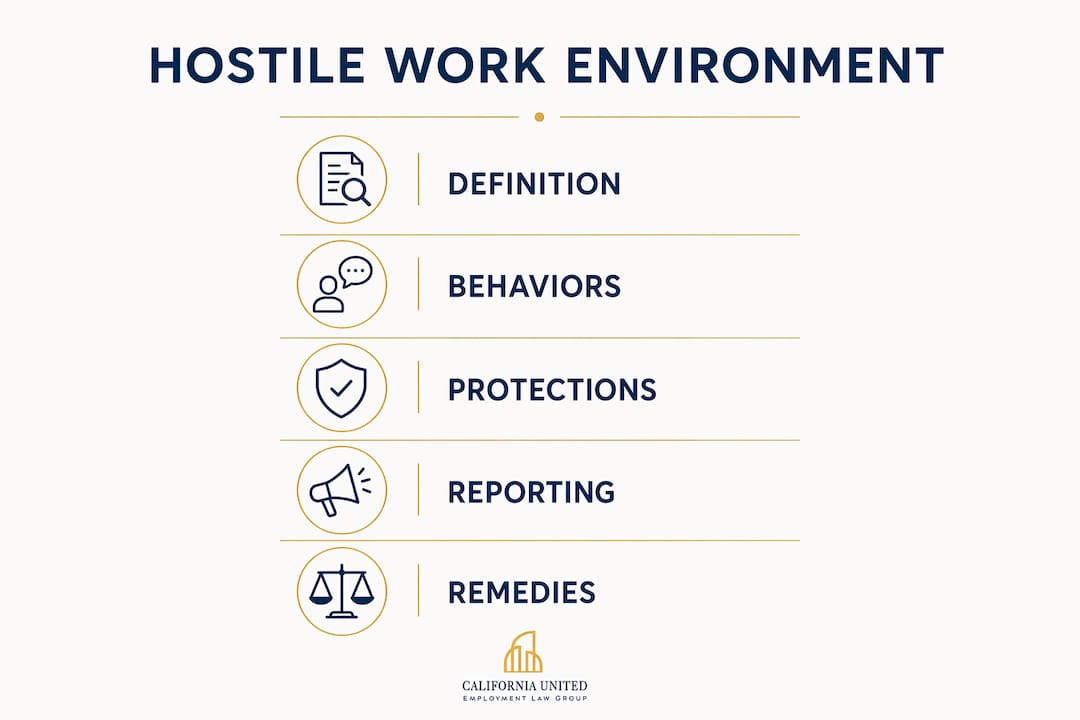
Harassment takes many forms, and not all of them are obvious. Understanding the range of conduct that qualifies helps you recognize when your situation crosses a legal threshold.
Common forms of harassment based on protected characteristics:
- Offensive jokes, slurs, or derogatory comments about race, religion, sex, or disability
- Unwanted sexual advances, touching, or requests for sexual favors
- Displaying offensive images, symbols, or written material
- Threats, intimidation, or bullying directed at a protected trait
- Mimicking someone’s accent or disability
- Excluding or isolating an employee because of their age or national origin
One area employees often overlook is digital harassment. Social media harassment targeting protected traits may be legally relevant when it affects the employee’s work environment, even if it originates from a coworker’s personal account. If it affects your work environment, it is legally relevant.
Harassment can come from supervisors, coworkers, clients, or vendors. The source matters for determining employer liability, but it does not determine whether the conduct qualifies as harassment in the first place.
What does NOT qualify as a hostile work environment:
- A difficult or demanding manager who treats everyone the same way
- Personality conflicts unrelated to any protected characteristic
- General workplace stress, criticism of work performance, or unpopular management decisions
- Rude behavior with no connection to a protected trait
Management hostility applied equally to all employees generally does not meet FEHA standards because it lacks the required link to a protected characteristic. The law targets discrimination, not general workplace friction. Knowing that line helps you assess your own situation more clearly.
What legal protections and employer duties apply in Pasadena?
California law places active obligations on employers, not just passive ones. Under FEHA and Government Code section 12940, employers must take reasonable steps to prevent and promptly correct harassment. They cannot wait for a formal complaint to act if they already have reason to know misconduct is occurring.
Key employer obligations under California law:
- Maintain a written anti-harassment policy and distribute it to all employees
- Provide sexual harassment prevention training every two years (two hours for supervisors, one hour for non-supervisory employees)
- Investigate complaints promptly and thoroughly
- Take corrective action based on investigation findings, even when the conduct has not yet risen to the level of a legal violation
- Protect complainants and witnesses from retaliation throughout and after the investigation
Employer liability differs depending on who commits the harassment. Employer liability depends on who engaged in the harassment. Under FEHA, an employer may be strictly liable for harassment by a supervisor acting in a supervisory capacity. For coworker or third-party harassment, liability generally depends on whether the employer knew or should have known about the conduct and failed to take immediate and appropriate corrective action. For coworker harassment, the employer is liable if it knew or should have known about the conduct and failed to act.
Pasadena employers operate within this statewide system. Pasadena employees generally rely on California’s statewide FEHA and CRD enforcement system for workplace harassment claims, although local facts and procedures may still affect how a claim is handled. For a broader overview of Pasadena employment law rights, the legal standards that apply locally are the same ones enforced statewide.
How can you identify and prove a hostile work environment?
Proving a hostile work environment requires meeting specific legal criteria. Knowing what those are before you take action helps you build a credible record from the start.
The legal proof requirements are:
- The conduct must be linked to a protected characteristic (race, sex, disability, etc.)
- The conduct must be severe or pervasive enough to alter your working conditions
- Both you and a reasonable person in your position must find the environment abusive or intimidating
- The totality of circumstances applies, meaning courts look at all incidents together, not each one in isolation
That last point is significant. Even minor insults or comments can contribute to a hostile environment claim when the overall pattern meets the threshold. A single severe incident may be enough in some circumstances, but not every offensive comment or slur automatically creates a FEHA violation. Courts evaluate the totality of the circumstances, including severity, frequency, whether the conduct was threatening or humiliating, and whether it interfered with work. California courts have emphasized that hostile work environment claims are fact-specific. In Miller v. Department of Corrections, the California Supreme Court evaluated the totality of the circumstances, including frequency, severity, whether the conduct was physically threatening or humiliating, and whether it interfered with work performance. In Aguilar v. Avis Rent A Car System, Inc., the Court recognized that FEHA uses the severe-or-pervasive standard, while also making clear that not every offensive workplace utterance automatically violates the law. These cases show why documenting the full context matters. Courts look at severity, frequency, whether the conduct was physically threatening, and whether it unreasonably interfered with your work.
Practical steps for documenting your situation:
- Write down each incident with the date, time, location, and what was said or done
- Note any witnesses who were present
- Save text messages, emails, voicemails, or screenshots that show the conduct
- Keep a personal log outside of company systems, such as a personal email or notebook
- Record how the conduct affected your ability to do your job
Pro Tip: Save copies of any relevant digital communications to a personal account or device as soon as possible. Evidence stored only on company systems can become inaccessible after a termination or suspension. Consistent, dated documentation is often one of the strongest ways to support a hostile workplace claim.
For a detailed breakdown of what California courts look for, the proof requirements for workplace harassment in California are worth reviewing before you file any complaint.

What steps should you take if you experience harassment in Pasadena?
Acting promptly protects your rights. Delays can affect your ability to file a valid claim, and certain deadlines apply under California law.
A general sequence of steps to consider:
- Consider reporting internally when it is safe and practical. Use your employer’s designated reporting channel, typically Human Resources or a direct supervisor if HR is unavailable, unless the circumstances make internal reporting unsafe, futile, or strategically unwise. Submit your complaint in writing and keep a copy.
- Document everything. Continue logging incidents, including any changes in treatment after you report.
- File with the CRD when you are ready to pursue administrative remedies. The California Civil Rights Department accepts complaints of harassment and discrimination based on FEHA-protected characteristics. Filing a CRD complaint is generally required before you can pursue a civil lawsuit.
- Know your deadlines. Under California law, employees generally have three years from the date of the last unlawful act to file a FEHA complaint with the CRD, but deadlines can vary depending on the claims and facts, so it is important to get legal advice promptly.
- Consult an attorney before signing anything. Employers sometimes present separation agreements or releases after a complaint is filed. Signing without legal review can waive rights you did not intend to give up.
California law prohibits retaliation against complainants, which can include negative performance reviews, workload changes, reassignments, or management-directed isolation when those actions are linked to protected activity. If any of those things happen after you report, document them the same way you documented the original harassment.
Pro Tip: If you are considering whether to report, speak with an employment attorney first. A confidential consultation does not obligate you to take any action, but it gives you a clear picture of your rights and the realistic options available to you before you make any formal move.
If you are concerned about what happens after you report, the retaliation protections in Pasadena are specific and enforceable under California law.
How do you find the right harassment attorney in Pasadena?
Choosing an attorney for a hostile work environment case is not just about finding someone who practices employment law. The specifics of California law, and FEHA in particular, require focused expertise.
Qualities to look for in a Pasadena employment attorney:
- Direct experience handling FEHA harassment and hostile work environment claims, including cases involving Government Code section 12923 standards
- Familiarity with CRD complaint procedures and California civil litigation timelines
- A track record with hostile work environment and harassment cases specifically
- Clear communication during the initial consultation about what your case involves and what outcomes are realistic
- Willingness to explain the process without pressure to commit immediately
The initial consultation is your opportunity to assess fit. A good attorney will ask detailed questions about your situation, explain the legal standards that apply, and give you an honest assessment of your options. Be cautious of anyone who guarantees a specific outcome or pressures you to sign a retainer before you feel ready.
Local knowledge also matters. An attorney familiar with Pasadena and Los Angeles County employment matters may better understand local employer practices, court procedures, and CRD processes.
Early legal advice, even before you file any complaint, can help you avoid procedural mistakes that are difficult to correct later.
How California United Law Group Supports Pasadena Employees
California United Law Group, P.C. represents employees in Pasadena facing workplace harassment and hostile work environment claims. The firm represents employees in California employment law matters, including FEHA and California Labor Code claims, and handles cases from early investigation through litigation when appropriate.
What the firm offers Pasadena employees:
- Representation in hostile work environment and harassment claims under FEHA and Government Code section 12923
- Guidance on documenting incidents, understanding proof requirements, and evaluating the strength of a claim
- Handling of CRD administrative filings and civil litigation when warranted
- Clear communication about realistic legal outcomes without overpromising results
- Representation in related matters including wrongful termination, retaliation, discrimination, and wage and hour violations
The firm’s approach centers on client education. Before any formal action, California United Law Group works to make sure you understand what the law requires, what your situation actually involves, and what options are available to you. That foundation matters in employment cases, where the facts are specific and outcomes vary based on the details.
For Pasadena employees dealing with harassment or a hostile workplace, counsel familiar with California employment standards and the local context can help evaluate options and avoid procedural missteps. California United Law Group handles the full range of California employment disputes, which means the firm can also identify related claims you may not have considered.
What remedies and outcomes are possible from a harassment claim?
If a hostile work environment claim succeeds, California law provides a range of remedies. The specific outcome depends on the facts of the case, the severity of the conduct, and the employer’s response.
Potential remedies available under FEHA include:
- Back pay and lost wages for income lost as a result of the harassment or any related adverse employment action
- Compensatory damages for emotional distress caused by the hostile environment
- Punitive damages, when legally available, in cases involving malice, oppression, or fraud
- Reinstatement to your former position if you were terminated or forced to resign
- Policy changes and training requirements imposed on the employer as part of a settlement or court order
- Attorney’s fees and costs when authorized by law, including in qualifying successful FEHA claims
Not every case results in litigation. Many hostile work environment claims resolve through settlement negotiations before trial. The value of a settlement depends on the strength of the evidence, the employer’s exposure, and the specific damages at issue. An attorney can help you evaluate any offer in the context of what a court might award.
Remedies are not guaranteed, and employment law outcomes are fact-specific. What matters is that California law gives employees real tools to seek accountability, not just acknowledgment.
What protections exist against retaliation for reporting harassment?
Retaliation after reporting harassment is itself an independent violation of California law. You do not necessarily need to prove the underlying harassment claim succeeded, but you generally must show that you engaged in protected activity, such as reporting or opposing conduct you reasonably believed was unlawful, and that the employer took retaliatory action because of it.
FEHA prohibits employers from retaliating against any employee who reports harassment, files a complaint with the CRD, participates in an investigation, or opposes conduct they reasonably believe violates the law. Retaliation covers a wide range of employer actions, not just termination.
Forms of retaliation California law recognizes:
- Termination or demotion following a complaint
- Negative performance reviews that did not occur before the report
- Sudden changes in schedule, workload, or assignments
- Being excluded from meetings, projects, or communications
- Ostracism or social isolation by management or coworkers at the employer’s direction
California employers are required to actively protect complainants from retaliation, including checking back with the complainant after an investigation concludes. The obligation does not end when the investigation closes. If you experience any of these changes after reporting, document them with the same detail you used for the original harassment, and consider speaking with an attorney about whether a separate retaliation claim applies.
How do internal complaint and investigation procedures typically work in Pasadena?
Most Pasadena employers covered by FEHA are required to have a written anti-harassment policy that includes a complaint procedure. That procedure should give you at least one reporting channel that does not require you to go through the person you are accusing.
What a compliant internal process typically includes:
- A written policy distributed to all employees
- A designated person or department to receive complaints (often HR)
- An alternative reporting channel when the accused is in HR or management
- A commitment to investigate complaints promptly and confidentially to the extent possible
- Notice to the complainant of the investigation’s outcome
California guidance makes clear that investigations should begin promptly and proceed without unnecessary delay. For serious allegations, including physical harassment or threats, employers should act immediately, and same-day action may be appropriate. Less urgent complaints should still receive an initial response within a day or two, with the full investigation completed within a few weeks when circumstances allow.
Anonymous complaints should not be ignored and should be investigated as far as reasonably possible based on the information available. If the complaint lacks enough detail for a standard investigation, the employer may conduct an environmental assessment, which involves interviewing employees in the affected work group about their general experiences without focusing on a specific individual.
If your employer’s internal process fails, that failure itself can be relevant to your legal claim. Documenting how the employer responded, or failed to respond, is part of building a complete record. For additional context on how California law defines what counts as harassment and what employers must do about it, that background strengthens your understanding before you engage any formal process.
California United Law Group Is ready to help Pasadena Employees
Facing a hostile work environment is serious, and knowing your rights is the first step toward doing something about it. California United Law Group represents Pasadena employees in harassment and hostile work environment claims under FEHA, as well as related retaliation, wrongful termination, and wage-and-hour matters when applicable.
The firm offers confidential consultations for employees dealing with workplace harassment, retaliation, discrimination, and related employment issues. There is no obligation to proceed after an initial conversation, and speaking with an attorney early gives you a clearer picture of your options before you take any formal action.
If you are ready to discuss your situation, contact California United Law Group to schedule a consultation. Employment law issues are fact-specific, and the sooner you get accurate information about your rights, the better positioned you are to protect them.
Key Takeaways
California employees in Pasadena have strong legal protections against workplace harassment and hostile work environments under FEHA and Government Code section 12923, and acting promptly preserves those rights.
| Point | Details |
|---|---|
| Single incident can qualify | Under California Government Code section 12923, a single severe incident may be enough to support a hostile work environment claim, depending on the facts. |
| Employer duty is active | California law requires employers to prevent and promptly correct harassment, not just respond after formal complaints are filed. |
| Document everything early | Logging dates, witnesses, and digital evidence can help build a stronger factual record. |
| Retaliation is a separate violation | Adverse actions after reporting harassment, including negative reviews or reassignments, are independently prohibited under FEHA. |
| California United Law Group | California United Law Group represents Pasadena employees in FEHA harassment and hostile work environment matters, from initial consultation through litigation when appropriate. |
Recommended
- Los Angeles Harassment And Hostile Work Environment Guide – California United Law Group –
- Understanding Hostile Work Environment Rights in West Hollywood – California United Law Group
- What Creates a Hostile Work Environment in West Hollywood? – California United Law Group
- How to Prove Workplace Harassment in California: A Legal Guide for Employees – California United Law Group