
Los Angeles breach of contract and fraud in employment are two distinct legal claims that California employees can pursue when employers violate job agreements or deceive workers with false promises. A breach of contract claim arises when one party fails to fulfill a binding obligation under a valid employment agreement. Fraud in employment can include intentional misrepresentation, concealment, negligent misrepresentation, or a false promise. When the false statement or promise induces someone to accept, leave, relocate for, or remain in a job, the claim is often framed as fraudulent inducement or promissory fraud. California courts treat these claims differently, and understanding that distinction determines what remedies you may recover. Decisions such as Lazar v. Superior Court and recent statutory changes affecting certain employment repayment provisions make this area of law especially relevant for Los Angeles workers.
What are the legal elements required to prove breach of contract and fraud in employment in Los Angeles?
Proving either claim requires meeting a specific set of legal elements. Courts do not accept general complaints. You must show concrete facts that satisfy each element.

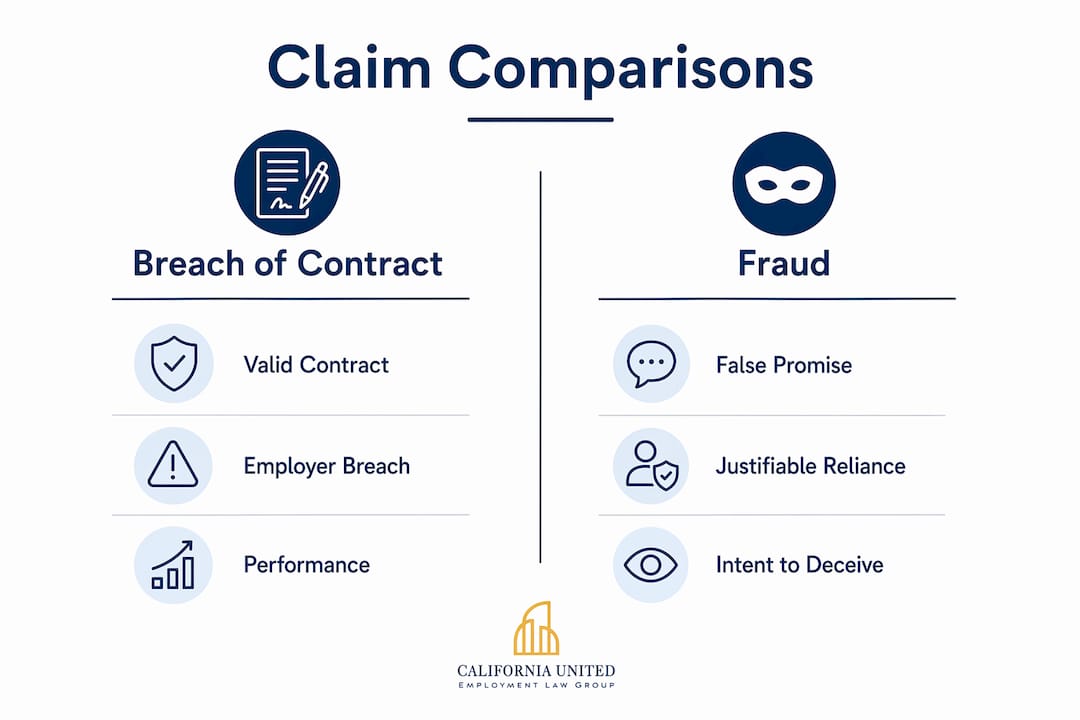
Elements of a breach of contract claim
A typical breach of contract claim in California requires proof of these core elements:
- Valid contract: A written, oral, or implied agreement existed between you and your employer.
- Your performance: You fulfilled your obligations under that agreement, or had a valid reason for not doing so.
- Employer’s breach: Your employer failed to perform a material term of the contract.
- Damages: You suffered measurable financial loss as a direct result of that breach.
Employment contracts in California can take many forms. A written offer letter promising a specific salary, a severance agreement, or even a consistent pattern of employer conduct can create enforceable obligations.
Elements of a fraud claim
A false-promise or promissory-fraud claim in California generally requires proof that the employer made a promise, did not intend to perform it when the promise was made, intended the employee to rely on it, the employee reasonably relied, the employer did not perform, and the employee was harmed because of that reliance.
- Promise or misrepresentation: The employer made a specific factual statement or promise.
- Falsity when made: For a false-promise claim, the employer did not intend to perform when the promise was made.
- Intent to induce reliance: The employer intended for you to act based on the statement or promise.
- Reasonable reliance: You reasonably relied on the statement or promise.
- Nonperformance or deception: The employer failed to perform the promised act or the statement was false.
- Harm and causation: You suffered actual harm, and your reliance was a substantial factor in causing that harm.
Justifiable reliance is the most common stumbling block in fraud claims. Courts assess what you knew, what you could have discovered, and whether your reliance was reasonable given the circumstances. However, when the alleged misrepresentation was intentional, an employer generally cannot defeat the claim merely by arguing that the employee was negligent in failing to discover the falsity.
Pro Tip: Document every promise your employer makes in writing, including emails, offer letters, and text messages. Courts look for contemporaneous evidence, not just your recollection.
How does the statute of limitations affect breach of contract and fraud claims in Los Angeles?
Filing deadlines are not flexible. Missing a deadline may bar your claim, regardless of how strong your underlying claim is.
Key deadlines by claim type
| Claim Type | Statute of Limitations | Governing Law |
|---|---|---|
| Written employment contract breach | 4 years | CCP Section 337 |
| Oral or implied contract breach | 2 years | CCP Section 339 |
| Fraud claim | 3 years from discovery or when the fraud reasonably should have been discovered | CCP Section 338 |
California’s statute of limitations for written contracts is 4 years under CCP Section 337. That means you have four years from the date of the breach to file a lawsuit based on a written employment agreement.
Fraud claims follow the discovery rule. The three-year clock starts when you discovered the fraud, or when a reasonable person in your position would have discovered it. Courts apply an objective standard. If suspicious facts existed that should have prompted an investigation, delayed discovery may not extend your deadline. Waiting too long after noticing red flags can cost you the case before it begins.
Assembly Bill 692, effective January 1, 2026, introduced new restrictions affecting certain employment contract repayment provisions in California. In qualifying cases, certain repayment-penalty provisions may be void, and statutory remedies may include minimum damages of $5,000 plus attorney fees. Los Angeles employees with contracts signed before 2026 should review those agreements in light of these changes.
Pro Tip: If you suspect fraud in your job contract, consult an attorney before the three-year window closes. The clock may have started earlier than you think.
What damages and remedies are available for breach of contract and fraud claims in Los Angeles?
The type of claim you bring determines the scope of what you may recover. Breach of contract and fraud claims carry different damage ceilings, and that difference matters significantly in Los Angeles employment disputes.
Contract damages
California jury instructions on employment-contract claims focus on the contract terms, the employee’s performance or excuse for nonperformance, the employer’s breach, causation, and resulting harm. Recoverable losses include:
- Past lost earnings caused by the breach
- Future wage loss, when supported by evidence and not speculative
- Lost benefits, including health insurance or retirement contributions when tied to the contract
- Other economic losses directly caused by the breach
Employees must mitigate their damages. Employees generally must make reasonable efforts to mitigate wage loss by seeking comparable employment. In litigation, employers often raise failure to mitigate as a defense and may argue that comparable employment was available. If you relocated because of a constructive discharge, relocation costs may also be recoverable.
Fraud damages
Fraud claims may allow broader recovery, but only for harm caused by the employee’s reliance on the misrepresentation or false promise. Because fraud is a tort rather than a contract claim, courts can award:
- Economic losses caused by reliance on the misrepresentation, such as relocation costs or losses tied to leaving secure prior employment
- Emotional distress damages, when legally available and supported by the facts
- Punitive damages, when the evidence supports the required showing of fraud, oppression, or malice
The California Supreme Court’s decision in Lazar v. Superior Court confirmed that fraudulent inducement claims qualify for tort damages beyond economic losses. That distinction is significant. A breach of contract claim may support recovery of wage and benefit losses caused by the breach. A fraud claim may support additional tort remedies, but the employee cannot obtain a double recovery for the same compensatory loss.
Distinguishing contract and tort claims directly impacts available damages and legal strategy. Choosing the right legal theory is not a technical formality. It shapes what you can realistically recover.
How do California courts differentiate breach of contract from fraud in employment?
California courts draw a clear line between contract and tort claims in employment. That line determines which remedies apply and how courts evaluate your case.
The fraudulent inducement distinction
Fraud in employment most often arises at the point of hiring. If an employer made false promises to persuade you to accept a job, quit a prior position, or relocate to Los Angeles, that conduct may support a fraudulent inducement claim. The promise must be specific enough to support reliance; vague assurances about future success, opportunity, or workplace culture usually are not enough. In Lazar v. Superior Court, the California Supreme Court allowed a promissory-fraud theory where an employee alleged he was induced to leave a job in New York and move to California based on false promises about continued employment and salary increases.
Fraud during termination is treated differently. California courts have also limited employment fraud claims where the alleged promise is too vague or the claimed harm does not result from reliance on the misrepresentation. For example, Rutter notes that vague promises generally cannot support a fraud claim, and that an employee must show actual damages caused by relying on the alleged misrepresentation. Rutter also explains that damages may exist where an employee leaves secure employment in reliance on a fraudulent promise of better pay. Misrepresentations made at or around termination are harder to plead as separate fraud claims when the claimed harm is the same wage loss caused by the termination itself. The fraud must relate to inducement, not just to how the employment ended.
The implied covenant limitation
In Foley v. Interactive Data Corp., the California Supreme Court held that tort remedies for breach of the implied covenant of good faith and fair dealing are generally unavailable in employment contracts. The implied covenant can still matter as a contract theory, but it does not automatically convert an employment contract dispute into a tort claim. Employees cannot convert a contract dispute into a tort claim simply by alleging bad faith. The distinction between contract and tort in employment is structural, not just semantic.
This ruling matters for Los Angeles employees who feel their employer acted in bad faith. Bad faith conduct alone does not trigger tort damages. You need a separate, provable fraud claim to access punitive damages and emotional distress recovery.
Tort remedies for implied covenant breaches are limited in employment contexts. That limitation pushes employees toward proving actual fraud rather than relying on general bad faith allegations.
California courts also enforce strict fraud pleading standards. Your initial complaint must specify who made the misrepresentation, what was said, when and where it occurred, and how it caused your harm. A vague allegation of fraud may not survive a demurrer or other pleading challenge. Knowledge and intent may be supported by circumstantial evidence, such as a hasty repudiation, failure even to attempt performance, or continued assurances after performance had become unlikely.
Key Takeaways
Los Angeles employees pursuing breach of contract or fraud claims must understand that the type of claim they bring controls both the legal standard and the damages available.
| Point | Details |
|---|---|
| Breach requires four elements | Prove a valid contract, your performance, the employer’s breach, and measurable damages. |
| False promise requires specific proof | The employee must prove a promise, lack of intent to perform when made, intended reliance, reasonable reliance, nonperformance, harm, and causation. |
| Deadlines vary by claim type | Written contract breaches allow 4 years; fraud claims allow 3 years from discovery under CCP Section 338. |
| Fraud may allow broader remedies | Fraudulent inducement may support tort remedies, but damages depend on proof, causation, and the facts of the case. |
| Pleading fraud requires specifics | California courts require detailed fraud allegations from the start, or the case faces dismissal. |
What I’ve Learned About Fraud And Contract Claims In Los Angeles Employment Cases
In Los Angeles employment disputes, employees often sense that something was wrong, but the legal issue usually depends on identifying the specific promise, misrepresentation, contract term, and resulting harm. That gap matters more than most people realize.
Fraudulent inducement cases are harder to build than breach of contract cases, and not because the facts are weaker. The pleading requirements are strict. California courts require you to specify who said what, when, where, and how. Employees who did not document promises at the time of hiring often find themselves relying on memory alone. Memory alone can make the claim harder to prove, especially when the employer denies the promise or points to written contract language.
The 2026 changes under Assembly Bill 692 add a new layer of complexity. Certain repayment-penalty provisions may now be void under California law. If your employer used one of those provisions against you, the 2026 changes may affect your legal options in ways that were not available before January 2026.
The most common misunderstanding I encounter is the belief that bad faith conduct automatically creates a fraud claim. It does not. Foley v. Interactive Data Corp. remains an important limitation on tort remedies for employment contract disputes. Bad faith in an employment relationship is a contract issue, not a tort. To pursue punitive damages, an employee generally needs a viable tort theory, such as intentional fraud, and evidence supporting the required showing of wrongful intent or conduct. That is a higher bar, and it requires specific evidence.
My practical advice: if you believe you were deceived into accepting a job or staying in one, start gathering documentation immediately. Offer letters, emails, lawful written communications, and written performance reviews may all become relevant. Wrongful termination protections may also overlap with fraud and contract issues, depending on the facts, timing, and evidence.
— California United Law Group
California United Law Group And Los Angeles Employment Contract Disputes
California United Law Group represents Los Angeles employees in breach of contract and fraud claims at every stage, from pre-litigation review through trial. If you received promises that were never honored, or if your employer misrepresented the terms of your employment to persuade you to take or keep a job, those facts may warrant legal review.
The firm handles employment contract disputes involving written agreements, implied contracts, and fraudulent inducement. California United Law Group also advises employees on how the 2026 Assembly Bill 692 changes may affect certain existing agreements.
The outcome of any breach of contract or fraud claim depends on the contract language, the evidence, the timing of the claim, and the specific facts of the employment relationship.
If you are a Los Angeles employee with questions about a broken employment agreement or workplace fraud, contact California United Law Group for a case review.
FAQ
What is the difference between breach of contract and fraud in employment?
Breach of contract occurs when an employer fails to fulfill a binding agreement. Fraud in employment may involve a false statement, concealment, negligent misrepresentation, or false promise. When the employer uses the misrepresentation or false promise to persuade an employee to accept, leave, relocate for, or remain in a job, the claim may be framed as fraudulent inducement or promissory fraud.
How long do I have to file a breach of contract claim in Los Angeles?
California gives you 4 years to file a breach of written employment contract claim under CCP Section 337, and 2 years for oral or implied contracts under CCP Section 339.
Can I recover punitive damages in an employment contract dispute?
Punitive damages are generally not available for breach of contract claims. They may be available when the employee proves a separate tort theory, such as fraudulent inducement, and the evidence satisfies the standard for punitive damages.
What does “justifiable reliance” mean in a fraud claim?
Justifiable reliance means you reasonably believed the employer’s false statement and acted on it. Courts assess whether a person in your situation, with your knowledge and access to information, would have relied on that statement.
Does Assembly Bill 692 affect my existing employment contract?
Assembly Bill 692, effective January 1, 2026, may void certain repayment-penalty provisions and may provide minimum damages of $5,000 plus attorney fees for qualifying violations. Los Angeles employees with pre-2026 contracts should review their agreements for affected provisions.