
Many Long Beach retail workers assume that only their lunch break is protected by law. The reality is that California law provides you with a paid 10-minute rest break for every 4 hours worked, or major fraction thereof (more than 2 hours), and your employer is legally required to let you take it. Missing that break is not a minor inconvenience. It is a wage violation, and you may be owed money for every single shift it happened.
Table of Contents
- Rest break rights for Long Beach retail workers explained
- How and why rest breaks are denied in Long Beach retail
- What employers must do (and common violations)
- If you’re denied a rest break: What you can do
- Legal support for wage and hour violations in Long Beach
- Frequently asked questions
Key Takeaways
| Point | Details |
|---|---|
| Legal rest break rights | All non-exempt Long Beach retail workers are legally entitled to paid, uninterrupted rest breaks during their shifts. |
| Common employer violations | Break denials, on-call requirements, or discouraging breaks are illegal and widespread in retail settings. |
| Premium pay penalties | You are owed an extra hour of pay each day a required rest break is not provided. |
| How to take action | If denied, document the violations and explore wage claims or legal remedies with professional support. |
Rest break rights for Long Beach retail workers explained
California’s rest break rules are specific, and they apply to virtually every non-exempt retail worker in Long Beach regardless of store size. Under California rest break law, you earn one paid 10-minute break for every 4 hours worked, or major fraction thereof. That means a 6-hour shift earns you one break, and an 8-hour shift earns you two.
These breaks must be duty-free. You cannot be asked to monitor a fitting room, answer the phone, or stay within earshot of the register. The break should also fall in the middle of each 4-hour work period when that is practical.
In Brinker Restaurant Corp. v. Superior Court (2012) 53 Cal.4th 1004, the California Supreme Court clarified that employers must authorize and permit rest breaks. If an employer adopts a policy that fails to provide the required number of breaks, it has violated the law even if individual employees choose not to take authorized breaks. Additionally, in Augustus v. ABM Security Services, Inc. (2016) 2 Cal.5th 257, the California Supreme Court held that on-call and on-duty rest breaks are illegal under state law, emphasizing that employers must relieve employees of all duties and relinquish control during these periods.
Here is a quick breakdown of what you are owed based on shift length:
| Shift length | Rest breaks owed |
|---|---|
| 3.5 hours or less | 0 |
| 3.5 to 6 hours | 1 |
| 6 to 10 hours | 2 |
| 10 to 14 hours | 3 |
A few things workers often get wrong:
- Breaks cannot be waived. Even if you agree to skip a break, that agreement does not protect your employer from a violation. The California Supreme Court in Brinker confirmed that no waiver issue ever arises for a break that was required by law but never authorized.
- On-call time does not count. If you are told to stay available during your break, that break never legally happened.
- Small stores are not exempt. A boutique with two employees must follow the same rules as a major chain retailer.
- Part-time workers qualify. If your shift is at least 3.5 hours, you are entitled to a break.
Pro Tip: Check whether your employer’s written break policy matches what actually happens on the floor. A policy that looks compliant on paper but is never enforced is still a violation. You can also review retail meal break violations to understand how meal and rest break issues often overlap.
For a deeper look at how employers are supposed to structure these breaks, rest break compliance guidance makes clear that the obligation falls entirely on the employer, not the worker.
How and why rest breaks are denied in Long Beach retail
Understanding the law is only half the battle. The reality on the shop floor can be very different. Break denials are widespread in California retail, driven by understaffing, pressure to push through busy periods, and on-call requirements that quietly swallow the break entirely.
In Long Beach specifically, retail stores commonly deny breaks during peak hours, citing short staffing as the reason. That explanation does not hold up legally, but many workers accept it because they do not know their rights or fear retaliation.

Here is how the law compares to what workers often experience:
| What the law requires | What commonly happens |
|---|---|
| Paid, duty-free 10-minute break | Worker stays on the floor during “break” |
| Break in the middle of the work period | Break skipped entirely during rush hours |
| No on-call requirements during breaks | Worker must keep radio or phone on |
| Employer must authorize and permit breaks | Manager says “we’re too busy right now” |
| Cannot be waived by the employee | Worker told to sign a break waiver |
The most common ways employers deny breaks in Long Beach retail include:
- Telling workers the store is too short-staffed to cover a break
- Scheduling shifts where breaks are technically possible but never actually offered
- Requiring workers to stay on the sales floor or within call range
- Creating a culture where taking breaks is seen as lazy or disloyal
- Pressuring workers to clock out for breaks that are then interrupted by work tasks
“I never took a break during my entire holiday season shift. My manager just said we were too busy. I didn’t know I could do anything about it until a coworker told me about premium pay.”
This kind of pressure is not just unfair. It is illegal. If you have experienced wage violations in LA or the greater Long Beach area, you are far from alone, and the law gives you real tools to respond.
What employers must do (and common violations)
So what is your boss actually required to do, and where do most employers fail? The legal standard is clear: employers must authorize and permit rest breaks, not simply have a written policy that nobody enforces. There is a big difference between those two things.
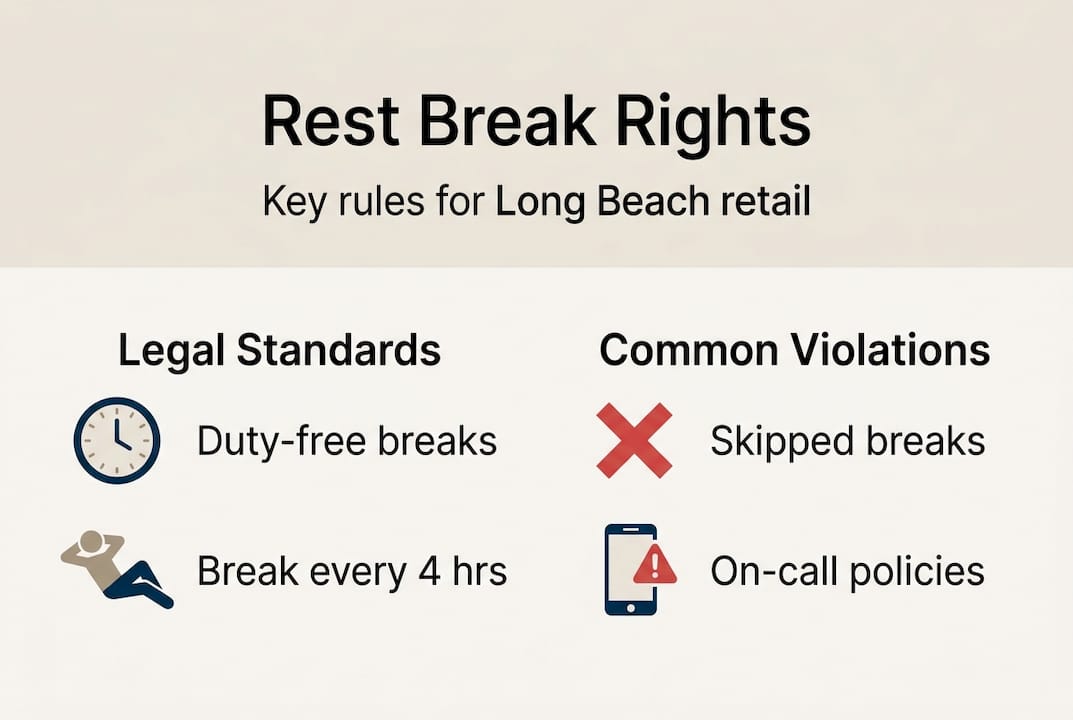
Rest breaks should also occur, when practicable, in the middle of each 4-hour work period. In Rodriguez v. E.M.E., Inc. (2016) 246 Cal.App.4th 1027, the court held that departure from this preferred schedule is permissible only when it will not unduly affect employee welfare and is tailored to alleviate a material burden on the employer.
Having a break policy in the employee handbook is not enough. If managers routinely discourage breaks, schedule shifts too tightly to allow them, or interrupt breaks with work tasks, the employer is in violation regardless of what the handbook says.
Common employer violations include:
- Interrupted breaks. A manager radios you during your break to help a customer. That break does not count.
- On-call breaks. You are told to stay near the register in case it gets busy. That is not a rest break.
- Pressure to work through. Subtle comments like “we really need you out there” make workers feel they cannot leave.
- Forced waivers. Some employers ask workers to sign forms saying they voluntarily skipped breaks. These waivers are generally unenforceable.
- Retaliation for taking breaks. Cutting hours or giving negative reviews to workers who assert their break rights is illegal.
For a full breakdown of what meal and rest breaks in California require from employers, the legal standards are well documented and consistently enforced by courts.
Pro Tip: Start keeping a personal log of your shifts, including when breaks were offered, when they were skipped, and any comments from managers. A simple notes app on your phone works fine. This record can be critical evidence if you later file a claim. You can also browse more legal insights to understand your broader rights as a California worker.
If you’re denied a rest break: What you can do
Knowing the rules is one thing. Acting on them is what makes the difference if your rights are denied. California law gives you real remedies, and you do not need to just accept the loss.
Here are the steps you can take:
- Document everything first. Write down dates, shift times, which breaks were missed, and any manager comments. The more specific your records, the stronger your claim.
- Understand your premium pay right. For every workday a rest break is denied, you are owed one additional hour of pay at your regular rate. If you worked 250 days last year and missed a break each day, that adds up fast. In Murphy v. Kenneth Cole Productions, Inc. (2007) 40 Cal.4th 1094, the California Supreme Court held that this additional hour of pay is a premium wage intended to compensate employees, not a penalty. This characterization is significant because it carries a three-year statute of limitations rather than the one-year limitation that applies to penalties.
- File a DLSE wage claim. The Division of Labor Standards Enforcement handles wage claims for California workers. Remedies include recovery of premium pay for violations going back three years, which is the applicable statute of limitations for these wage claims under California Code of Civil Procedure section 338(a).
- Consider a civil lawsuit. If your employer has a pattern of denying breaks across multiple workers, a class action or representative action under California’s Private Attorneys General Act (PAGA) may be appropriate. PAGA allows employees to step into the shoes of the state labor commissioner and recover civil penalties on behalf of themselves, other employees, and the State of California for Labor Code violations. These cases can result in significant recoveries for all affected workers.
- Do not wait on enforcement agencies alone. State enforcement backlogs are real. Private claims through an employment attorney often move faster and recover more.
For guidance on reporting workplace violations in Long Beach, including how to document and submit a complaint, resources are available to walk you through the process. You can also review your full rest break rights to confirm what you are owed before taking action.
One thing worth knowing: retaliation for asserting your break rights is also illegal. If your hours get cut or your schedule changes after you raise a concern, that is a separate violation worth documenting.
Legal support for wage and hour violations in Long Beach
If you are a Long Beach retail worker who has been denied rest breaks, you do not have to figure this out alone. At California United Law Group, P.C., we represent employees in wage and hour disputes, including rest break and meal break violations. The outcome of any legal matter depends on the specific facts and circumstances of each case. We offer confidential consultations so you can understand your options based on your individual situation. Our team offers confidential consultations so you can understand your options without any pressure. Whether your situation calls for a DLSE claim, a civil lawsuit, or a class action, a Long Beach employment lawyer from our firm can help you assess the strength of your case. Visit our wage and hour resources page to learn more about the types of claims we handle and how we approach these cases for retail workers across Long Beach and the greater Los Angeles area.
Important Legal Disclaimer
This article provides general information about California rest break laws and is not intended as legal advice for your specific situation. The application of these laws can vary based on individual circumstances, industry-specific wage orders, and the particular facts of each case. If you believe your rest break rights have been violated, consult with a qualified employment attorney to evaluate your specific situation.
Frequently asked questions
How many rest breaks am I entitled to during a typical 8-hour retail shift in Long Beach?
You are entitled to two paid 10-minute rest breaks during an 8-hour shift, based on the rule of one break per 4 hours worked or major fraction thereof.
Can my employer require me to stay on-call or handle customers during my rest break?
No. Rest breaks must be completely duty-free, and on-call breaks are illegal under California law regardless of how busy the store is. Rest breaks must be completely duty-free, and on-call breaks are illegal under California law. The California Supreme Court in Augustus v. ABM Security Services, Inc. (2016) 2 Cal.5th 257 definitively held that employers cannot require employees to remain on call during rest periods, regardless of business necessity.
What if my employer says the store is too busy for breaks?
Business needs, including staffing shortages or busy periods, do not excuse an employer’s obligation to authorize and permit rest breaks. Your employer owes you premium pay if a break is skipped for any reason, including claimed business necessity.”
Reason: More precise legal statement based on Brinker holding.
How much is the penalty if my rest break is denied?
You are owed one additional hour of pay at your regular rate for each workday a rest break is denied, which can add up significantly over time. The California Supreme Court has clarified that ‘regular rate of pay’ encompasses not only hourly wages but all nondiscretionary payments for work performed. (Ferra v. Loews Hollywood Hotel, LLC (2021) 11 Cal.5th 858.)
Is there a deadline to file a wage claim for missed rest breaks?
You generally have three years to file a wage claim for rest break violations under California Code of Civil Procedure section 338(a), based on the California Supreme Court’s holding in Murphy v. Kenneth Cole Productions, Inc. (2007) 40 Cal.4th 1094 that premium pay for missed breaks constitutes wages, not penalties.