
TL;DR:
- California law requires employers to pay for all work performed, including pre- and post-shift tasks.
- Workers should document any off-the-clock work to recover unpaid wages through claims or lawsuits.
- Retaliation against employees reporting wage violations is prohibited under California law.
Thousands of warehouse workers across California are losing pay every single day for work they’re legally owed. If you clock out after your shift but still spend time cleaning equipment, removing safety gear, or finishing paperwork, that time belongs to you under California law. Off-the-clock work remains a recognized ongoing issue for manufacturing and warehouse workers in El Monte, California. This guide will help you recognize when your rights are being violated, show you how to build a solid record of evidence, and explain the legal steps available to help you pursue the wages you may be owed..
Table of Contents
- The scope of off-the-clock work in El Monte warehouses
- California law: What counts and what you’re owed
- Recognizing and documenting violations: Practical steps
- Legal remedies, timeframes, and retaliation protection
- Why uncompensated work persists: A hard look at systemic barriers
- Connect with expert legal help for wage violations
- Frequently asked questions
Key Takeaways
| Point | Details |
|---|---|
| All tasks must be paid | California law requires payment for every work-related task, no matter how minor or short. |
| Document violations | Keeping detailed records of unpaid tasks is critical for proving wage claims. |
| Strong protections exist | State law offers robust anti-retaliation and legal support for affected workers. |
| Systemic enforcement challenges | Despite legal clarity, understaffed agencies and employer tactics contribute to ongoing violations. |
| Legal help matters | Connecting with an employment attorney can help you understand your rights and navigate the claims process more effectively. |
The scope of off-the-clock work in El Monte warehouses
Off-the-clock work happens when your employer requires or allows you to perform job duties without paying you for that time. It sounds simple, but it shows up in ways that are easy to miss or dismiss as “just part of the job.”
Here are the most common unpaid tasks warehouse workers in El Monte experience:
- Pre-shift setup: Arranging workstations, loading conveyor systems, or calibrating equipment before the official clock-in time
- Donning and doffing: Putting on or removing safety gear, gloves, hard hats, or protective clothing before and after shifts
- Post-shift cleanup: Sweeping work areas, sanitizing surfaces, or storing tools after clocking out
- Security screenings: Waiting in line for bag checks or safety inspections off the clock
- Mandatory meetings: Attending brief team huddles or safety briefings that start before the paid shift begins
The scale of this problem is significant. DOL wage recovery data shows that wage violations in warehouse and manufacturing sectors affect thousands of workers annually, with millions of dollars in back wages recovered each year. Yet enforcement still struggles to keep pace with the volume of violations.
Who is most affected? Workers on production lines, logistics teams, and fulfillment centers in El Monte face the highest exposure. These jobs involve physical gear, regulated environments, and shift-based scheduling, all of which create natural opportunities for unpaid time to slip through the cracks.
| Common unpaid task | When it typically occurs | Why employers often ignore it |
|---|---|---|
| Donning/doffing safety gear | Before and after shifts | Treated as personal time |
| Equipment setup | 5-15 minutes pre-shift | Not tracked by timekeeping systems |
| Post-shift cleanup | After clock-out | Considered “voluntary” |
| Security screenings | End of shift | Seen as employer-controlled but unpaid |
| Pre-shift safety briefings | Before official start time | Labeled as informal or optional |
The pattern is clear. Employers often frame these tasks as informal or outside the scope of paid work. But California law says otherwise, and understanding that distinction is your first step toward protecting your pay.

California law: What counts and what you’re owed
With a clear sense of how common unpaid work is, it’s critical to understand which tasks the law covers and what you’re rightfully owed.
California sets a higher standard than federal law. Under the California Labor Code, all time you spend working must be compensated, including tasks that last only a few minutes. This is not a gray area.
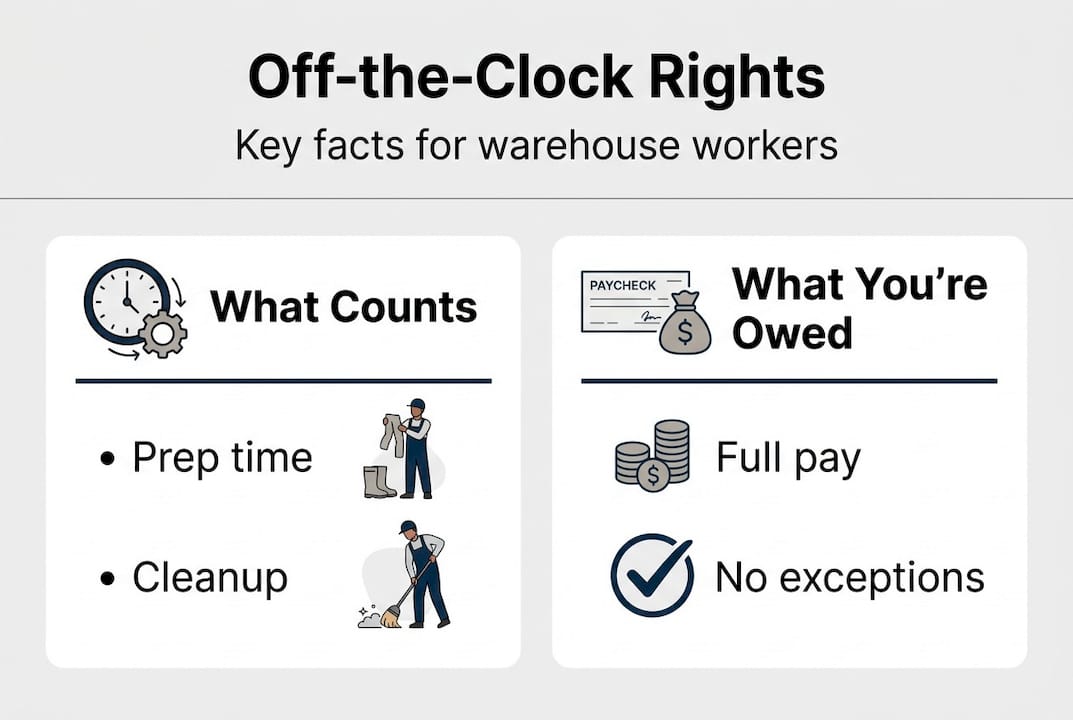
The landmark case Troester v. Starbucks (2018) made this crystal clear. The California Supreme Court ruled that no de minimis exception applies under California law, meaning employers cannot legally argue that short tasks are too brief to be worth paying. If the task is part of your job and is regularly required, it must be paid. The Court left open only the narrow question of whether activities that are so irregular or brief that they cannot reasonably be tracked might be treated differently—a question that rarely applies in warehouse settings.
California courts have reinforced these protections across a range of industries. In Morillion v. Royal Packing Co. (2000) 22 C4th 575, the California Supreme Court held that time employees spent riding employer-mandated buses to worksites was compensable because the employees were required to use company transportation and were under the employer’s control during that time. This “control” standard applies broadly to pre- and post-shift activities in warehouse settings. Additionally, the U.S. Supreme Court’s decision in IBP, Inc. v. Alvarez (2006) 546 US 21 confirmed that time spent by slaughterhouse workers donning and doffing unique protective gear is compensable as “integral and indispensable” to their principal job activities—a principle that California courts apply with equal or greater force given California’s rejection of the de minimis doctrine.
Here is a numbered breakdown of compensable work scenarios that apply directly to warehouse jobs:
- Putting on or removing protective equipment before or after your shift
- Setting up your workstation or production area before the shift officially begins
- Cleaning or sanitizing your work area after the shift ends
- Waiting in mandatory security lines controlled by your employer
- Attending required briefings or safety meetings before your paid start time
- Completing required paperwork or digital logs outside your scheduled hours
California’s Labor Code and the Industrial Welfare Commission (IWC) Wage Orders apply to all of these scenarios. The law does not require that your supervisor explicitly tell you to stay late or arrive early. If the work benefits the employer and you’re required to do it, it’s compensable.
Pro Tip: If your employer’s timekeeping system only starts tracking when you scan a badge or log into a terminal, but you’re already working before that moment, you may have a valid wage claim. The system’s limitations don’t override your legal right to be paid.
For additional context on how California handles these situations, California wage violation legal guidance outlines the broader framework workers can rely on. You can also review wage violation strategies specific to California employees to understand how these claims are typically pursued.
Recognizing and documenting violations: Practical steps
Knowing your legal rights, the next step is learning how to spot and build proof of violations before you take action.
Spotting off-the-clock violations starts with paying attention to your daily routine. Ask yourself: Am I doing anything work-related before I clock in or after I clock out? If the answer is yes, even occasionally, that’s worth tracking.
Here are the most commonly missed tasks that warehouse workers often overlook:
- Arriving early to receive instructions from the outgoing shift
- Staying late to finish a count or complete a safety log
- Removing personal protective equipment after clocking out
- Responding to work-related messages or calls outside paid hours
Once you identify these moments, documentation becomes your most powerful tool. Follow these steps:
- Keep a daily log. Write down the date, exact times you started and stopped working, and a brief description of the task. A notebook or phone note app both work.
- Note who was present. Record the names of supervisors or coworkers who witnessed or directed the unpaid work.
- Save any communications. Text messages, emails, or app notifications that show you were asked to work off the clock are strong evidence.
- Compare your records to your pay stubs. Look for patterns where your actual work time consistently exceeds your recorded hours.
- Preserve everything. Store copies of logs, messages, and pay stubs somewhere outside of work systems, like a personal email or cloud storage.
As workers facing potential off-the-clock violations should know, for most wage claims based on the Labor Code—including unpaid minimum wages and overtime—the statute of limitations is three years. However, if your attorney pursues a claim under California’s Unfair Competition Law (Bus. & Prof. Code § 17200), the limitations period extends to four years. Because the right deadline depends on the specific claims in your case, speaking with an attorney early is especially important. That means you have time to build your case, but starting early gives you the strongest position.
Pro Tip: Even if you’re unsure whether what you’re experiencing qualifies as a violation, start documenting now. Detailed records from the start of a dispute consistently produce better outcomes in wage claims than records assembled after the fact.
Understanding the full wage claim process in California will also help you know what to expect once you’re ready to move forward. And if you’re worried about what happens if you speak up, California’s retaliation protections are strong and specifically cover wage complaints.
Legal remedies, timeframes, and retaliation protection
Once you’ve documented your case, it’s time to consider how to seek justice and what protections you have along the way.
You have several paths for recovering unpaid wages in California::
- File a DLSE wage claim. The Division of Labor Standards Enforcement investigates wage theft complaints at no cost to you. You can file online or in person at a local DLSE office.
- File a civil lawsuit. An employment attorney can pursue your unpaid wages, interest, and penalties directly in court, often on a contingency basis—meaning no attorney’s fees unless you recover. Note that clients may still be responsible for certain case costs and expenses regardless of the outcome; you should discuss the specific fee arrangement with any attorney you consult.
- File a PAGA representative action. Under the Labor Code Private Attorneys General Act (PAGA, Lab. Code § 2698 et seq.), an aggrieved employee may bring a representative action for civil penalties on behalf of themselves and coworkers for Labor Code violations. PAGA penalties are shared: 75% goes to the state, and 25% is distributed among the aggrieved employees. A PAGA claim can be pursued alongside a civil lawsuit and does not require class certification.
Most wage claims under the Labor Code carry a three-year statute of limitations, though certain claims—including those brought under California’s Unfair Competition Law—may allow up to four years. The applicable deadline depends on the specific legal theories pursued. That clock starts on the date of each violation, so the sooner you act, the more wages you can recover.
During a DLSE investigation, the agency may:
- Contact your employer and request payroll records
- Interview coworkers and supervisors
- Calculate the total wages owed, including interest
- Issue a citation or order your employer to pay
“Warehouse wage violations persist statewide, with the DOL recovering $4.8 million for more than 3,700 workers over five years,” according to KQED’s reporting on wage enforcement challenges. Enforcement agencies are stretched thin, which is why having an attorney in your corner matters.
On retaliation: California law is explicit. Your employer cannot fire you, reduce your hours, demote you, or threaten you for filing a wage complaint or cooperating with an investigation. If they do, that retaliation becomes a separate legal claim with its own remedies. Review your retaliation legal options if you believe your employer has already started to push back.
You deserve to be paid for every minute you work. The law is on your side, and so are the enforcement tools available to you.
Why uncompensated work persists: A hard look at systemic barriers
Although there are clear steps to fight back, it’s worth asking why off-the-clock work is still a problem and what can actually turn the tide.
The law is not the issue. California has some of the strongest wage protections in the country. The problem is enforcement. Understaffed agencies mean that even documented violations can take months or years to resolve through government channels alone.
Employers in high-volume warehouse environments also face intense pressure to cut labor costs. That pressure doesn’t justify wage theft, but it explains why some managers look the other way when workers arrive early or leave late without recording the time.
What most guides miss is this: individual workers who document carefully and work with an employment attorney are often better positioned to navigate the process—private litigation allows for discovery, penalty claims, and direct negotiation that agency processes may not offer. A legal analysis of warehouse violations shows that private claims often move faster and recover larger amounts than DLSE complaints alone.
The workers who win are the ones who treat their own time as seriously as the law does.
Connect with expert legal help for wage violations
If you’ve been working off the clock without pay, you don’t have to figure this out alone. At California United Law Group, P.C., we represent warehouse workers across California who are fighting to recover unpaid wages and hold employers accountable.
👉 Our team handles wage and hour claims from the first consultation through resolution, whether that means a DLSE filing, a private lawsuit, or a class action.
We also represent workers facing wrongful termination after reporting wage violations. If you’re ready to talk, reach out to us today for a confidential consultation. Your time has value, and we’re here to help you protect it.
Frequently asked questions
What qualifies as off-the-clock work in California warehouse jobs?
Any work-related task performed before or after your scheduled shift—such as setup, cleanup, or donning safety gear—must be paid under California law. Tasks performed during your scheduled shift are, of course, also compensable.
Do short tasks or preparations need to be paid?
Yes. Even brief tasks like equipment setup or quick paperwork before your shift are compensable; California rejects the de minimis defense following Troester v. Starbucks.
How should warehouse workers document wage violations?
Keep a log of dates, times, specific tasks, and supervisors involved; written and digital records consistently help strengthen wage claims during investigations.
What is the deadline for filing an off-the-clock wage claim?
You have up to three years from each violation to file a claim with the DLSE or in court under California’s statute of limitations.
Can my employer retaliate if I report wage violations?
No. California law strictly prohibits retaliation against workers who file wage complaints, as outlined under California’s retaliation protections.