
TL;DR:
- Thousands of LA Uber drivers may be owed back pay due to misclassification and wage theft claims.
- Proposition 22 limits pay protections to active trip time, excluding waiting and offline hours.
- Drivers are advised to document all hours, calculate actual earnings, and seek legal or union assistance.
Thousands of LA Uber drivers are caught in one of the largest wage disputes in California history. Over 5,000 LA drivers filed wage theft claims before Proposition 22 passed, and state-wide liability could reach tens of billions of dollars. If you drive for Uber in Los Angeles, you may be owed back pay, and you may not even know it. Regulatory changes, misclassification lawsuits, and a confusing pay structure have left many drivers unsure of where they stand. This article breaks down your rights, explains what the law actually guarantees, and tells you exactly what to do next.
⚠️ Important Legal Notice: As of the publication of this article, Proposition 22’s constitutionality is under active review by the California Supreme Court in Castellanos v. State of California (Case No. S279622). The Court of Appeal previously allowed Prop 22 to stand with limited exceptions, but the California Supreme Court granted review on June 30, 2023 to determine whether the measure violates the California Constitution. If the Supreme Court rules it unconstitutional, all Prop 22 provisions — including the pay protections described in this article — could be rendered unenforceable. Readers should consult an employment attorney for the most current status of the law.
Table of Contents
- The wage denial controversy: Pre-Prop 22 lawsuits and legal actions
- How Prop 22 changed pay for Uber drivers in LA
- Real earnings vs. Uber claims: What LA drivers actually make
- What LA Uber drivers can do: Documenting, filing claims, and new union rights
- Our take: Why the ‘minimum wage’ claim is misleading for Uber drivers
- Need help? Legal advice and representation for LA Uber drivers
- Frequently asked questions
Key Takeaways
| Point | Details |
|---|---|
| Many LA Uber drivers face wage disputes | Thousands are part of lawsuits alleging unpaid wages due to misclassification between 2016 and 2020. |
| Prop 22 alters pay structure | Drivers are guaranteed minimum earnings for active time only, often leaving waiting time unpaid. |
| Actual earnings often fall below expectations | Studies show net pay for LA Uber drivers is frequently below local minimum wage when all time is included. |
| Documentation is crucial for claims | Keeping detailed records and screenshots empowers drivers to file wage complaints or join lawsuits. |
| Union rights emerging in 2026 | LA Uber drivers will soon have new options to collectively bargain and address pay issues. |
The wage denial controversy: Pre-Prop 22 lawsuits and legal actions
Before Proposition 22 passed in November 2020, Uber classified its drivers as independent contractors rather than employees. That classification mattered enormously. Employees are entitled to minimum wage, overtime, expense reimbursements, and other protections under California law. Independent contractors get none of that.
California’s Supreme Court changed the game in 2018 with the Dynamex decision, which established the ABC test for worker classification. Under this test, the burden fell on Uber — not the driver — to prove that each driver qualified as an independent contractor by satisfying all three prongs of the test. Because driving passengers is central to Uber’s core business, many drivers would likely have met the standard for employee status, particularly under the test’s second prong. Uber disagreed and kept classifying drivers as contractors anyway.
In Dynamex Operations West, Inc. v. Superior Court (2018) 4 Cal.5th 903, the California Supreme Court adopted the “ABC test” and placed the burden squarely on hiring entities to prove independent contractor status. Critically, the California Supreme Court later confirmed in Vazquez v. Jan-Pro Franchising Int’l, Inc. (2021) 10 Cal.5th 944, 948 that the Dynamex holding applies retroactively to all cases not yet final as of the date Dynamex became final — meaning drivers who worked prior to 2018 may still benefit from the ruling in active lawsuits.
That gap between what the law required and what Uber did is the heart of the wage denial controversy.
Thousands of California drivers are now pursuing back pay through lawsuits tied to misclassification between 2016 and 2020. If you drove for Uber during that period, you could be part of that group.
Understanding your misclassification rights in California is the first step. Here is what you need to know about back pay eligibility:
- Work period: Claims generally cover trips completed between 2016 and 2020
- Employment status: You must have been classified as an independent contractor during that time
- Earnings gap: Your actual pay must fall short of what a California employee would have earned
- Documentation: Trip logs, earnings statements, and app records are critical evidence
From the editors: “The scale of potential liability here is unlike anything California has seen in a gig economy case. Drivers who stayed quiet may have the most to gain by coming forward now.”
The Dynamex misclassification lawsuits reshaped how courts evaluate gig worker status, and ongoing settlement talks with Uber show that these claims carry real legal weight.
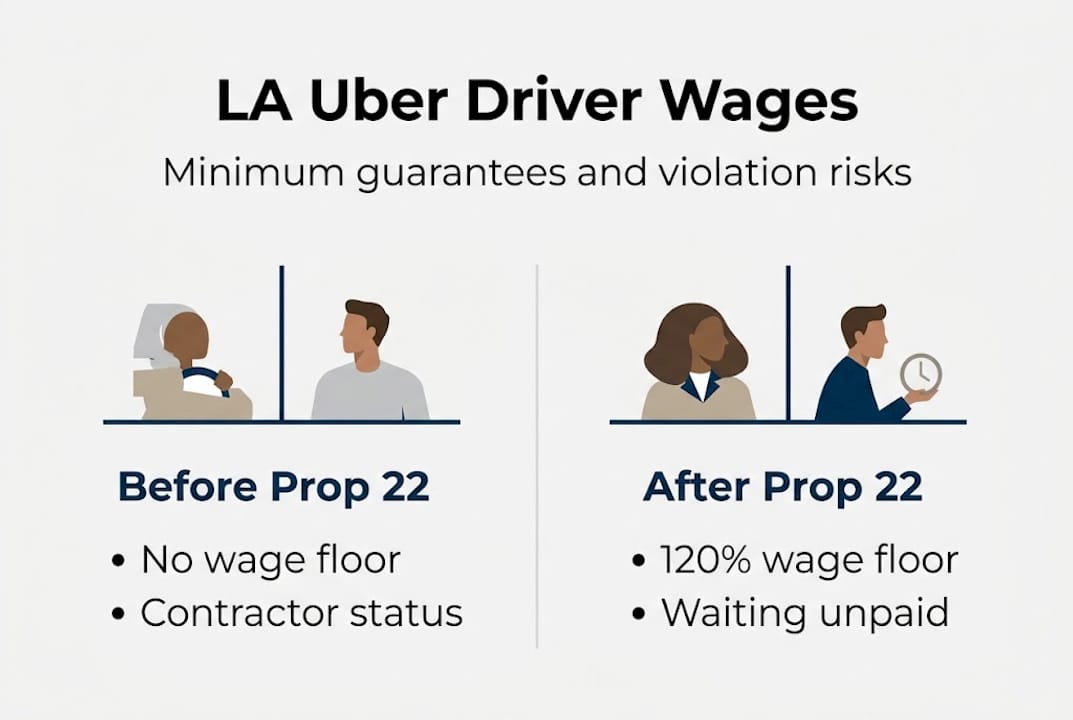
| Pre-Prop 22 (Before Nov 2020)* | Post-Prop 22 (After Nov 2020) |
|---|---|
| No guaranteed minimum wage | 120% of local minimum wage (active time only) |
| No mileage reimbursement | 30 cents per mile reimbursement |
| No expense coverage | Limited healthcare stipend |
| Classified as contractor | Still classified as contractor |
| Subject to full ABC test | Exempt from ABC test under Prop 22 |
* Note: Proposition 22’s enforceability is currently under review by the California Supreme Court in Castellanos v. State of California (Case No. S279622). These protections may be affected by the outcome of that case.
The Uber wage theft settlement talks are still active in 2026, which means there is still time to act if you have a valid claim.
How Prop 22 changed pay for Uber drivers in LA
Proposition 22 passed after Uber, Lyft, DoorDash, Instacart, and other app-based companies collectively spent over $200 million campaigning for it — the most expensive ballot measure campaign in California history at the time. It kept app-based drivers classified as independent contractors while layering on certain minimum pay and benefit floors that typical independent contractors do not receive — a structure that looks protective on paper but, as explained below, has significant gaps in practice. The result is a pay structure that looks protective on paper but has significant gaps in practice.
Here is what Prop 22 actually guarantees for LA Uber drivers:
- Active time pay: 120% of local minimum wage for time spent on trips, not for time spent waiting for a ride request
- Mileage reimbursement: 30 cents per mile driven during trips
- Healthcare stipend: A partial contribution toward health insurance if you average 15 or more hours per week in active time
- Accident insurance: Coverage for injuries sustained during active trips
A critical caveat: The protections listed above assume Proposition 22 remains in effect. As of this writing, the California Supreme Court is actively reviewing whether Prop 22 is unconstitutional in Castellanos v. State of California (Case No. S279622). The Court of Appeal previously upheld Prop 22 in part, but the Supreme Court granted review on June 30, 2023. If the court strikes down Prop 22, app-based drivers could revert to full employee status under the Labor Code — with significantly stronger protections, including overtime and full expense reimbursement.
What Prop 22 does NOT guarantee is equally important. Waiting time, the period when you have the app open but have not accepted a ride, is completely unpaid. Studies suggest drivers spend 30 to 50% of their time waiting, which means a large portion of your working day generates zero income.
| Pay Component | Covered Under Prop 22? |
|---|---|
| Active trip time | Yes, at 120% minimum wage |
| Waiting/online time | No |
| Mileage during trips | Yes, 30 cents/mile |
| Overtime | No |
| Expense reimbursements | No |
| Full health benefits | No |
Pro Tip: Track your total online hours separately from your active trip hours. If your earnings during active trip time fall below 120% of the local minimum wage, you may have grounds for a Prop 22 earnings shortfall claim. If you drove before November 2020, calculating your total online earnings per hour may also help establish the wage gap relevant to a pre-Prop 22 misclassification claim. These are two different legal theories — and an employment attorney can help you identify which applies to your situation.
The practical effect is that Prop 22 created a floor, but it is a floor with holes. Drivers who do not track their waiting time carefully often do not realize how far below the legal minimum their effective hourly rate falls. The Prop 22 wage effects are real, but they only protect the hours Uber counts, not the hours you actually work.
Real earnings vs. Uber claims: What LA drivers actually make
Uber publicly states that its drivers earn $34.46 per hour during active time. That number sounds reasonable. The problem is what it leaves out.
Frequent Prop 22 top-ups are required to bring drivers up to the legal minimum, which means base earnings often fall below the guaranteed floor even before waiting time is factored in. When researchers account for all hours a driver has the app open, the picture changes dramatically.
Here is what independent research found:
- A Berkeley Labor Center study found median LA and SF driver pay of just $5.97 per hour after accounting for all online time
- CalMatters reported a slightly higher figure of $9.09 per hour when tips are included
- Both figures fall well below California’s minimum wage
- Uber’s $34.46 figure only counts time when a driver is actively on a trip
Our observation, based on reviewing driver earnings data: “When you divide your weekly earnings by every hour you had the app open, the number you get is almost always lower than what Uber advertises. That gap is not a coincidence.”
The disconnect comes down to how “working time” is defined. Uber counts only active trip time. Drivers count every hour they are available and waiting. California labor law, in most employment contexts, would count waiting time as compensable work. Under Prop 22, it does not.
Drivers should also be aware of the Labor Code Private Attorneys General Act (PAGA), which allows an aggrieved employee to bring a representative civil action to recover civil penalties for Labor Code violations on behalf of themselves and other similarly situated employees. In Adolph v. Uber Technologies, Inc. (2023) 14 Cal.5th 1104, the California Supreme Court held that even when Uber compelled a driver’s individual PAGA claims to arbitration, the driver retained standing to pursue non-individual PAGA claims — covering other aggrieved drivers — in court. This ruling significantly limits Uber’s ability to use arbitration agreements to defeat wage-related representative actions.
This matters for your LA real pay study understanding because it shows that the legal minimum guarantee is narrower than it appears. If you want to assess whether you are being underpaid, check our driver wage legal insights for a clearer picture of how courts evaluate these claims.
The statistic that should concern every LA Uber driver: if your effective hourly rate including waiting time is below $9.09, you are earning less than what even the most generous independent estimate considers fair pay.
What LA Uber drivers can do: Documenting, filing claims, and new union rights
Knowing you may be underpaid is one thing. Doing something about it is another. Here are the concrete steps you can take right now.
Step 1: Document everything
Start tracking your hours in detail. Do not rely on Uber’s app alone.
- Screenshot your trip logs daily, including start and end times
- Record the time you log on and log off the app each session
- Keep a separate log of your online hours versus active trip hours
- Save all earnings statements and payment records
Step 2: Calculate your real hourly rate
Divide your total weekly earnings by your total online hours, not just active hours. If that number is below the local minimum wage, that may reflect the structural limitation of Prop 22 rather than a Prop 22 violation in itself — but it could support a pre-Prop 22 misclassification claim if you drove before November 2020. For post-2020 driving, the relevant check is whether your earnings during active trip time only meet 120% of the local minimum wage. Either way, documenting this gap is a critical first step before consulting an attorney. Effective documentation and legal consultation are the recommended starting points for any back pay claim.
Step 3: File a wage claim
You can file wage complaints with the California Labor Commissioner’s Office. This is a formal process that puts your claim on record and triggers an investigation. You do not need a lawyer to file, but having one strengthens your position significantly.
Step 4: Join the class action or settlement process
If you drove between 2016 and 2020, monitor the ongoing Prop 22 wage violations settlement proceedings. Participating in a certified class action may allow you to recover back pay without requiring you to file an individual claim, though any recovery depends on the specific facts of your situation and the outcome of the litigation.
Step 5: Know your union rights
LA drivers may vote on union representation in May 2026 under AB1340. Union membership could give you collective bargaining power over pay rates, working conditions, and dispute resolution.
Pro Tip: Consult an employment attorney before accepting any settlement offer from Uber. Settlement amounts offered directly to drivers are often far lower than what a represented driver may be able to recover through litigation or negotiation. Outcomes vary based on the specific facts, documentation, and legal circumstances of each driver’s situation.
Our take: Why the ‘minimum wage’ claim is misleading for Uber drivers
Here is something most articles will not tell you directly: the phrase “minimum wage guarantee” under Prop 22 is doing a lot of heavy lifting that it cannot actually support.
When people hear “minimum wage guarantee,” they picture a floor that covers every hour they work. For Uber drivers in LA, that is not what Prop 22 delivers. The guarantee only applies to active trip time. Your waiting time, which can easily represent a third of your day, is simply erased from the calculation.
Uber’s pay statistics are built on that same narrow definition. When the company says drivers earn $34.46 per hour, it is not lying exactly. It is just measuring something different from what you experience as a driver.
The uncomfortable truth is that many drivers do not realize they are being underpaid because they never track their online hours separately. They see a weekly deposit and assume it reflects fair compensation. It often does not.
Our view, after working with many drivers on wage claims, is this: the law as written gives you fewer protections than it appears to. But the law as enforced, through active claims, documentation, and legal pressure, can deliver real results. The Prop 22 insights we have gathered show that drivers who take an assertive, well-documented approach tend to be better positioned to pursue meaningful pay recovery. Do not wait passively for the law to change. If you believe you have a claim, document your records now — delays can affect your ability to pursue certain remedies.
Results vary based on the individual facts of each driver’s case, applicable law, and other circumstances. Nothing in this article constitutes a guarantee of any particular outcome.
Need help? Legal advice and representation for LA Uber drivers
👉 If you believe you are being underpaid or were misclassified, you do not have to figure this out alone.
California United Law Group, P.C. represents LA Uber drivers in wage and hour disputes, misclassification claims, and class action matters. Our wage and hour lawyers understand the specific rules that apply to app-based drivers under Prop 22 and California labor law. We can evaluate your records, identify potential violations, and guide you through the claims process.
Whether you need help with LA wage violation claims or want to understand your broader rights under California’s employment law framework, we are here to help. Contact us for a consultation and find out what you may be owed.
Frequently asked questions
Can LA Uber drivers claim back pay for pre-2021 wage violations?
Yes, drivers who worked in LA between 2016 and 2020 may be eligible for back pay due to ongoing misclassification lawsuits. Gather your pay records and trip logs, then consult an employment attorney to assess your eligibility.
Note that statutes of limitations may affect individual claims, particularly for drivers who are not already included in an active class action. A tolling analysis specific to your situation is essential — consult an employment attorney as soon as possible.
How is Uber driver pay calculated under Prop 22 in Los Angeles?
Drivers receive 120% of local minimum wage for active trip time only, plus 30 cents per mile. Waiting time and most expenses are not included in the calculation.
Do Uber drivers in LA have unionization rights in 2026?
Yes, new union rights under AB1340 allow LA Uber drivers to vote on union representation starting in May 2026, giving drivers collective bargaining power for the first time.
However, because Proposition 22 as originally passed explicitly excluded bargaining rights for app-based drivers, the interplay between AB1340 and Prop 22 — particularly given the pending Castellanos constitutional challenge — may affect the scope of these union rights. Drivers interested in union organizing should consult with a labor attorney for current guidance.
What can Uber drivers do if they believe they are underpaid in LA?
Drivers should document all online and active hours, screenshot trip records, and file claims with the Labor Commissioner or consult an employment attorney to pursue wage violation remedies.
Disclaimer: This article is intended for general informational purposes only and does not constitute legal advice. Reading this article does not create an attorney-client relationship. Laws and pending litigation can change rapidly. For advice specific to your situation, consult a licensed California employment attorney.
Recommended
- Off-the-clock work in El Monte warehouses: Know your rights – California United Law Group
- Legal Insights – California United Law Group
- Monterey Park Wage Complaint Rights: Understanding California’s Strong Retaliation Protections in 2026 – California United Law Group
- Are LA delivery drivers underpaid after Prop 22 in 2026? – California United Law Group