
Yes, Pasadena employees can pursue sexual orientation discrimination claims under California law, and the Fair Employment and Housing Act (FEHA) is the primary legal authority behind that protection. Parallel federal remedies may apply under Title VII because the U.S. Supreme Court has held that firing an employee for being gay or transgender is discrimination because of sex. Federal and state procedures have different filing deadlines and prerequisites, so employees should confirm which route applies before relying on either process. Depending on the facts and the claims proven, potential remedies may include back pay, front pay, reinstatement, emotional distress damages, injunctive relief, attorney fees, and, in some cases, punitive damages. Legal representation is available to Pasadena-area employees in these cases to help understand what the situation may support.
TL;DR:
- FEHA generally covers discrimination claims against employers with five or more employees, while FEHA harassment protections can apply more broadly, including to employers with one or more employees.
- Federal protections under Title VII also apply, especially when discrimination involves harassment, adverse job actions, or a hostile environment.
- Evidence including incident logs, written communications, and employer records is crucial, as timely documentation influences case strength.
- Filing often begins with an internal report, but an internal report does not replace the need to file a timely CRD or EEOC charge when required.
- Successful claims often depend on evidence, witness credibility, and prompt legal consultation, especially in complex retaliation or hostile environment cases.
Table of Contents
- FEHA, Title VII, and Who Is Protected
- What Sexual Orientation Discrimination Looks Like at Work
- Preserving Evidence Before Memories Fade
- Filing a Claim: Internal Reports, FEHA, and the EEOC
- How Liability and Remedies Are Determined
- When to Consult an Employment Lawyer
- Local Protections Beyond State and Federal Law
- Local Resources for Support and Guidance
- Requesting Accommodations at Work
- Effects on Benefits and Workplace Culture
- What Tends to Separate Strong Claims From Weak Ones
- Talk to Our Pasadena Employment Team
- FAQ
- Sources
FEHA, Title VII, and Who Is Protected
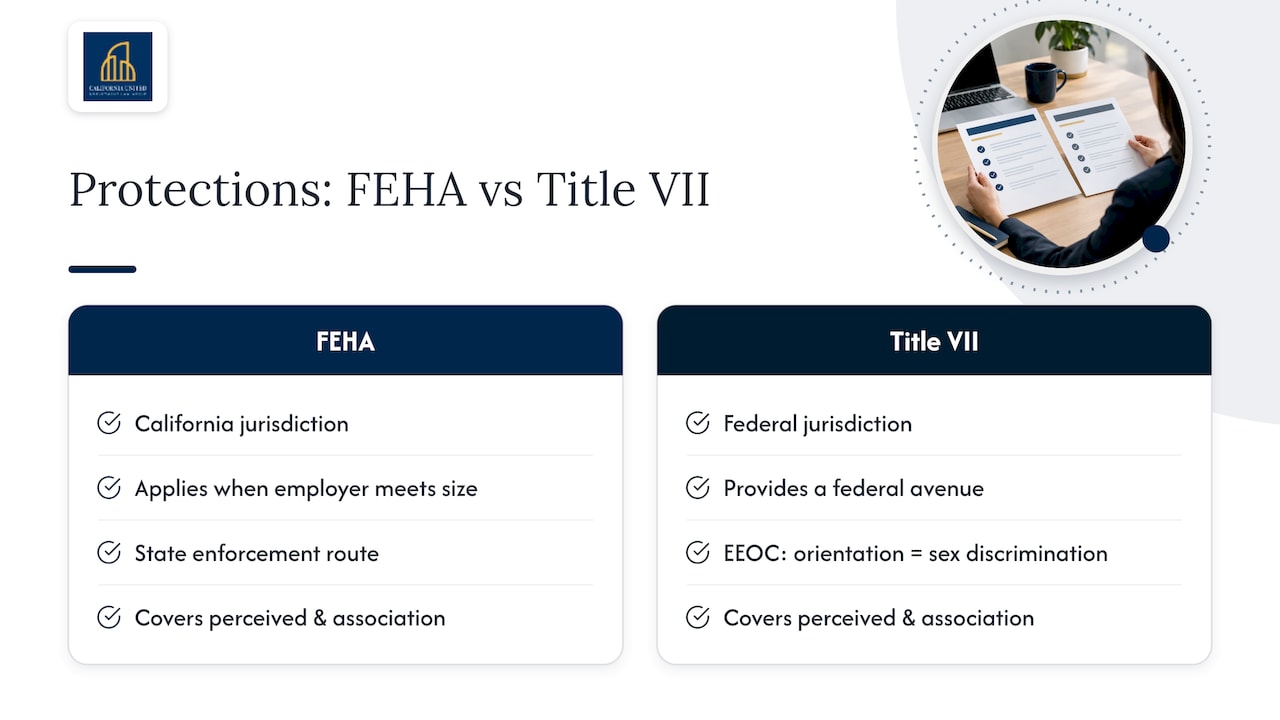
California’s FEHA prohibits workplace discrimination based on sexual orientation, covering hiring, firing, promotions, pay, and day-to-day treatment on the job. FEHA generally applies to discrimination claims against employers with five or more employees, and its harassment provisions can apply to employers with one or more employees; public-sector rules, religious-entity issues, and other exemptions can affect the analysis.
Federal law reinforces this protection. Title VII bars sex discrimination, and the U.S. Supreme Court has held that an employer violates Title VII by firing an individual for being gay or transgender. EEOC guidance may also be relevant, but the stronger authority to cite is Bostock v. Clayton County, which recognized Title VII protection for gay and transgender employees.
Protection extends beyond an employee’s actual orientation. Actual or perceived sexual orientation can support a FEHA claim, and harassment by supervisors, coworkers, or third parties may be actionable depending on the facts and the employer’s response. That said, not every workplace dispute qualifies. Employer size, public-sector status, religious-entity issues, the identity of the harasser, and the type of conduct alleged can affect which claims and remedies are available. A Pasadena employee’s path often depends on these details as much as on the underlying conduct.
What Sexual Orientation Discrimination Looks Like at Work
Discrimination rarely announces itself with a single clear statement. More often, it shows up as a pattern that becomes obvious only when pieced together. Common forms include:
- Hiring or firing decisions tied to an applicant’s or employee’s actual or perceived orientation, including comments made during interviews or termination meetings.
- Harassing conduct, such as slurs, sexualized jokes, persistent stereotyping, or repeated exclusion from meetings and team activities, when the conduct is severe or pervasive enough to alter workplace conditions or otherwise meets FEHA’s harassment standard.
- Assignment and pay disparities, including being passed over for raises, denied projects, or demoted in ways that track with disclosed or assumed orientation.
- Retaliation, where an employee reports discrimination, opposes unlawful conduct, or participates in an investigation and then faces a materially adverse employment action such as discipline, a significant schedule change, demotion, or termination.
Perceived-orientation cases deserve particular attention. An employee does not have to be correctly identified to experience unlawful treatment. If coworkers or a supervisor act on an assumption, even a mistaken one, the resulting harassment or adverse action can still support a claim under the same legal framework. Our guide to hostile work environment standards for Pasadena employees walks through how these patterns are evaluated in more detail.
Preserving Evidence Before Memories Fade
Strong documentation shapes how an administrative agency or attorney evaluates a claim, and most of it needs to be gathered while details are still fresh.
- Log each incident as it happens, noting the date, time, location, who was present, and exactly what was said or done.
- Save written communication, including emails, text messages, and any screenshots that capture discriminatory remarks or decisions. Do not secretly access, copy, or forward confidential employer files or privileged communications; preserve only materials you can lawfully access.
- Collect your employment records, such as performance reviews, pay history, and the employee handbook or relevant workplace policies.
- Keep copies of complaints and responses, including anything you submitted to HR, their written reply, and any disciplinary memos that followed.
Pro Tip: Create a timestamped incident log in a single document, and next to each entry note why it felt discriminatory and whether it affected your duties, schedule, or pay. That context often matters as much as the incident itself.
Filing a Claim: Internal Reports, FEHA, and the EEOC
Many claims start with an internal report to HR, which can create a record of notice to the employer and may help resolve the issue, but internal reporting is not always legally required and does not by itself preserve administrative filing deadlines. California employees may file an administrative complaint with the California Civil Rights Department, and some employees may request an immediate right-to-sue notice if they intend to proceed in court. A parallel option exists at the federal level. Filing with the EEOC may preserve Title VII rights, and CRD and EEOC filings are often coordinated through work-sharing procedures, but employees should confirm that the correct agency, claims, parties, and deadlines are covered. FEHA claims generally require a CRD filing within three years of the alleged unlawful practice, with limited exceptions, and a civil lawsuit generally must be filed within one year after the right-to-sue notice; federal Title VII deadlines may be shorter.
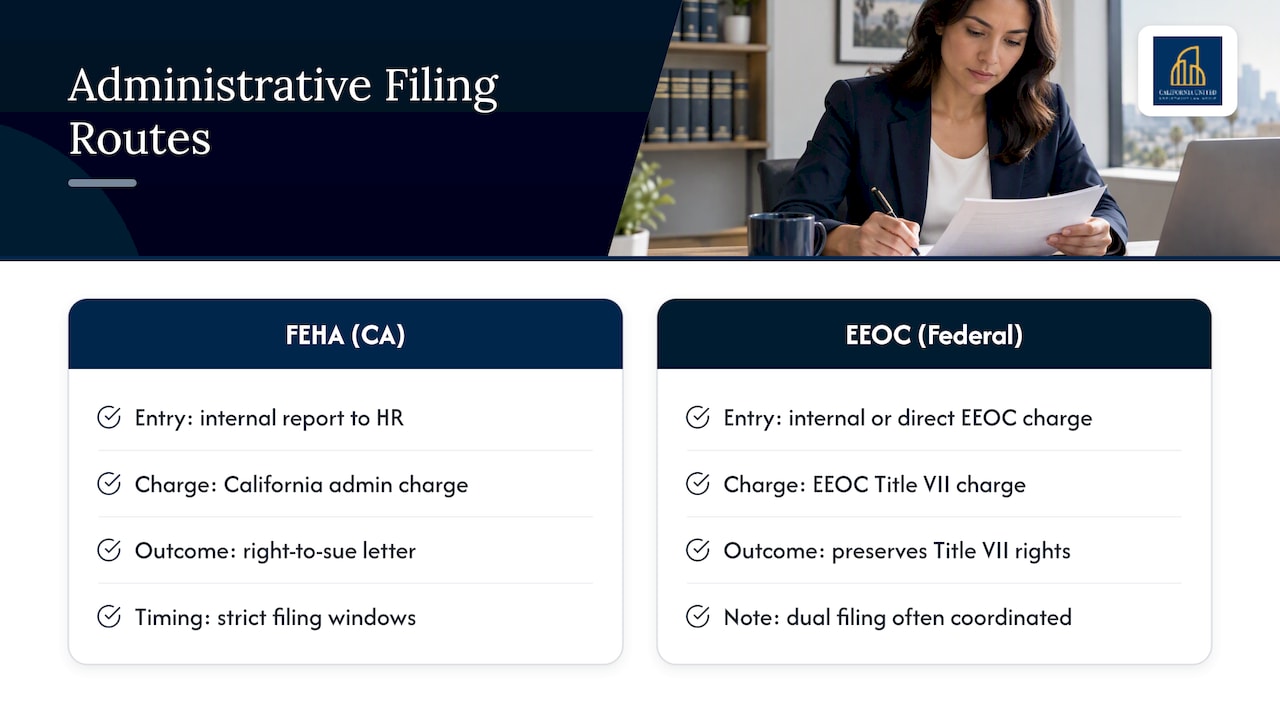
Because these timelines are fact-specific and the administrative prerequisites differ depending on which claims you pursue, we recommend treating any suspected discrimination as time-sensitive from the moment it occurs. Our overview of FEHA deadlines and evidence to preserve covers related timing considerations for Pasadena employees facing termination.
How Liability and Remedies Are Determined
California case law draws a meaningful distinction between harassment by a supervisor and harassment by a coworker. Under FEHA, employers are strictly liable for harassment by supervisors. When a coworker is responsible, liability generally turns on whether the employer knew, or should have known, about the conduct and failed to take appropriate corrective action. Hope v. California Youth Authority, 134 Cal.App.4th 577 (2005), applied FEHA’s sexual-orientation harassment framework and recognized different employer-liability standards depending on whether the harasser was a supervisor or nonsupervisory employee. Bostock v. Clayton County, 590 U.S. 644 (2020), provides the leading federal authority that discrimination against employees for being gay or transgender is discrimination because of sex under Title VII.
If liability is proven, potential remedies may include back pay, front pay, reinstatement, emotional distress damages, injunctive relief, attorney fees, and, in some cases, punitive damages. The strength of these outcomes depends heavily on the quality of the evidence and the credibility of witness testimony, which is part of why early documentation matters so much to how a case ultimately resolves.
When to Consult an Employment Lawyer
Consulting an attorney becomes especially important when evidence is complex, retaliation seems to be developing, a termination has occurred, or a hostile work environment is ongoing without resolution. An attorney can evaluate potential claims, help identify filing deadlines, prepare administrative charges, send preservation letters, and negotiate or litigate when informal resolution fails.
Our employment practice focuses on FEHA, retaliation, wrongful termination, and related California workplace claims for employees from pre-litigation through trial. Jennifer A. Clingo and our team work with Pasadena-area employees navigating discrimination, harassment, retaliation, and wrongful-termination matters.
Local Protections Beyond State and Federal Law
Pasadena employers generally operate within the same California and federal employment-discrimination framework that applies statewide, with FEHA providing core protection against sexual-orientation discrimination. Some city and county government employers maintain their own internal equal employment opportunity policies and human resources procedures that go beyond what state law strictly requires, often including dedicated internal complaint channels or designated compliance officers.
These internal policies do not replace FEHA or Title VII protections. Instead, they typically operate alongside state and federal law, giving an employee at a city agency, for instance, an additional internal avenue to raise a concern before or alongside filing an administrative charge. For many private employers in Pasadena, workplace protections against sexual-orientation discrimination come primarily from FEHA, Title VII when applicable, and any internal policies the employer has adopted in its handbook or code of conduct.
Because local ordinance coverage can vary and is often narrower than state protections, the most reliable approach is to treat FEHA as the governing standard and check your specific employer’s policies, whether public or private, for any additional internal reporting requirements. An employee handbook or HR policy manual is usually the fastest way to confirm whether an employer has adopted procedures beyond what the state requires.
Local Resources for Support and Guidance
Pasadena employees facing sexual orientation discrimination are not limited to legal action alone. Several categories of local and regional resources can provide support, information, or informal mediation while a situation is unfolding.
Community-based LGBTQ advocacy organizations operating in the greater Los Angeles region often provide informational resources, referrals, and sometimes direct advocacy for workers experiencing discrimination. Legal aid organizations serving the San Gabriel Valley, where Pasadena sits, can offer intake screening for employees who may not yet be ready to retain private counsel, helping them understand whether their situation fits within FEHA’s protections.
The California Civil Rights Department, the state agency that processes FEHA charges, also maintains public information about the filing process and can answer procedural questions directly. Because contact details and intake procedures for these organizations change periodically, we recommend checking directly with each organization before relying on older contact information found elsewhere online.
For employees who want to understand how a specific incident fits into the broader discrimination framework before contacting an outside organization, our article on sexual orientation discrimination rights under California law offers additional context that applies statewide.
Requesting Workplace Changes Related to Sexual Orientation or Gender Identity
Employees navigating sexual-orientation or gender-identity issues at work may need practical workplace changes rather than, or in addition to, a discrimination claim. This might include a request to use a particular name or pronoun in internal systems, access to facilities consistent with gender identity, or consistent application of dress-code policies.
The most effective first step is usually a direct, written request to HR or a supervisor describing the accommodation needed and why. Putting the request in writing, even a simple email, creates a record that the employer was on notice, which matters if the request is denied and later becomes part of a broader discrimination or retaliation claim. Employers covered by FEHA should respond carefully to requests connected to protected characteristics, but the legal duties and available remedies depend on the specific request, workplace, and claim involved.
If a workplace-change request tied to sexual orientation, gender identity, or gender expression is denied or ignored, the denial may become relevant evidence if it appears inconsistent with how similar requests were handled. Documenting the request, the response, and any stated justification follows the same preservation principles that apply to discrimination evidence generally.
Effects on Benefits and Workplace Culture
Sexual orientation discrimination, even when it falls short of a formal adverse action like termination, can affect an employee’s day-to-day experience in ways that ripple into benefits and workplace culture. An employee excluded from informal mentorship networks or passed over for stretch assignments may see slower advancement, which can affect eligibility for certain benefit tiers tied to tenure or performance ratings.
Pasadena’s employer base includes a mix of government offices, hospitals, research institutions, and small businesses, and workplace culture around LGBTQ inclusion varies accordingly. Some employers maintain explicit nondiscrimination policies addressing domestic partner benefits, gender-affirming health coverage, names, pronouns, dress codes, or facility access, while others rely on baseline legal requirements and general handbook policies. Reviewing your own employer’s benefits documentation and employee handbook is the most direct way to understand what protections and accommodations are already built into your specific workplace, rather than assuming a citywide standard applies uniformly.
What Tends to Separate Strong Claims From Weak Ones
Claims are often easier to evaluate when they include contemporaneous documentation, timely reporting where appropriate, and witnesses or records that corroborate what happened. Cases without those elements may still be viable, but they often require closer factual analysis and may depend more heavily on credibility assessments.
Expect administrative processing, possible settlement discussions, and, for some claims, eventual litigation. This article is educational only and does not substitute for individualized legal advice, since employment law outcomes are fact-specific and vary case by case.
— California United Law Group
Talk to Our Pasadena Employment Team
If you believe you have experienced sexual-orientation discrimination at a Pasadena workplace, we offer free consultations to help you understand your options. If we accept your case on a contingency-fee basis, attorney fees are paid from a recovery; clients may still be responsible for certain costs depending on the fee agreement. You can review our employment law practice areas or contact our team to discuss what happened and what options may be available.
This article is general information, not a substitute for advice from a qualified lawyer. Consult a qualified legal professional about your own circumstances before acting on anything here.
FAQ
Is discrimination based on sexual orientation illegal?
Yes. Sexual-orientation discrimination is prohibited by FEHA, and Title VII also protects employees from discrimination for being gay or transgender under Bostock v. Clayton County. Coverage can depend on employer size and the specific facts involved.
Can a job legally ask about your sexual orientation?
Employers should generally avoid asking about sexual orientation during hiring or employment. A question may become legally significant if the employer uses the answer, or assumptions about the answer, in hiring, firing, promotion, pay, discipline, assignments, or other workplace decisions.
What is an example of sexual orientation discrimination at work?
Examples may include being denied a promotion after a supervisor learns of your orientation, facing derogatory comments or slurs tied to sexual orientation, or being terminated after disclosing your orientation when the employer’s stated reason is unsupported or inconsistent. Retaliation after reporting or opposing discrimination may also support a separate claim.
Is it legal to discriminate based on gender?
No. FEHA prohibits discrimination based on sex, gender, gender identity, gender expression, and sexual orientation. Title VII also prohibits sex discrimination, including discrimination against employees for being gay or transgender under Bostock v. Clayton County.
How long do I have to file a discrimination claim in California?
FEHA claims generally require filing with the California Civil Rights Department within three years of the alleged unlawful practice, with limited exceptions. A civil lawsuit generally must be filed within one year after a right-to-sue notice. Title VII deadlines may be shorter, so employees should act promptly and confirm the deadline that applies.
Sources
- Hope v. California Youth Authority, Court of Appeal (2005)
- Title VII of the Civil Rights Act of 1964 | U.S. Equal Employment Opportunity Commission
- Bostock v. Clayton County, 590 U.S. 644 (2020)
- California Fair Employment and Housing Act, Government Code section 12940
- California Civil Rights Department, Employment Discrimination Complaint Process