
Yes. Pasadena employees may have disability discrimination rights under California’s Fair Employment and Housing Act (FEHA), the federal Americans with Disabilities Act (ADA), or both, depending on employer size, the worker’s condition, and the facts of the employer’s conduct. If you believe you were fired, demoted, harassed, or denied accommodation because of a disability, start preserving emails, texts, and performance records now, and consider contacting the California Civil Rights Department or an employment attorney before any filing deadline passes.
TL;DR:
- Pasadena employees must understand that FEHA covers workplaces with five or more employees, potentially offering broader protections than the federal ADA, which applies to employers with 15 or more employees.
- Discrimination often appears in subtle forms, such as adverse actions shortly after disability disclosure or policies that disproportionately impact employees managing chronic conditions.
- Employers are required to engage in a good-faith, ongoing interactive process to provide reasonable accommodations unless it causes undue hardship, which must be clearly demonstrated.
- Filing deadlines are strict. Under FEHA, employees generally must file with the California Civil Rights Department within three years of the unlawful practice and file a civil lawsuit within one year after the CRD issues a Right-to-Sue notice. ADA deadlines follow a separate federal administrative process, so employees should act quickly and confirm the applicable deadline before relying on either system.
- Preserving written evidence such as emails, accommodation requests, performance reviews, and witness contact information is crucial to building a strong discrimination claim.
Table of Contents
- Which Laws Protect Pasadena Employees From Disability Discrimination?
- What Counts as Disability Discrimination in Pasadena Workplaces?
- How Do Reasonable Accommodations and the Interactive Process Work?
- Filing a Disability Discrimination Complaint: Deadlines and Process
- What Evidence Should You Preserve for a Discrimination Claim?
- When Should You Consult an Employment Attorney?
- A Practical Perspective for Pasadena Employees Weighing a Claim
- How California United Law Group Can Help
- Sources
- FAQ
Which Laws Protect Pasadena Employees From Disability Discrimination?
Two separate legal systems cover disability discrimination in Pasadena, and they don’t always overlap the way people expect. Understanding both matters because California’s law tends to reach further than federal law does.
FEHA is the state statute, and it generally offers broader protection than the ADA for workers in Pasadena and across California. FEHA covers a wider range of conditions, applies to smaller employers, and often provides broader reasonable-accommodation protections than the ADA. The California Attorney General’s guidance on disability rights confirms that state-law options often extend beyond what federal claims allow.
The size of your employer changes which laws apply to your situation:
- FEHA generally applies to employers with five or more employees, a threshold that pulls most small and mid-size Pasadena businesses into coverage.
- ADA protections, enforced by the U.S. Equal Employment Opportunity Commission, generally kick in only for employers with 15 or more employees, per the ADA’s introductory overview.
- A worker at a 10-person Pasadena firm might have a viable FEHA claim with no ADA claim available at all.
Both laws define disability broadly enough to cover more than obvious physical impairments. Protected categories typically include:
- Physical conditions that limit a major life activity, such as mobility impairments, chronic pain conditions, or vision and hearing loss.
- Mental health conditions, including anxiety, depression, and PTSD, when they meet the applicable legal definition of disability. Under FEHA, the limitation standard is broader than the ADA’s traditional “substantial limitation” phrasing.
- A perceived disability, meaning the employer treated the worker as having a physical or mental condition that limits a major life activity, even if the employer was mistaken. Temporary conditions may qualify depending on severity, duration, and the applicable law.
- A history of disability, such as a past cancer diagnosis or a completed medical leave, even after full recovery.
Knowing which statute governs your case shapes everything that follows, from the accommodation standard your employer must meet to the deadline for filing.
What Counts as Disability Discrimination in Pasadena Workplaces?
Disability discrimination rarely announces itself. It usually shows up wrapped in a performance review, a hiring decision, or a policy that sounds neutral on paper but lands hard on one employee. Here’s how it tends to play out in practice.
- Termination shortly after disclosure. An employee tells HR about a newly diagnosed condition, requests minor scheduling flexibility, and is let go within weeks, often for a vague or shifting reason like “restructuring” or “performance concerns” that weren’t raised before the disclosure.
- Denied promotion tied to disability assumptions. A qualified employee with a visible mobility impairment is passed over for a role a manager assumes requires physical stamina the employee never actually needs to perform.
- Refusal to engage on an accommodation request. An employee with a documented condition asks for a modified schedule or ergonomic equipment, and the request is ignored, delayed indefinitely, or denied without any real evaluation.
- Harassment tied to a disability. Repeated comments about someone’s medication, mobility aid, or mental health, especially from a supervisor, that create a hostile or demeaning environment.
- Neutral policy with discriminatory effect. A strict attendance policy that penalizes intermittent absences may look even-handed, but if it disproportionately punishes employees managing a chronic condition without considering accommodation, it can still support a claim.
The distinction between a neutral policy applied unfairly and outright refusal to accommodate matters legally. The first often requires showing disparate impact; the second is usually a more direct failure-to-accommodate claim. Either way, the pattern that tends to matter most is timing: adverse action that follows closely after a disability becomes known to the employer.
California cases also caution that disability discrimination claims often turn on practical workplace questions, not just pretext. In Wallace v. County of Stanislaus, the court explained that disability cases may focus on whether the employee could perform essential job functions, whether reasonable accommodations would have allowed the employee to do so, and whether accommodation would impose undue hardship. In Green v. State of California, the California Supreme Court held that a FEHA disability discrimination plaintiff must prove the ability to perform essential job duties with or without reasonable accommodation.
How Do Reasonable Accommodations and the Interactive Process Work?
Once an employer knows about a disability and the need for accommodation, California law may require more than sympathy. It requires action, specifically a good-faith effort to figure out what will let the employee keep doing the job.
A reasonable accommodation is an adjustment that allows a qualified employee to perform essential job functions or enjoy equal employment benefits and privileges, unless it would impose an undue hardship on the employer. Common examples include:
- A modified or flexible work schedule to accommodate medical appointments or symptom flare-ups.
- Additional unpaid leave beyond standard policy, when medically supported.
- Assistive equipment, such as ergonomic chairs, screen readers, or modified workstations.
- Remote work, where the role’s core duties don’t require physical presence.
- Reassignment to a vacant position when the current role can’t reasonably be modified.
The California Civil Rights Department’s accommodation guidance makes clear that employers must provide reasonable accommodation unless doing so causes undue hardship, and that obligation comes bundled with a separate duty: the interactive process.
This process is a two-way conversation, not a form to fill out once and forget. The CalHR Reasonable Accommodation Best Practices guidance describes it as an ongoing, individualized dialogue where the employer and employee assess options together, rather than the employer unilaterally deciding what’s workable. Good-faith participation looks like timely responses, real consideration of alternatives, and documentation showing the employer actually engaged rather than stalled. The employer does not always have to provide the exact accommodation the employee prefers if another reasonable accommodation is effective and selected in good faith.
Employers can request medical documentation, but that request has limits. They may ask for information confirming the functional limitation and the need for accommodation. They generally should not demand broad medical history or unrelated diagnosis details when narrower documentation would confirm the functional limitation and need for accommodation.
Pro Tip: Put every accommodation request in writing, even if you already discussed it verbally with a supervisor. A dated email creates a record that’s far harder for an employer to dispute later than a hallway conversation.
Undue hardship is a real defense, but it requires more than an employer’s preference. It typically involves a genuine showing of significant expense or operational disruption relative to the size and resources of the business.
Filing a Disability Discrimination Complaint: Deadlines and Process
Before suing in court on a FEHA claim, California generally requires the employee to exhaust the administrative process first by filing with the CRD. Skipping that step can bar a FEHA lawsuit.
The process generally works like this:
- CRD intake: File with the California Civil Rights Department as the initial administrative step. FEHA claims generally must be filed with CRD within three years from the date the unlawful practice occurred, subject to limited exceptions.
- Right-to-Sue notice: CRD may issue a Right-to-Sue notice, including an immediate notice when the employee requests one through the CRD process. The CRD’s official instructions for obtaining a Right-to-Sue notice describe the procedural steps.
- One-year window to sue: A FEHA civil action generally must be filed within one year after CRD issues the Right-to-Sue notice. This overview does not substitute for legal advice about your specific deadline.
- EEOC filing for ADA claims: If your claim rests on federal ADA protections, particularly relevant when your employer has 15 or more employees, filing with the EEOC may be the appropriate path, and the ADA explains how that federal enforcement structure works.
Many employees file with CRD and let the agency cross-file with the EEOC when both statutes potentially apply, which preserves rights under both without duplicating paperwork. The right path depends heavily on your employer’s size and the specific conduct at issue, which is exactly the kind of fact-specific question worth discussing with someone who reviews these deadlines regularly.
What Evidence Should You Preserve for a Discrimination Claim?
Documentation often plays a major role in disability discrimination claims. Memory fades, but a dated email doesn’t, and the difference between a strong case and a weak one often comes down to what an employee saved before things escalated.
Start collecting and preserving:
- Emails and texts related to your condition, any accommodation request, and your employer’s response.
- Written accommodation requests and any denial, delay, or non-response from HR or management.
- Performance reviews, especially any that shifted noticeably after your disability became known.
- HR notes or meeting summaries, if you have access to them.
- Pay records and staffing changes around the time of the disputed conduct.
- Names and contact information for coworkers who witnessed relevant events.
Keep a simple factual log as events unfold. Note the date, what happened, and who was involved, in plain language, without editorializing. This kind of contemporaneous record tends to carry more weight than a reconstructed account written months later.
Disability affects a significant share of the population, a point the CDC’s data on disability prevalence makes clear, which is part of why these protections exist at scale rather than as a narrow exception.
Be selective about medical disclosures. Share only what your employer actually requested and what’s relevant to the functional limitation at issue. Dated accommodation requests and written HR responses are often among the most valuable pieces of evidence, because they establish exactly when the employer knew and how it reacted. For related guidance on preserving evidence in a broader workplace dispute, see how to document workplace harassment in California.
When Should You Consult an Employment Attorney?
Not every workplace disagreement needs a lawyer, but certain situations tend to benefit from one early rather than after the record has already gone cold. Termination that follows an accommodation request, retaliation after you’ve reported a problem, or a claim involving significant lost wages and complicated damages are the kinds of cases where early legal guidance may help protect deadlines, frame the issues, and avoid mistakes in the administrative process.
Employment attorneys typically assist with case evaluations, administrative filings with CRD or the EEOC, and litigation when a case doesn’t resolve earlier. Many employment firms use contingency fee arrangements, meaning attorney’s fees are owed only if the case resolves successfully, depending on the fee agreement. Clients should confirm whether they may be responsible for litigation costs or expenses.
Tight statutory deadlines are another reason to act sooner rather than later. Once the three-year CRD intake window or the one-year Right-to-Sue window starts running, there’s little room for error. For Pasadena workers specifically, resources focused on Pasadena employment law representation can clarify what local filing realities look like in practice.
A Practical Perspective for Pasadena Employees Weighing a Claim
Every disability discrimination case turns on its own facts, and outcomes vary even between cases that look similar on paper. That’s not a discouraging statement. It’s a reason to focus on what you can control: preserving evidence and watching the clock.
Reporting internally to HR or an EEO officer is often a reasonable first step, but it doesn’t pause the CRD’s three-year deadline. If your employer denies your accommodation request outright, delays it for months, or retaliates after you raise a concern, that’s typically the signal to escalate toward an agency filing or a consultation with counsel.
— California United Law Group
How California United Law Group Can Help
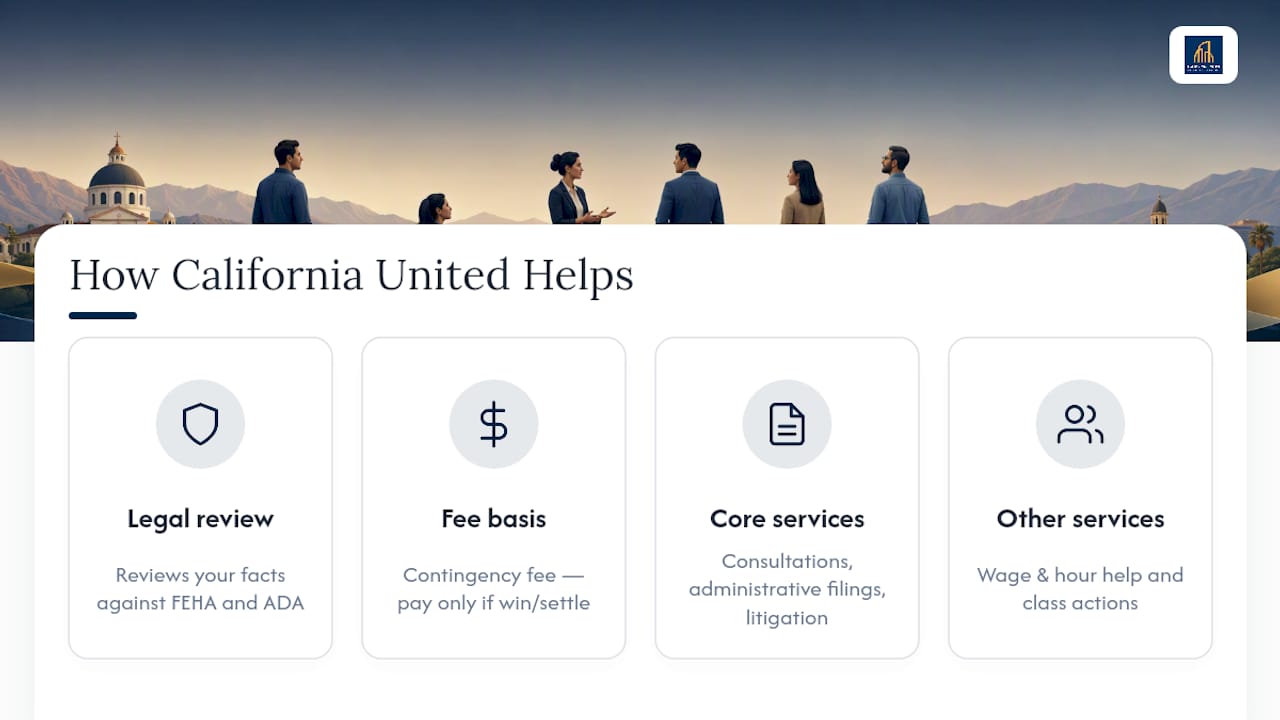
California United Law Group is a direct option for Pasadena employees who suspect disability discrimination but aren’t sure whether their situation meets the legal threshold. Unlike piecing together guidance from agency websites and forum posts, working with attorneys who handle California employment law matters means someone can review your specific facts against FEHA and ADA standards from the start, not after a deadline has already slipped by.
The firm handles disability discrimination and related employment law matters for California workers, including consultations, administrative filings, and litigation when needed, often on a contingency fee basis, depending on the case and fee agreement. Ask during the consultation whether you may be responsible for any costs or expenses. Michelle Rapoport and the team also support workers dealing with unpaid wages through the firm’s wage and hour services and broader workplace disputes through class action representation when multiple employees are affected by the same practice.
If you’re in Pasadena and weighing whether your situation warrants a formal complaint, schedule a consultation to get a clear read on your options before any filing deadline arrives.
This article is general information, not a substitute for advice from a qualified lawyer. Consult a qualified legal professional about your own circumstances before acting on anything here.
Sources
FAQ
What Is Considered Disability Discrimination in the Workplace?
Disability discrimination includes firing, demoting, harassing, or refusing to accommodate an employee because of a physical or mental condition, a perceived disability, or a history of one. In Pasadena and across California, FEHA and the ADA both prohibit these actions when the employer meets the applicable size threshold.
How Hard Is It to Prove Disability Discrimination?
Difficulty varies by case, since proof often depends on timing, documentation, and whether the employer engaged in the interactive process in good faith. Cases with clear written accommodation requests and a documented denial or close-in-time retaliation may be easier to evaluate than cases resting only on subtle patterns.
Can You Give an Example of Disability Discrimination in the Workplace?
A common example is an employee disclosing a chronic health condition, requesting a minor schedule adjustment, and then being terminated within weeks for a vague performance reason that was never mentioned before the disclosure. Refusing to respond to a written accommodation request is another frequent pattern.
Can I Sue My Employer for Not Accommodating My Disability?
Yes, failure to provide reasonable accommodation or failure to engage in the interactive process can support a FEHA claim when the legal elements are met, including disability coverage, employer knowledge, ability to perform essential job duties with reasonable accommodation where required, and completion of the CRD process before filing in court. Deadlines and eligibility depend on your specific facts, so a case-specific review is worth pursuing before assuming any particular outcome.