
El Monte meal period violations occur when an employer fails to provide a legally required, uninterrupted 30-minute meal break within the timeframes set by California Labor Code sections 512 and 226.7. Under California meal break laws, every non-exempt employee working more than five hours in a day is entitled to this break, and failing to provide it triggers a premium pay penalty. If you work in El Monte and suspect your employer is not meeting this obligation, understanding the specific rules and your remedies is the first step toward protecting your wages.
What are the legal meal period requirements for El Monte employees?
California law sets precise standards for meal breaks, and El Monte workers are fully covered by these protections. The core rule is straightforward: meal breaks must be provided before the end of the fifth hour of work, must last at least 30 minutes, and must be completely off-duty and uninterrupted. During this time, your employer must relieve you of all work duties and relinquish control over your activities.
Several specific rules govern how these breaks work in practice:
- First meal break: Required for any shift longer than five hours. Employees and employers may mutually agree to waive this break only if the total shift is six hours or less.
- Second meal break: Shifts over 10 hours require a second 30-minute meal break before the end of the 10th hour. This second break is waivable only if the total workday does not exceed 12 hours and the first meal break was not waived.
- On-duty meal breaks: Allowed only in very limited circumstances, such as when the nature of the work prevents the employee from being relieved, and only with a written agreement that the employee may revoke at any time.
- Rest breaks: Separate from meal breaks, paid 10-minute rest breaks are required for every four hours worked and cannot be waived. Missing a rest break triggers its own separate premium pay penalty.
- Exempt employees: Certain salaried employees classified as exempt under California law are not entitled to these breaks. Misclassification is a separate issue worth examining if your employer claims you are exempt.
The 2026 California minimum wage of $16.90 per hour is the baseline for calculating penalties when violations occur, making compliance more financially significant for employers than in prior years.
How do El Monte meal period violations typically occur?
Recognizing a violation is not always obvious. Employers rarely post a sign saying breaks are denied. Instead, violations tend to emerge from workplace culture, scheduling practices, and production demands. El Monte’s warehouse, logistics, and manufacturing sectors are particularly prone to these patterns.
Here are the most common ways violations happen:
- Automatic payroll deductions. The most frequent litigation trigger is the “automatic deduction” trap where employers deduct 30 minutes from every shift for a meal break without confirming the break was actually taken. If you worked through lunch but your pay stub shows a deduction, that is a violation.
- Production quota pressure. When workloads or deadlines make it practically impossible to step away, the employer has failed its legal duty. Impossible production quotas that prevent employees from taking breaks count as violations even when a written break policy exists.
- Supervisor discouragement. A manager who says “we’re too busy right now” or gives you a disapproving look when you try to take a break is creating an environment that violates the law. The employer’s obligation is to provide a real opportunity to take a break, not just list it in an employee handbook.
- Understaffing. When a shift is too short-staffed to allow anyone to leave the floor, courts treat that as a failure to provide breaks. Courts have consistently held that failing to relieve employees of all duties due to staffing demands is a violation, even if breaks are nominally scheduled.
- Discipline for taking breaks. Some employers write up or penalize workers who take their legally mandated breaks. Disciplining employees for taking meal breaks is itself a violation and can support a retaliation claim.
Pro Tip: Keep a personal log of your start time, end time, and whether you received each meal break. A simple note in your phone with the date and time takes 10 seconds and becomes powerful evidence if you later file a claim.
What are the penalties for meal period violations in El Monte?

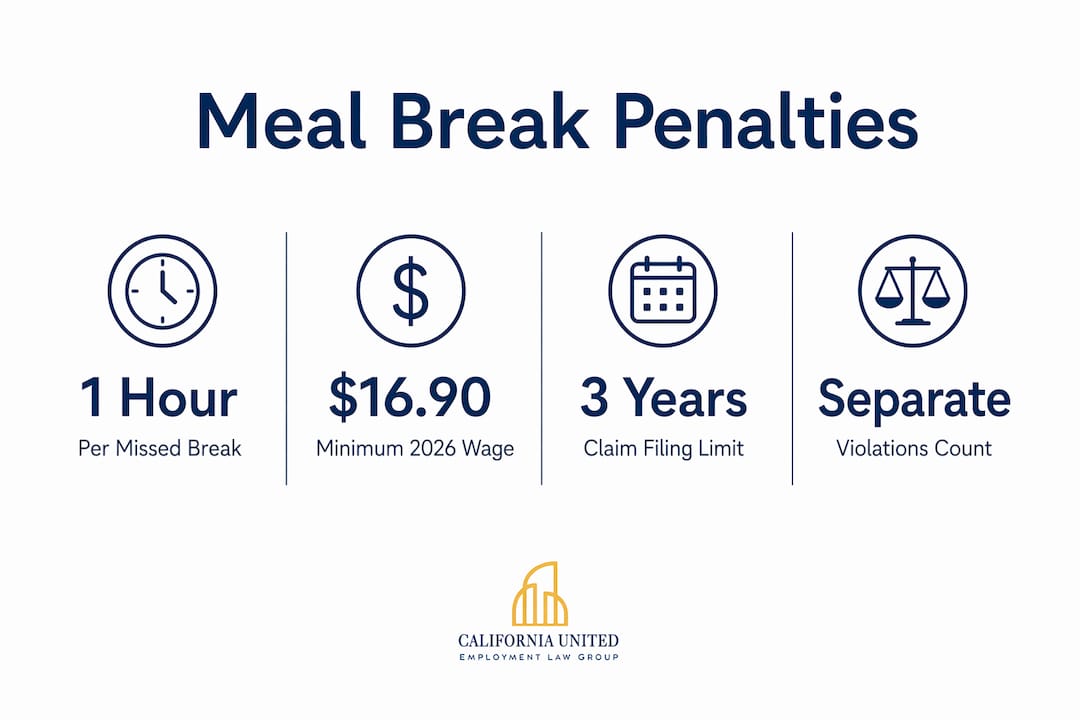
The financial consequences for employers who violate meal break rules are concrete and cumulative. Under California Labor Code section 226.7, employers must pay one additional hour of pay at the employee’s regular rate of pay for each workday a compliant meal break is not provided. This premium pay is classified as wages, not a fine, which means it must appear on your wage statement and be included in your final paycheck.
Here is what the math looks like at the 2026 California minimum wage of $16.90 per hour:
| Scenario | Daily Penalty | Weekly (5 days) | Annual Impact |
|---|---|---|---|
| 1 missed meal break per day | $16.90 | $84.50 | ~$4,394 |
| 1 missed meal break + 1 missed rest break per day | $33.80 | $169.00 | ~$8,788 |
| 2 missed meal breaks per day (10+ hour shifts) | $16.90 | $84.50 | ~$4,394 |
Important: Premium pay for meal break violations is capped at one additional hour of pay per workday, no matter how many meal breaks were missed that day. United Parcel Service, Inc. v. Sup.Ct. (Allen) (2011) 196 Cal.App.4th 57, 69; Lab. Code § 226.7. A second hour of premium pay per day is available only if, in addition to a missed meal break, a required rest break was also not provided — as shown in the second scenario above.
Penalties can accumulate significantly over time, reaching tens of thousands of dollars for repeated daily violations per employee. For workers earning above minimum wage, the penalty is calculated at their actual regular rate of pay — which under California law includes not only the base hourly wage but also nondiscretionary bonuses, commissions, and shift differentials, making the numbers even higher for many El Monte workers.
Several landmark California Supreme Court decisions shape how these rules are enforced in practice. In Brinker Restaurant Corp. v. Superior Court (2012) 53 Cal.4th 1004, the California Supreme Court held that an employer’s duty is to provide a meal period — meaning relieve the employee of all duties and relinquish control — but that employers are not required to police whether an employee actually eats. However, the Court made clear that employers cannot impede or discourage employees from taking breaks; doing so makes the employer fully liable. In Donohue v. AMN Services, LLC (2021) 11 Cal.5th 58, the Court held that employers cannot round employees’ time records to shorten or delay meal periods, and that incomplete or missing time records create a rebuttable presumption that a meal break violation occurred. In Naranjo v. Spectrum Security Services, Inc. (2022) 13 Cal.5th 93, the Court confirmed that meal period premium pay is classified as wages — not penalties — meaning employers who withhold this pay also face wage statement penalties and waiting-time penalties under Labor Code section 203 when the premium is not included in a final paycheck. Finally, in Murphy v. Kenneth Cole Productions, Inc. (2007) 40 Cal.4th 1094, the Court established the three-year statute of limitations applicable to these claims. Together, these decisions give El Monte employees strong, well-established legal footing when asserting their meal break rights.
Premium pay for missed breaks is legally classified as wages under California law. This means your employer cannot simply call it a “penalty” and ignore it on your pay stub. It must be reported, and if your employer willfully refuses to pay it in your final paycheck, waiting-time penalties under Labor Code section 203 may also apply.
Each missed break is a separate violation with its own statute of limitations clock. Employees have three years from the date of each violation to file a claim for unpaid meal period premiums. That three-year window means violations from 2023 onward are still actionable today.
What rights and protections do El Monte employees have?
California law gives employees in El Monte clear rights when meal breaks are denied. Knowing these protections helps you act with confidence rather than uncertainty.
- Right to premium pay. For every workday a compliant meal break is not provided, you are owed one hour of pay at your regular rate. This is a wage you have already earned, and your employer is required to pay it.
- Three-year statute of limitations. You have three years from each individual violation to file a wage claim. Because each missed break is a separate violation, the clock resets with every denied break, giving you a meaningful window to recover unpaid wages.
- Extended recovery under the Unfair Competition Law. In addition to the three-year statute, employees may bring a claim under California’s Unfair Competition Law (Bus. & Prof. Code § 17200), which carries a four-year statute of limitations. This means some violations that are time-barred under the Labor Code may still be actionable as an unfair business practice, potentially expanding the window of recovery. Discuss this option with your attorney to determine whether it applies to your situation.
- Protection from retaliation. California law prohibits employers from retaliating against you for asserting your meal break rights. If you are demoted, disciplined, or terminated after raising a complaint, that action may constitute unlawful retaliation. You can learn more about retaliation protections for wage complaints under California law.
- Right to document your breaks. You are entitled to keep personal records of your hours worked and breaks taken. Your employer cannot prohibit you from tracking your own time.
- Coverage under California law. Most hourly, non-exempt employees in El Monte are covered. Independent contractor misclassification is a separate issue, but if you are treated as an employee in practice, you likely have these rights regardless of how your employer labels your position.
If you work in El Monte’s warehouse or logistics sector, off-the-clock work violations often accompany meal break violations, since both stem from the same pressure to maximize production time. Documenting both types of violations together strengthens any claim you bring.
Key Takeaways
El Monte meal period violations are wage violations under California Labor Code sections 512 and 226.7, and every missed compliant break entitles you to one hour of premium pay at your regular rate.
| Point | Details |
|---|---|
| Legal timing requirement | Meal breaks must be provided before the end of the fifth hour of work, every workday. |
| Premium pay is a wage | Each missed break earns you one hour of pay at your regular rate, reportable on your wage statement. |
| Violations accumulate fast | At $16.90/hour in 2026, one missed break per day adds up to over $4,000 annually per employee. |
| Three-year claim window | Each missed break restarts its own three-year statute of limitations for filing a wage claim. |
| Retaliation is prohibited | California law protects you from discipline or termination for asserting your meal break rights. |
What I’ve Seen Working With El Monte Employees On Meal Break Claims
Working with employees in El Monte and across the San Gabriel Valley, I’ve noticed one pattern that surprises people every time: the workers most likely to have strong claims are often the ones who assumed their situation was normal. They worked through lunch for months, saw their pay stub show a deduction, and figured that was just how it worked. It is not.
The “automatic deduction” issue is particularly common in warehouse and distribution environments, where shift supervisors are measured on throughput, not compliance. The written policy says breaks are provided. The reality on the floor is something different. Courts look at what actually happened, not what the handbook says.
I also want to address a common misunderstanding. Many employees believe that because they “chose” to work through lunch, they cannot file a claim. California law places the obligation on the employer, not the employee. If your employer did not provide a real, uninterrupted opportunity to take a break, the violation belongs to them regardless of whether you personally skipped the break.
If you are unsure whether what happened to you qualifies, the most practical step is to gather your records, note the dates and circumstances, and speak with an employment attorney who handles wage and hour disputes in California. You do not need a perfect case to start a conversation.
How California United Law Group Can Help El Monte Employees
If you believe your meal break rights have been violated, you do not have to figure this out alone.
California United Law Group represents California employees in wage and hour disputes, including meal period violation claims in El Monte and throughout Los Angeles County. The firm handles cases at every stage, from initial consultations through litigation, and focuses exclusively on employee-side California Labor Code claims.
Whether you are dealing with automatic deductions, supervisor pressure, or a pattern of denied breaks, understanding your options starts with a conversation. Visit California United Law Group’s employment law services page to learn more about how the firm supports workers facing wage violations. You can also explore the firm’s dedicated El Monte employment law resources for location-specific guidance.
FAQ
What counts as a meal period violation in California?
A meal period violation occurs when an employer fails to provide a 30-minute, uninterrupted, off-duty break before the end of the fifth hour of work. Automatic payroll deductions for breaks not actually taken also qualify as violations.
How much is the penalty for a missed meal break in El Monte?
The penalty is one hour of pay at the employee’s regular rate for each workday a compliant break is not provided. At the 2026 California minimum wage of $16.90, that is $16.90 per missed break, per day.
How long do I have to file a meal break claim in California?
You have three years from the date of each individual violation to file a wage claim. Because each missed break is treated as a separate violation, the three-year window applies independently to each occurrence.
Can my employer retaliate against me for reporting meal break violations?
No. California law prohibits retaliation against employees who assert their meal period rights. Discipline, demotion, or termination in response to a complaint may constitute unlawful retaliation under the California Labor Code.
Does the meal break rule apply if I agreed to skip my break?
A waiver is only valid for shifts of six hours or less, by the mutual and knowing consent of both the employer and employee. For longer shifts, the break cannot be waived, and any informal understanding to skip it does not eliminate the employer’s legal obligation or your right to premium pay. For longer shifts, the break cannot be waived, and any agreement to skip it does not eliminate the employer’s legal obligation or your right to premium pay.
Recommended
- Monterey Park Wage Complaint Rights: Understanding California’s Strong Retaliation Protections in 2026 – California United Law Group
- Off-the-clock work in El Monte warehouses: Know your rights – California United Law Group
- Long Beach Retail Meal Break Violations – Worker Rights – California United Law Group