
TL;DR:
- California law explicitly protects workers from ancestry discrimination, separate from race.
- Even a single severe incident of harassment can be grounds for a hostile work environment claim under FEHA, and a single discriminatory adverse employment action can be enough for a disparate treatment claim.
- Filing within three years and documenting evidence are crucial steps to pursue legal action.
Many workers assume that only “race” is a protected category under employment law. That assumption is wrong, and it costs people real money and real justice. California’s Fair Employment and Housing Act, known as FEHA, explicitly lists ancestry as a protected class, separate from race and national origin. If you work in Monterey Park and your employer has treated you unfairly because of your ancestry, you may have a strong legal claim. This guide covers who is protected, what discrimination actually looks like, how to file a claim, and what you can recover.
Table of Contents
- Who is protected: California law and Monterey Park workers
- What counts as ancestry discrimination on the job?
- Filing a claim: Monterey Park workers’ step-by-step guide
- What you can win: Remedies, damages, and retaliation protection
- Common missteps and overlooked strategies in ancestry discrimination cases
- Connect with Monterey Park employment law experts
- Frequently asked questions
Key Takeaways
| Point | Details |
|---|---|
| Ancestry discrimination is illegal | FEHA makes it unlawful for Monterey Park employers to discriminate or harass employees based on ancestry. A single severe act of harassment may support a hostile work environment claim, and a single discriminatory adverse action may support a disparate treatment claim. |
| Strict filing deadlines | You must file a claim with the Civil Rights Department within three years to preserve your right to sue. |
| Strong retaliation protections | California law prohibits employers from punishing you for reporting ancestry discrimination. |
| Broad remedies available | Winning a claim can yield lost wages, emotional distress damages, attorney fees, and punitive damages. |
Who is protected: California law and Monterey Park workers
Now that you know this is about more than just race, let’s define exactly who is protected and how the law applies to Monterey Park workers.
California’s FEHA is one of the strongest workplace anti-discrimination laws in the country. It covers a wide range of protected characteristics, and ancestry is explicitly one of them. This matters because ancestry and race are legally distinct. Your ancestry refers to your ethnic lineage or heritage, such as being of Chinese, Armenian, Mexican, or Filipino descent. Race is a broader biological or social classification. Both are protected, but they are not the same.
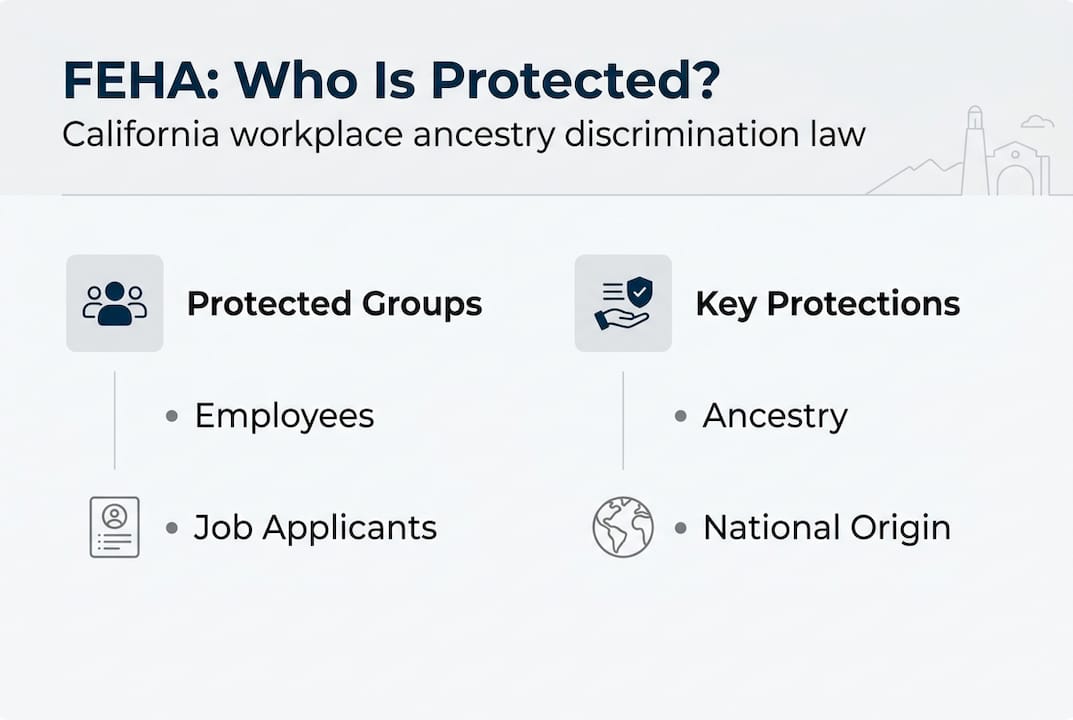
If you work in Monterey Park, you are covered by California state law. There is no separate local ordinance that limits or overrides these protections. The California Civil Rights Department workplace poster confirms that FEHA applies statewide to employers with 5 or more employees, with ancestry explicitly listed as a protected class. This threshold is broader than federal law, which generally requires 15 or more employees.
If you need Monterey Park employment discrimination help, understanding this coverage threshold is the first step.
“Ancestry is a protected characteristic under California law. Employers may not discriminate, harass, or retaliate against employees based on ancestry.” — California Civil Rights Department
Other protected characteristics under FEHA include:
- Race and color
- National origin
- Religion
- Sex and gender identity
- Age (40 and over)
- Disability
- Sexual orientation
- Marital status
- Military and veteran status
One common misconception is that ancestry and national origin are the same thing. They are related but legally distinct. National origin refers to the country where you or your family came from. Ancestry goes deeper, covering your ethnic lineage regardless of national borders. For example, a person of Cantonese ancestry may have been born in the United States, making national origin claims less straightforward. But an ancestry claim can still apply. Understanding the difference matters when you build your case. You can learn more about national origin discrimination rules to see how these two protections work together.
What counts as ancestry discrimination on the job?
Knowing you’re protected is one thing. Understanding what discrimination looks like in real situations is another.
Ancestry discrimination can be obvious or surprisingly subtle. Employers rarely announce biased motives. Instead, discrimination often shows up in patterns of behavior, coded language, or decisions that seem neutral on the surface but disproportionately harm workers of a specific heritage.

Ancestry discrimination covers disparate treatment, disparate impact, harassment, and even employer misperceptions about a worker’s background.
Situations that may be illegal but often go unnoticed:
- Being passed over for promotion while less qualified coworkers of a different heritage advance
- Receiving harsher discipline than colleagues for the same behavior
- Being assigned worse shifts, territories, or tasks based on your background
- Hearing ethnic slurs, even if framed as “jokes”
- Being excluded from meetings, training, or opportunities
- Facing pressure to change your name, accent, or cultural practices
| Clear discrimination | Subtle discrimination |
|---|---|
| Direct ethnic slurs from a manager | Being told you’re “not a cultural fit” |
| Fired after disclosing ethnic heritage | Consistently lower performance scores without explanation |
| Denied a job because of a foreign-sounding name | Excluded from informal networking events |
| Harassed about cultural dress or religious practices | Assigned only low-visibility projects |
It also matters that FEHA protects you even if your employer perceives your ancestry incorrectly. If a manager assumes you are of a certain heritage and discriminates based on that assumption, you still have a valid claim, even if the assumption was wrong.
There are three main legal theories to understand. Disparate treatment means your employer treated you differently because of your ancestry. Disparate impact means a neutral policy disproportionately harms workers of a specific ancestry. Harassment means a hostile work environment based on your heritage. You can read more about what counts as workplace harassment and how courts evaluate these claims.
Pro Tip: Under California law, even a single severe incident can support a hostile work environment harassment claim—particularly when committed by a supervisor. For disparate treatment claims, a single discriminatory adverse action, such as a termination or demotion tied to your ancestry, can also be sufficient. You do not necessarily need a long pattern of repeated events. However, the severity and context of the conduct matter. Consult an attorney to assess the strength of your specific facts.
California courts have consistently reinforced these principles. In Dee v. Vintage Petroleum, Inc. (2003) 106 Cal.App.4th 30, 35, the court found that a single ethnic slur by a supervisor was sufficient to illuminate his discriminatory motivation and could, together with other conduct, create an abusive working environment. The California Supreme Court has also confirmed, in Aguilar v. Avis Rent A Car System, Inc. (1999) 21 Cal.4th 121, 132, that “in a civil action under the FEHA, all relief generally available in noncontractual actions…may be obtained,” including injunctive relief to stop ongoing discriminatory conduct. And on the question of punitive damages, Weeks v. Baker & McKenzie (1998) 63 Cal.App.4th 1128, 1147–1148, made clear that California’s punitive damages statute, Civil Code section 3294, applies to FEHA actions—though recovery requires showing that the employer itself acted with oppression, fraud, or malice, not merely that an employee did so.
Filing a claim: Monterey Park workers’ step-by-step guide
Understanding what constitutes discrimination is important, but knowing how to take legal action is what actually protects your rights.
The process for filing an ancestry discrimination claim in California follows a clear sequence. Missing any step, especially the deadlines, can end your case before it begins.
You must file a complaint with the CRD within 3 years of the discriminatory act, receive a right-to-sue letter, and then file in Superior Court if needed.
Step-by-step process:
- Gather your evidence. Collect emails, text messages, performance reviews, witness names, and a written timeline of events.
- File a complaint with the California Civil Rights Department (CRD). This is required before you can sue in court.
- CRD investigates your claim. They may mediate, investigate, or issue a right-to-sue letter.
- Receive your right-to-sue letter. Once issued, you have one year from the date of the notice to file a civil lawsuit in Superior Court. This deadline is strict—missing it bars your court claim.
- File your lawsuit in Superior Court. This is where damages are pursued with legal representation.
What to include in your CRD complaint:
| Element | Details to provide |
|---|---|
| Your identity | Name, contact info, employment details |
| Employer information | Company name, address, number of employees |
| Description of discrimination | Dates, events, witnesses, impact |
| Supporting documents | Emails, performance records, any written communications |
| Requested remedy | What outcome you are seeking |
Pro Tip: File with the CRD even if you are unsure whether your situation qualifies. The deadline is strict, and filing early protects your rights. The investigation process can also surface evidence you may not have access to on your own.
If you are undocumented or a non-citizen, FEHA still protects you. California law does not require citizenship or work authorization to bring a discrimination claim. You also have retaliation protection the moment you file, which means your employer cannot legally punish you for speaking up.
👉 If you are ready to move forward, contact a Monterey Park employment lawyer to review your situation before the deadline passes.
What you can win: Remedies, damages, and retaliation protection
After you file a complaint or lawsuit, here is an overview of the remedies that may be available if you prevail, and how the law protects you from further employer backlash. The specific remedies available in your case will depend on the facts, the legal theories asserted, and the evidence presented.
California’s FEHA gives workers meaningful remedies when discrimination is proven. These are not symbolic. They can significantly impact your financial and professional recovery.
Common remedies available under FEHA:
- Back pay: Wages lost due to wrongful termination, demotion, or missed promotions
- Front pay: Estimated future earnings if reinstatement is not practical
- Emotional distress damages: Compensation for psychological harm caused by discrimination
- Attorney fees and court costs: You may not need to pay legal fees out of pocket if you win
- Punitive damages: Available when the employer itself acted with oppression, fraud, or malice—or authorized, ratified, or had advance knowledge of an employee’s such conduct. These damages are not automatic and require meeting a specific legal standard under California Civil Code section 3294.
- Reinstatement: Return to your job or a comparable position
California discrimination awards have reached six figures in some cases when emotional distress, punitive damages, and lost wages are combined. Results vary significantly depending on the specific facts, evidence, employer conduct, and other case-specific circumstances. Past results in other cases do not guarantee a similar outcome in yours.
Note: In cases where an employer establishes that it would have made the same employment decision regardless of the discriminatory motive—known as a mixed-motive defense—certain remedies such as back pay, reinstatement, and noneconomic damages may be limited or unavailable, even where a FEHA violation is found.
“It is unlawful for an employer to retaliate against an employee for opposing a discriminatory practice, filing a complaint, or participating in an investigation or proceeding.” — California Civil Rights Department
Retaliation protection is automatic once you report discrimination or file a claim. Illegal retaliation includes:
- Firing or laying you off after you file a complaint
- Demoting you or reducing your hours
- Giving you a negative performance review in response to your claim
- Transferring you to a worse position or location
- Creating a hostile environment to pressure you to quit
If retaliation occurs, document it immediately and report it as a separate violation. You can read more about workplace retaliation protections and your specific retaliation rights in Monterey Park to understand your full set of options.
Common missteps and overlooked strategies in ancestry discrimination cases
With the official pathways covered, let’s look at what most people miss, and what actually works in Monterey Park cases.
The single biggest mistake we see is waiting. Workers often assume they need multiple incidents, a clear paper trail, or a direct slur on record before they have a case. That is not how California law works. One severe act can be enough, and the 3-year CRD deadline moves faster than people expect.
The second mistake is relying on HR. Internal HR processes exist to protect the company, not you. An “investigation” that results in no action does not reset your legal deadlines or strengthen your position. Contacting an employment attorney early changes the dynamic entirely.
In Monterey Park specifically, discrimination is sometimes disguised as “cultural fit” concerns or vague “policy violations.” These coded phrases deserve scrutiny. If you notice a pattern where workers of a specific ancestry are consistently flagged for the same issues, that is worth documenting.
Explore local discrimination case strategies to understand how these patterns are identified and used in court.
Pro Tip: Document everything, even if you are unsure whether it matters. A clear, dated timeline of events is one of the most powerful tools in any discrimination case.
Connect with Monterey Park employment law experts
Ready to take the next step, or still have questions about your situation?
If you believe you’ve experienced ancestry discrimination at work, the most important thing you can do right now is talk to someone who knows California employment law. Deadlines are real, and missing them closes doors permanently. At California United Law Group, we represent employees at every stage, from the first conversation through litigation. Our team understands California employment law and the specific challenges workers in Monterey Park face.
👉 Schedule a consultation with a Monterey Park employment lawyer today. We’ll help you understand your rights, evaluate your claim, and guide you through the employment lawsuit process from start to finish. You don’t have to figure this out alone.
The information in this article is for general educational purposes only and does not constitute legal advice or create an attorney-client relationship. Every case is unique, and outcomes depend on the specific facts and circumstances of your situation. Past results do not guarantee future outcomes.
Frequently asked questions
What is the deadline to file an ancestry discrimination claim in Monterey Park?
There are two deadlines you must meet. First, you must file a complaint with the California Civil Rights Department (CRD) within three years of the discriminatory act to preserve your administrative rights. Second, once the CRD issues your right-to-sue notice, you have one year from the date of that notice to file a civil lawsuit in Superior Court. Missing either deadline can permanently bar your claim. Do not wait to consult an attorney.
Does FEHA protect against employer misperceptions of ancestry?
Yes, California law covers perceived ancestry cases, meaning you are protected even if your employer acted on a false assumption about your heritage.
What compensation can I receive if I win an ancestry discrimination lawsuit?
If you prevail, you may be able to recover lost wages (back pay and front pay), emotional distress damages, and potentially attorney fees and court costs. Punitive damages may be available where the employer acted with oppression, fraud, or malice as defined under California Civil Code section 3294—not merely because the conduct was severe. The specific remedies available depend on the facts and theories of your particular case.
Am I protected from retaliation if I file a claim?
Yes, FEHA strictly prohibits retaliation against any worker who reports discrimination or participates in a related investigation or legal proceeding.
Do I need to be a U.S. citizen or documented worker to be protected?
No, FEHA protections apply regardless of your citizenship or immigration status, covering all workers employed in California.