
Many California employees worry that their Alhambra employers systematically violate paystub laws, but the reality is more nuanced. While no evidence shows widespread systematic violations among Alhambra businesses, individual errors do occur and can significantly impact your ability to verify wages, track hours, and protect your employment rights. Understanding California’s strict paystub requirements under Labor Code §226 empowers you to spot violations, document them properly, and take action when your employer fails to provide accurate itemized wage statements. This guide explains your paystub rights, common errors to watch for, penalties employers face, and practical steps to protect yourself.
Table of Contents
- Key takeaways
- Understanding California paystub laws and requirements
- Identifying common paystub errors and potential violations by Alhambra employers
- Penalties for paystub violations and how employees can respond
- How Alhambra employees can protect their rights and get help
- Get expert help with paystub violations in California
- Frequently asked questions about California paystub violations
Key Takeaways
| Point | Details |
|---|---|
| No widespread violations | In Alhambra, there is no evidence of widespread paystub violations, though individual errors still occur. |
| Nine required elements | California Labor Code 226 requires itemized paystubs with nine specific elements. |
| DLSE claims and penalties | Violations carry penalties and allow employees to file claims with DLSE. |
| Document paystubs | Employees should document paystubs and can access free claim resources or seek legal advice. |
| Fix errors quickly | Employers can cure wage statement errors once in 12 months within 33 days to avoid PAGA penalties. |
Understanding California paystub laws and requirements
California Labor Code §226 establishes some of the nation’s strictest paystub requirements to ensure wage transparency and help you verify that you’re paid correctly. California Labor Code §226 requires accurate itemized paystubs semi-monthly or each payday including nine key elements. These requirements protect both hourly and salaried workers from wage theft and payroll errors.
Your employer must provide itemized wage statements containing these nine elements:
- Gross wages earned during the pay period
- Total hours worked (for non-exempt employees only)
- All applicable hourly rates in effect and corresponding hours worked at each rate
- The legal name and physical address of your employer
- Your name and either last four digits of your Social Security number or employee identification number
- Inclusive dates of the pay period
- All deductions itemized separately with clear descriptions
- Net wages earned after all deductions
- Available paid sick leave balance in hours or days
Each element serves a critical purpose for verifying your compensation. Gross wages let you confirm your employer calculated pay correctly based on hours worked and applicable rates. The hours breakdown helps you spot missing overtime or meal period violations. Deduction details ensure your employer isn’t making unauthorized withholdings. The sick leave balance helps you track accrued benefits under California’s paid sick leave law.
California distinguishes between exempt and non-exempt employees for paystub purposes. Non-exempt workers receive hourly pay and must see total hours worked on their paystubs. Exempt employees earn salaries and don’t track hours the same way, but they still deserve accurate paystubs showing gross pay, deductions, and other required elements. Understanding your classification matters because it affects which wage & hour protections apply to your situation.
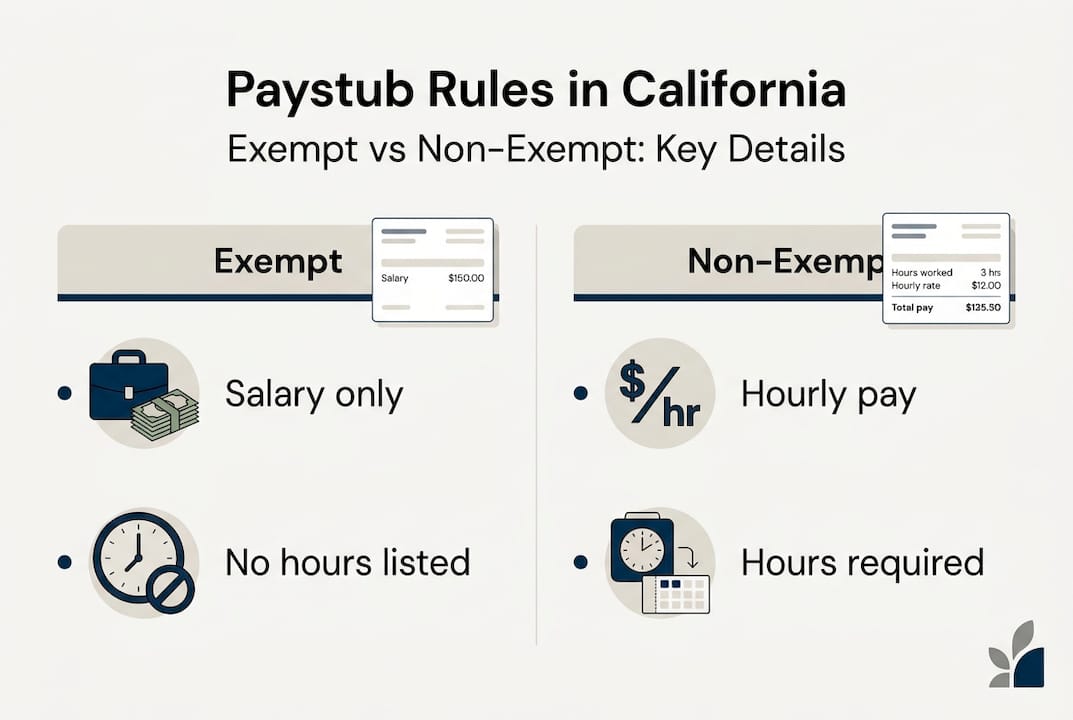
Your employer must provide paystubs either semi-monthly (twice per month) or on each payday if you’re paid more frequently. The timing requirement ensures you receive timely documentation to track your earnings and catch errors quickly. Whether you receive paper paystubs or electronic versions through a secure system, the content requirements remain identical.
It’s important to note that under Labor Code §226(e), an employer is only liable for statutory penalties if the violation is ‘knowing and intentional’ and the employee cannot promptly and easily determine required information from the deficient paystub. However, under the Private Attorneys General Act (PAGA), employees can pursue civil penalties without needing to prove the violation was knowing and intentional, as confirmed in Lopez v. Friant & Assocs., LLC (2017) 15 Cal.App.5th 773 and Raines v. Coastal Pacific Food Distributors, Inc. (2018) 23 Cal.App.5th 667.
Identifying common paystub errors and potential violations by Alhambra employers
Recognizing paystub violations requires knowing what errors commonly occur in California workplaces. Common violations include missing sick leave balances, overtime hours/rates, incorrect legal employer name, often due to payroll software errors. These mistakes can happen to any employer regardless of size or industry, from small Alhambra restaurants to large retail chains.
Typical paystub errors you might encounter include:
- Missing or incorrect sick leave balance showing zero hours when you’ve accrued time
- Omitted overtime hours or failure to show the overtime rate separately from regular rate
- Listing a trade name or DBA instead of the legal employer entity name
- Incomplete pay period dates or missing start/end dates entirely
- Vague deduction descriptions like “misc” instead of specific itemization
- Wrong employee identification showing another worker’s information
- Missing hourly rate breakdowns when you worked at multiple rates
- Absent employer address or listing only a corporate headquarters in another state
California courts have consistently held employers to strict compliance with these requirements. In Dunlap v. Superior Court (2006) 142 Cal.App.4th 330, the court confirmed that Labor Code §226(e) creates liability for employers who fail to provide accurate itemized wage statements, establishing the $50/$100 penalty structure. More recently, in Lopez v. Friant & Assocs., LLC (2017) 15 Cal.App.5th 773, the court clarified that employees may recover civil penalties for paystub violations under PAGA without first establishing injury as required under §226(e).
These errors affect your ability to verify compensation accuracy and track benefits. A missing sick leave balance prevents you from knowing how much paid time off you’ve earned under California law. Omitted overtime details make it impossible to confirm you received the correct 1.5x or 2x premium pay. Vague deductions could hide unauthorized withholdings that violate state wage laws.
Some errors stem from innocent mistakes like outdated payroll software, manual data entry problems, or confusion about legal requirements. Other violations result from deliberate attempts to hide wage theft, misclassify employees, or avoid overtime obligations. The law doesn’t distinguish between intentional and accidental violations when assessing penalties, which means even good faith errors carry consequences.
Even exempt employees deserve accurate paystubs despite not tracking hours. If you’re classified as exempt, your paystub should still show your salary amount, all deductions with clear descriptions, sick leave balance, and other required elements. Misclassification as exempt when you should receive hourly pay creates additional wage and hour violations beyond paystub errors, potentially including unpaid overtime and improper deductions.

Pro Tip: Regularly compare your paystub to your actual hours and paystubs from previous periods to detect discrepancies early. Catching errors within the pay period makes documentation easier and gives you more time to address problems before the statute of limitations expires.
Penalties for paystub violations and how employees can respond
California imposes substantial penalties on employers who violate paystub laws to encourage compliance and compensate affected workers. Penalties include $50 for the first violation, $100 for subsequent, up to $4,000 total per employee/pay period and attorney fees; PAGA allows representative claims with $100 to $250 per pay period. These penalties apply per pay period, meaning violations across multiple paychecks multiply quickly.
The penalty structure works as follows. Your employer owes you $50 for the initial pay period with a paystub violation. Each additional pay period with continuing or new violations increases the penalty to $100. The total penalty caps at $4,000 per employee, but that maximum can accumulate rapidly if violations persist across 40 or more pay periods. Courts may also award your attorney fees and costs if you prevail in a lawsuit.
The Private Attorneys General Act (PAGA) expands enforcement beyond individual claims. PAGA lets you file representative actions on behalf of yourself and other affected employees, even without class action certification. PAGA penalties range from $100 per pay period for initial violations to $250 for subsequent violations, with 75% going to the state and 25% distributed to affected employees. This mechanism incentivizes employees to report violations that benefit the broader workforce.
You can pursue paystub violation claims through multiple routes. Filing with the Division of Labor Standards Enforcement (DLSE) costs nothing and doesn’t require an attorney. The DLSE investigates your claim, holds hearings, and can order your employer to pay penalties and correct violations. Alternatively, you may hire an employment attorney to file a civil lawsuit or PAGA claim in court, which can result in higher recoveries but takes longer.
Follow these steps to document violations and file claims:
- Save physical or digital copies of every paystub showing violations
- Compare paystubs to your work schedules, time cards, and actual hours worked
- Write down specific missing elements or incorrect information on each paystub
- Request copies of your payroll records from your employer (they must provide within 21 days)
- File a wage claim with your local DLSE office or consult an employment attorney about litigation options
- Continue documenting ongoing violations on future paystubs while your claim proceeds
Time limits matter significantly. California law imposes different time limits depending on the type of claim. For penalty claims under Labor Code §226(e), you have one year from each paystub violation to file. However, if you’re seeking lost wages and injunctive relief (rather than penalties), California courts have held that a three-year statute of limitations applies under Code of Civil Procedure §338(a), as discussed in Singer v. Becton, Dickinson & Co. (S.D. Cal. 2008). This statute of limitations runs separately for each pay period, so older violations may be time-barred while recent violations remain actionable. Act promptly to preserve all available remedies. Act promptly to preserve your rights and maximize potential recovery.
| Claim Type | Penalty Amount | Filing Process | Typical Timeline |
|---|---|---|---|
| DLSE Wage Claim | $50 first, $100 subsequent, $4,000 max | Free filing at DLSE district offices | 6-12 months |
| Civil Lawsuit | $50 first, $100 subsequent, $4,000 max plus attorney fees | Hire attorney, file in court | 12-24 months |
| PAGA Claim | $100 first, $250 subsequent per employee | Attorney files representative action | 18-36 months |
Understanding the employment lawsuit process overview California helps you decide which enforcement route fits your situation best. DLSE claims work well for straightforward violations affecting one employee. PAGA suits make sense when multiple coworkers experienced similar violations. Your choice depends on the violation’s severity, how many employees were affected, and whether you want to invest time in litigation.
Pro Tip: Keep copies of your paystubs and wage records securely as evidence for any claim. Store them separately from your workplace to prevent loss if your employment ends unexpectedly.
How Alhambra employees can protect their rights and get help
Protecting your paystub rights starts with careful documentation and knowing when to seek assistance. Employees should document paystubs, compare to schedules, submit free DLSE claims or consult attorneys; employers can cure some errors within 33 days to avoid penalties. Taking proactive steps helps you catch violations early and strengthens any future claim.
Save every paystub you receive, whether paper or electronic. Create a dedicated folder or digital file where you store paystubs chronologically along with corresponding work schedules, time cards, and any written communications about pay. This documentation becomes critical evidence if you later discover violations and need to prove the specific missing elements or incorrect information.
Take these practical steps if you suspect paystub violations:
- Review each paystub immediately upon receipt and compare it to the nine required elements
- Cross-reference your paystub hours against your actual work schedule and time records
- Calculate whether your gross wages match your hours worked times your hourly rate
- Check that overtime hours appear separately with the correct premium rate
- Verify your sick leave balance increases with accrual and decreases when you use time
- Note any missing or vague information in a dated log with specific descriptions
- Request copies of your payroll records in writing if you need additional documentation
California law gives you the right to inspect and copy payroll records. Submit a written request to your employer’s human resources or payroll department. Your employer must provide copies within 21 calendar days of your request. These records include time cards, wage statements, and other documents showing your hours and pay calculations. If your employer refuses or misses the deadline, that creates an additional violation you can report.
Filing a free claim with the DLSE offers an accessible first step for many workers. Visit your local DLSE office or file online through the California DIR website. Provide your documentation, explain the specific paystub violations, and identify the pay periods affected. The DLSE assigns an investigator who contacts your employer, reviews evidence, and schedules a hearing if necessary. You don’t need an attorney for this process, though you can hire one if you prefer representation.
Consulting an employment lawyer makes sense for complex situations, ongoing violations affecting multiple employees, or cases where you’ve experienced other workplace violations beyond paystubs. Attorneys can evaluate whether a civil lawsuit or PAGA claim offers better recovery than a DLSE claim. Many employment lawyers offer free consultations and work on contingency, meaning you pay nothing unless you win.
Employers have limited opportunities to cure certain technical errors and avoid penalties under PAGA. If your employer corrects a violation within 33 days of receiving written notice and pays you any owed wages, they may escape PAGA penalties for that specific error. However, for wage statement violations specifically under Labor Code §226, an employer can cure the same violations only once in a 12-month period, not three times like other Labor Code violations. This cure provision applies only to technical violations, not knowing and intentional misconduct. The cure period creates an incentive for employers to fix mistakes quickly once notified.
You should know your rights and be proactive about enforcement. California’s strong paystub laws only work if employees actually review their wage statements and report violations. Many workers ignore paystubs or assume errors are normal. By staying informed through resources like legal insights and taking action when you spot problems, you protect not just yourself but also your coworkers who may face similar violations.
Get expert help with paystub violations in California
If you believe your Alhambra employer violated California paystub laws, consulting experienced employment lawyers can help you understand your options and pursue the compensation you deserve. California United Law Group represents employees facing wage and hour disputes throughout California, including paystub violations, unpaid wages, and overtime claims. Our team knows the complexities of employment law services and can evaluate your paystubs to identify violations you might have missed.
We guide clients through the entire California employment lawsuit process, from initial consultation through DLSE claims, settlement negotiations, or litigation if necessary. Whether you need help filing a wage claim or pursuing a PAGA representative action, our firm provides the support and advocacy you need. California courts have developed substantial case law interpreting paystub requirements, and an experienced attorney can analyze how decisions like Dunlap v. Superior Court (2006) 142 Cal.App.4th 330, Lopez v. Friant & Assocs., LLC (2017) 15 Cal.App.5th 773, and Pineda v. Bank of America, N.A. (2010) 50 Cal.4th 1389 apply to your specific circumstances. Contact California United Law Group for a consultation about your wage & hour legal help and protect your paystub rights effectively.
Frequently asked questions about California paystub violations
What makes a paystub legally deficient under California law?
A paystub violates California Labor Code §226 if it omits any of the nine required elements, including gross wages, total hours for non-exempt workers, applicable hourly rates, employer legal name and address, employee name and ID, pay period dates, itemized deductions, net wages, or available sick leave balance. Even one missing element per pay period creates liability.
How do I prove my employer violated paystub requirements?
Collect copies of deficient paystubs showing missing or incorrect information, then compare them against the nine statutory requirements. Document which specific elements are absent or wrong on each paystub. Request your payroll records in writing to obtain additional evidence. This documentation supports DLSE claims or lawsuits.
Can I still file a claim for old paystub violations from several years ago?
The time limit depends on what you’re seeking. For penalty claims under Labor Code §226(e), you must file within one year of each violation. However, if you’re seeking lost wages and injunctive relief, a three-year statute of limitations may apply. Paystubs outside the applicable limitations period are typically time-barred. However, if violations continued within the limitations period, you can still pursue claims for those recent pay periods even if earlier violations are too old. Consult an employment attorney to determine which remedies are available for your specific situation.
Do exempt salaried employees have the same paystub rights as hourly workers?
Exempt employees receive most of the same paystub protections except the requirement to show total hours worked. Your employer must still provide gross wages, pay period dates, deductions, net wages, sick leave balance, and other required elements. Misclassification as exempt when you should be non-exempt creates additional violations beyond paystub errors.
What happens if my employer fixes paystub errors after I complain?
Employers can cure certain technical paystub violations within 33 days of receiving notice by correcting the error and paying any owed wages, which may avoid PAGA penalties for those specific violations. However, the cure provision doesn’t erase your right to penalties for past pay periods before the correction. Quick fixes benefit employers more than employees in most cases.
Additionally, note that while Labor Code §226(e) requires proof that violations were ‘knowing and intentional,’ PAGA claims do not require this showing, as clarified in Lopez v. Friant & Assocs., LLC (2017) 15 Cal.App.5th 773.