
TL;DR:
- California law prohibits firing employees solely for pregnancy or related medical conditions.
- Workers should document timelines, gather evidence, and consult an attorney if they suspect discrimination.
- Pregnancy-related protections include job-protected leave and safeguards against workplace retaliation.
If you’ve just announced your pregnancy at work and you’re worried about your job, you’re not alone. Many Glendale employees fear the worst after sharing the news. But here’s what you need to know right away: firing you for pregnancy is illegal under California law. The Fair Employment and Housing Act, known as FEHA, prohibits employers from terminating you because of pregnancy, childbirth, or any related medical condition. Whether you work for a private company or the City of Glendale itself, these protections apply to you. This guide walks you through your rights, what the law actually says, and exactly what to do if you believe your employer has crossed a legal line.
Table of Contents
- Understanding pregnancy discrimination laws in Glendale
- Can you be fired after announcing a pregnancy?
- Pregnancy leave rights and job protection
- What to do if you suspect illegal termination
- Why proving discrimination is harder—and what works in practice
- Get experienced help: Protect your rights today
- Frequently asked questions
Key Takeaways
| Point | Details |
|---|---|
| Protected from firing | Your employer cannot legally fire you just for announcing your pregnancy in Glendale. |
| Document suspicious actions | Keep records if you suspect your employer is using another reason to terminate you after your announcement. |
| Know your leave rights | Both public and private sector workers have strong job protection under pregnancy leave laws. |
| Act quickly after termination | You have three years to file a complaint with the CRD. After the CRD issues a right-to-sue notice, you then have one year from that notice to file a civil lawsuit. Moving fast strengthens both. |
Understanding pregnancy discrimination laws in Glendale
Glendale employees are protected by some of the strongest pregnancy discrimination laws in the country. California’s FEHA is the primary law shielding you from adverse employment actions, including termination, demotion, or reduced hours, simply because you are pregnant.
FEHA defines pregnancy discrimination as any negative employment action taken because of pregnancy, childbirth, or a related medical condition. This includes being fired, passed over for promotion, or treated differently than non-pregnant employees in similar roles.
One important fact: FEHA covers all employers with five or more employees in California. That includes private businesses, nonprofits, and public agencies like the City of Glendale. There are no local exceptions. As confirmed by California employment guidance, Glendale follows state law identically, so city employees receive the same protections as workers at any private company in Los Angeles County.
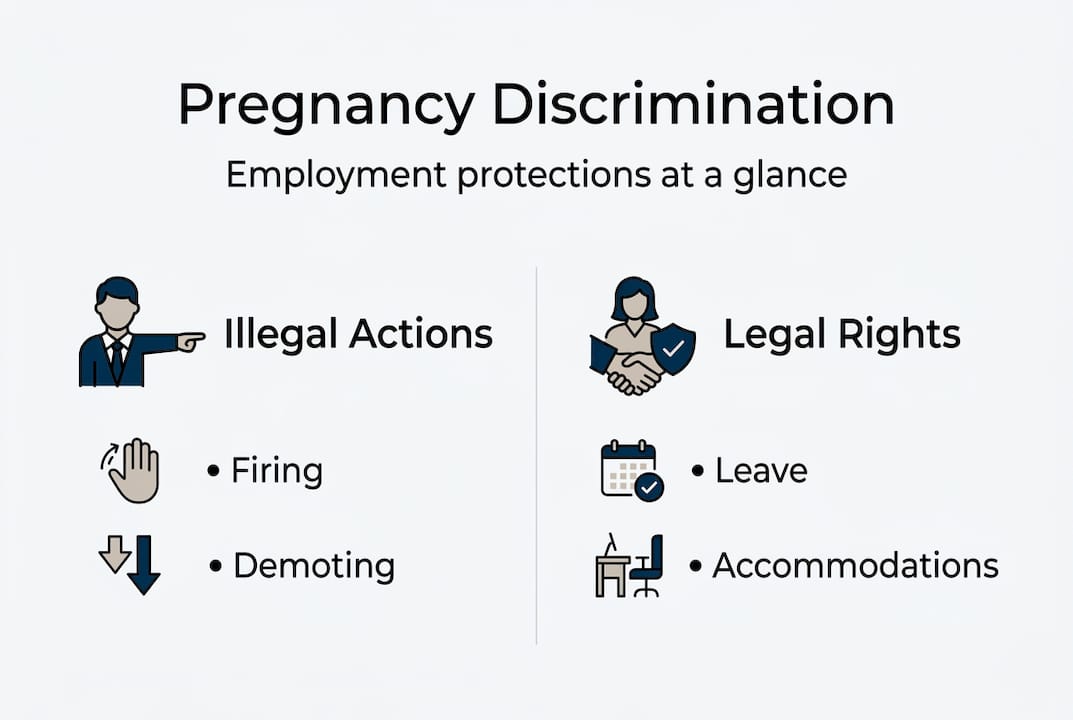
Employer actions prohibited under FEHA include:
- Firing or laying off an employee because of pregnancy
- Refusing to hire a qualified applicant who is visibly pregnant
- Demoting a pregnant employee or cutting their pay
- Denying reasonable accommodations for pregnancy-related conditions
- Retaliating against an employee who requests pregnancy leave
- Creating a hostile work environment based on pregnancy status
California courts have long enforced these protections in practice. In Kelly v. Stamps.com Inc. (2005) 135 Cal.App.4th 1088, a California Court of Appeal found that a plaintiff establishes a prima facie case of pregnancy discrimination under FEHA by showing her employer knew she was pregnant and by offering evidence of pregnancy-discriminatory motive. Notably, the protections extend even beyond FEHA’s five-employee threshold: in Badih v. Myers (1995) 36 Cal.App.4th 1289, the court held that even employers with fewer than five employees can face tort liability for wrongful discharge in violation of public policy when the firing is motivated by pregnancy, because pregnancy discrimination violates the California Constitution’s prohibition on sex discrimination. These cases confirm that California’s commitment to protecting pregnant workers is both broad and enforceable.
For a broader look at your rights as a pregnant worker, the pregnant employee rights PDF from the California Civil Rights Department is a helpful starting point.
State vs. federal pregnancy protections at a glance
| Protection | California (FEHA) | Federal (PDA / ADA / FMLA) |
|---|---|---|
| Employer size threshold | 5+ employees | 15+ employees |
| Covers pregnancy-related conditions | Yes | Limited |
| Requires reasonable accommodation | Yes | Varies |
| Job-protected leave available | Yes (PDL, CFRA) | Yes (FMLA) |
| Applies to public employers | Yes | Yes |
California’s protections are broader than federal law in almost every category. That matters for Glendale employees, because it means more of your employer’s actions are covered and more remedies are available if those protections are violated.
If you want to understand how Glendale schedule reduction rights connect to these broader protections, that resource explains how changes to your hours may also constitute discrimination.
Can you be fired after announcing a pregnancy?
The short answer is no. Firing you solely for announcing a pregnancy is illegal in California. But the reality is more complicated, because employers rarely say outright that pregnancy is the reason.
Instead, many employers use what lawyers call “pretext.” That means they give a different, seemingly legitimate reason for the termination, such as performance issues, a company restructuring, or a budget-driven layoff. California courts apply the McDonnell Douglas burden-shifting framework to pregnancy discrimination claims: the employee first establishes a prima facie case of discrimination; the burden then shifts to the employer to produce a legitimate, nondiscriminatory reason for the termination; and if the employer does so, the burden shifts back to the employee to show that reason is a pretext for discriminatory action. Guz v. Bechtel National, Inc. (2000) 24 Cal.4th 317. The timing often tells the real story. If your performance reviews were positive before your announcement and suddenly turn negative afterward, that pattern is significant evidence.
What is and isn’t a protected termination reason
| Termination reason | Protected under FEHA? |
|---|---|
| Announcing a pregnancy | Yes, firing for this is illegal |
| Genuine, documented performance issues (pre-dating pregnancy) | No, may be lawful |
| Layoff that disproportionately targets pregnant employees | Yes, likely illegal |
| Business closure affecting all employees equally | No, generally lawful |
| Retaliation for requesting pregnancy leave | Yes, illegal |
If you suspect discrimination, employers may use pretextual reasons like performance or layoffs. Documenting the timeline is critical. Here’s what you should do right away:
- Save all performance reviews. Gather any written evaluations, emails praising your work, or records showing you were in good standing before your announcement.
- Note the timeline. Write down the exact date you announced your pregnancy and the date any negative action occurred. Proximity matters legally.
- Preserve communications. Screenshot or save any emails, texts, or messages from your employer that relate to your pregnancy or your job status.
- Identify witnesses. Think about colleagues who may have heard comments or observed changes in how you were treated after your announcement.
- Request your personnel file. In California, you have the right to review your employment records. Do this promptly.
For more on proving workplace harassment and building a discrimination case, that guide covers the evidentiary standards you’ll need to meet.
Your rights don’t disappear the moment your employer hands you a termination notice. California law gives you real options, and the evidence you gather now can make all the difference later.
The official CRD booklet on pregnant employee rights also outlines what employers are required to tell you about your legal protections.
Pro Tip: If you receive a termination notice, do not sign anything immediately. Ask for time to review any severance agreement. Signing certain documents can waive your right to sue. Consult an employment attorney before putting your name on any separation paperwork.
Pregnancy leave rights and job protection
Termination isn’t the only risk you face. Pregnancy leave rights are just as important, and understanding them protects your job even if you take extended time off.
California offers two main types of job-protected leave for pregnant employees:
Pregnancy Disability Leave (PDL) allows eligible employees to take up to four months of leave for pregnancy-related disability. PDL is generally unpaid, though employees may be eligible for California State Disability Insurance (SDI) wage-replacement benefits during leave, and may also use accrued paid sick time or vacation concurrently. This includes time before and after childbirth if your doctor certifies that you are disabled by pregnancy. Public sector employees receive PDL protections under FEHA, including City of Glendale workers. Your job, or a comparable one, must be held for you during this period.

California Family Rights Act (CFRA) leave provides an additional 12 weeks of job-protected leave for baby bonding after PDL ends. To qualify for CFRA leave, an employee must have been employed by the same employer for at least 12 months and worked at least 1,250 hours during the 12-month period preceding the start of leave. Unlike PDL, CFRA is not available to all employees of covered employers—newly hired or low-hours workers may not yet meet these thresholds. This means eligible employees can take up to approximately seven months of combined protected leave when PDL and CFRA are stacked. CalHR guidance confirms that PDL protections apply to public employees without exception, meaning City of Glendale employees are fully covered. Courts have also recognized that in some cases, additional leave beyond PDL’s four-month maximum may itself be required as a reasonable accommodation under FEHA. In Sanchez v. Swissport, Inc. (2013) 213 Cal.App.4th 1331, the court held that additional disability leave for a pregnant employee after the conclusion of her full four-month PDL entitlement may be required as a reasonable accommodation under the FEHA. This means your employer’s obligations may not end when your statutory leave period expires.
For a complete breakdown, the CFRA and PDL guide from the California Civil Rights Department is the most authoritative resource available.
What is protected during your leave:
- Your job or a comparable position upon return
- Continuation of group health insurance benefits
- Protection from demotion or pay cuts upon reinstatement
- Freedom from retaliation for taking legally protected leave
- Right to use accrued sick leave during PDL in some circumstances
For Glendale city employees specifically, your department’s HR policies must align with state law. You can also review Glendale schedule rights for related information on how schedule changes during pregnancy are handled.
Pro Tip: Submit your leave request in writing, even if your employer accepts verbal requests. Keep a copy of everything. If your employer denies your leave or retaliates after you return, that written record becomes your strongest evidence.
What to do if you suspect illegal termination
If you believe your termination was connected to your pregnancy announcement, the steps you take in the next few days and weeks matter enormously.
Immediate steps to take:
- Write everything down. Create a detailed account of what happened, including dates, names, and exact words used. Memory fades, so do this now.
- Collect your evidence. Gather performance reviews, offer letters, emails, pay stubs, and any documentation showing your employment history.
- Identify the timeline. Map out when you announced your pregnancy and when the adverse action occurred. Courts look closely at this.
- Contact an employment attorney. An attorney can assess whether you have a viable claim before you take any other action. Many offer free initial consultations.
- File a complaint with the CRD. The California Civil Rights Department accepts complaints and investigates employers. You must file within three years of the termination. After the CRD completes its investigation or you request one, it will issue a right-to-sue notice—and once you receive that notice, you have one year to file a civil lawsuit in court.
Types of evidence that strengthen your case:
- Written performance reviews showing positive ratings before your announcement
- Emails or messages from supervisors praising your work
- Records of the date and method of your pregnancy announcement
- Witness statements from coworkers who observed changes in treatment
- Any written or verbal comments from management about your pregnancy
- Documentation showing similarly situated non-pregnant employees were not terminated
Understanding how schedule reduction rights connect to your broader situation can also help you recognize whether other violations occurred alongside your termination. And if you want to understand the full lawsuit process guide for California employment claims, that resource walks you through each stage from filing to resolution.
Pro Tip: Acting quickly is not just about meeting deadlines. The sooner you consult an attorney, the more options you have. Evidence can disappear, witnesses move on, and employers sometimes destroy records. Early action protects your case.
Why proving discrimination is harder—and what works in practice
Here’s what most guides skip over: winning a pregnancy discrimination case is rarely about one dramatic moment. Employers almost never say, “We’re firing you because you’re pregnant.” What you’re actually fighting is a paper trail that your employer has carefully constructed to look legitimate.
Employees often lose otherwise strong cases because they waited too long to gather evidence, or because they assumed a single incident would be enough. It rarely is. What works is showing a pattern: a positive review before the announcement, a sudden performance improvement plan after it, and a termination shortly thereafter. That sequence speaks louder than any single email.
Another common mistake is signing a severance agreement too quickly. That document may contain a release of claims, which means you give up your right to sue in exchange for a few weeks of pay. Always have an attorney review it first.
The strongest cases involve employees who documented consistently, acted early, and understood that proving discrimination is about building a timeline, not finding a smoking gun. Your instincts about what happened to you matter—but in court, it is the paper trail that wins. Your instincts about what happened to you matter. But in court, it’s the paper trail that wins.
Get experienced help: Protect your rights today
Facing a potential wrongful termination after announcing your pregnancy is frightening, but you don’t have to navigate it alone. At California United Law Group, P.C., we represent employees in exactly these situations. Our firm focuses on California employment law rights under FEHA and the Labor Code, and we handle cases from the initial complaint stage through full litigation.
👉 If you believe your termination was connected to your pregnancy, contact us to discuss your situation. We can review your case, explain your options, and help you understand the full lawsuit process if that becomes the right path. You deserve clear answers and strong representation.
Frequently asked questions
Does Glendale have its own pregnancy discrimination policy?
No. Glendale follows state law entirely, so city employees have the same pregnancy protections as private sector workers across California.
How long do I have to file a complaint for wrongful termination after announcing pregnancy?
Under California law, you must file your administrative complaint with the CRD within three years of the termination date. After the CRD issues a right-to-sue notice, you have one year from the date of that notice to file a civil lawsuit. Both deadlines matter—missing either one can bar your claim.
Am I protected if I work for Glendale as a temporary or part-time employee?
Yes. As long as your employer has five or more employees, FEHA protects you from pregnancy discrimination regardless of whether you work full-time, part-time, or on a temporary basis.
What should I do first if I think my firing was related to my pregnancy?
Document everything immediately, then contact an employment attorney and file a complaint with the California Civil Rights Department as soon as possible.