
Disclaimer: This article is for informational purposes only and does not constitute legal advice. The information provided is based on California law as of the publication date and may change. For specific guidance about your situation, consult with a qualified employment attorney.
Many salaried employees in Alhambra find themselves questioning whether they truly qualify for overtime pay under California law. With federal overtime threshold updates that expanded eligibility for millions of workers nationwide, the rules surrounding exempt and non-exempt classifications are more important than ever. Clear knowledge of local and federal requirements helps you spot errors in classification and ensures you receive the compensation you deserve for every hour worked.
Table of Contents
- Defining Overtime Pay For Salaried Workers
- Types Of Exempt And Non-Exempt Roles
- California’s Legal Standards For Overtime
- Misclassification And Common Employer Mistakes
- Protecting Your Rights And Taking Action
Key Takeaways
| Point | Details |
|---|---|
| Understand Exempt vs. Non-Exempt Status | Employees must know their classification to ensure they receive proper pay and protections under California law. |
| Track Work Hours Diligently | Maintaining detailed records of hours worked helps support claims for overtime and protects employee rights. |
| Regularly Review Job Classifications | Employers should audit employee roles to prevent misclassification and mitigate legal risks. |
| Know Your Legal Rights | Employees should be aware of their rights and potential actions to take if overtime violations occur. |
Defining Overtime Pay for Salaried Workers
Overtime pay for salaried workers represents a complex aspect of California employment law that significantly impacts workplace compensation. Understanding how overtime applies to different employee classifications requires careful examination of both federal and state regulations.
Under the Fair Labor Standards Act, employers must compensate non-exempt salaried workers at one-and-a-half times their regular pay rate for hours worked beyond 40 in a single workweek. However, not all salaried employees qualify for overtime pay. Exemption status depends on several critical factors:
- Salary Level: Current minimum annual earnings threshold
- Job Duties: Primary responsibilities and executive/professional classifications
- Compensation Structure: How wages are calculated and paid
The Department of Labor’s recent rules have expanded overtime eligibility, potentially impacting approximately 4.3 million workers. These updated regulations increase salary thresholds for exempt status, creating opportunities for more salaried workers to receive overtime compensation.
Key considerations for salaried workers in Alhambra include understanding their specific job classification, verifying their exempt or non-exempt status, and tracking actual hours worked. Employers must carefully evaluate each employee’s role to determine appropriate overtime compensation.
Pro tip: Keep detailed records of your work hours and consult with an employment law professional to confirm your overtime eligibility.
Types of Exempt and Non-Exempt Roles
Understanding the distinctions between exempt and non-exempt roles is crucial for salaried workers in Alhambra to protect their wage and overtime rights. California labor laws establish specific criteria that determine an employee’s classification, which directly impacts compensation and workplace protections.
According to California labor regulations, exempt employees must meet three primary criteria:
- Salary Level: Earn a monthly salary equivalent to at least twice the state minimum wage for full-time employment (as of 2026, this threshold is based on California’s current minimum wage)
- Job Duties: Primarily engaged in exempt duties—generally spending more than half of work time performing exempt tasks in any given workweek
- Independent Judgment: Exercise significant discretion in job responsibilities
Typical exempt roles often include:
- Executive positions with management responsibilities
- Professional roles requiring specialized degrees or advanced training
- Administrative positions involving high-level decision-making
- Outside sales representatives
- Certain technical and computer-related professionals
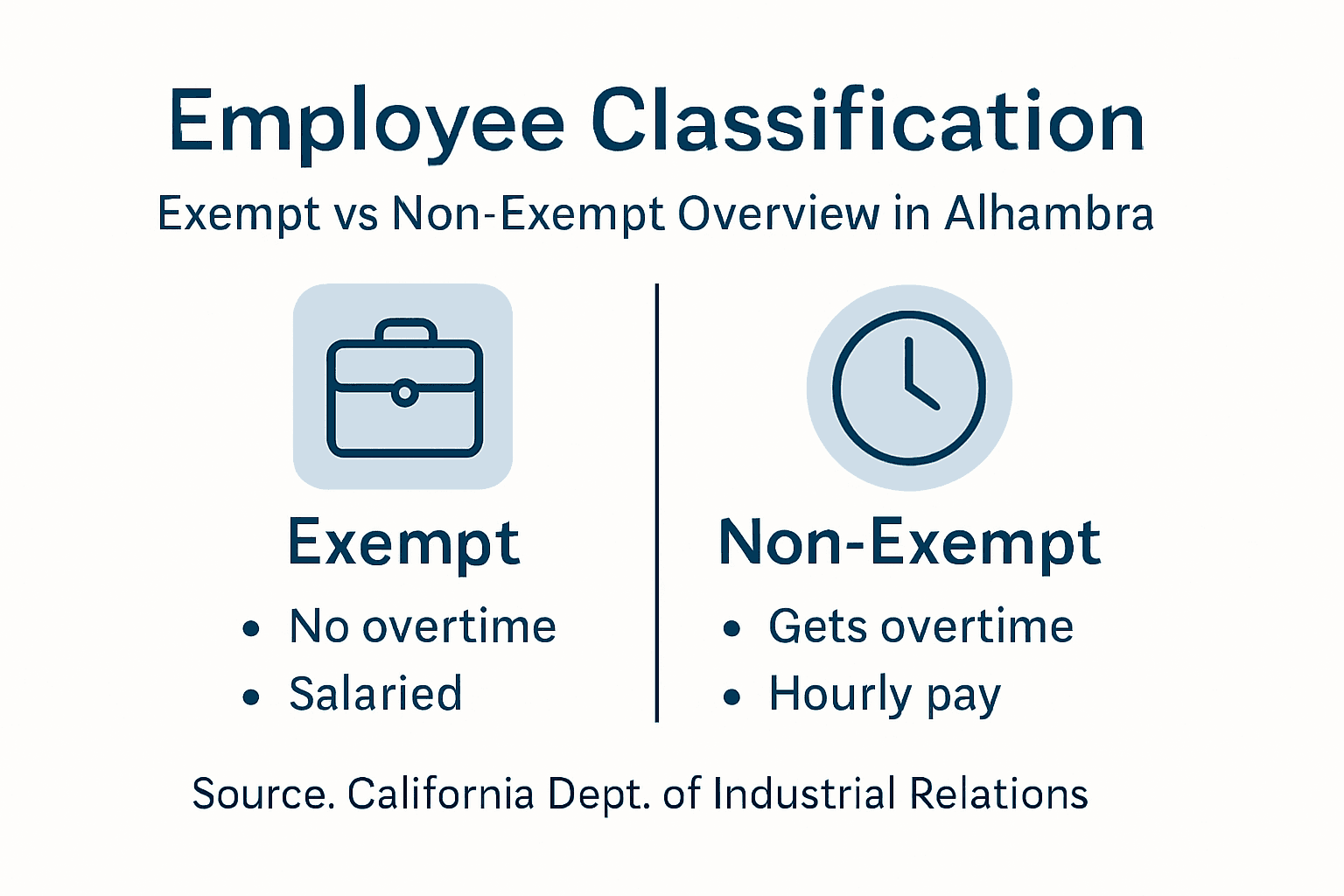
Non-exempt employees, by contrast, receive hourly wages and are entitled to overtime compensation. These workers must be paid at least minimum wage and receive additional pay for hours worked beyond 40 per week. Common non-exempt roles include entry-level positions, support staff, and hourly workers across various industries.
Job titles alone do not determine exemption status – actual job duties and responsibilities are the critical factors.
Employers must carefully evaluate each position’s specific responsibilities to ensure proper classification. Misclassification can result in significant legal and financial consequences for both employers and employees.

Pro tip: Review your job description and actual daily responsibilities to determine whether your current classification accurately reflects your work.
Here’s a summary of the main differences between exempt and non-exempt roles:
| Aspect | Exempt Employees | Non-Exempt Employees |
|---|---|---|
| Compensation Type | Salary-based | Hourly wage |
| Overtime Eligibility | Not entitled in most cases | Entitled to overtime pay |
| Typical Roles | Executive, professional | Support, entry-level, hourly |
| Workplace Protections | Limited by classification | Extensive under state law |
This visual comparison helps clarify classification impacts under California labor law.
California’s Legal Standards for Overtime
California maintains some of the most comprehensive and employee-protective overtime regulations in the United States, establishing rigorous standards that go beyond federal requirements. These state-specific rules are designed to ensure fair compensation and protect workers’ rights across various industries and employment classifications.
The state’s overtime regulations for 2026 establish critical standards for employee compensation, including:
- Minimum wage increases impacting overtime calculations
- Strict definitions of overtime-eligible work
- Specific thresholds for exempt and non-exempt employee classifications
- Enhanced protections for hourly and salaried workers
Key overtime provisions in California include unique requirements beyond standard federal laws:
- Overtime pay for hours worked beyond 8 in a single day
- Overtime compensation for work exceeding 40 hours in a workweek
- Double-time pay for work performed beyond 12 hours in a single day
- Mandatory meal and rest break considerations
California’s overtime laws prioritize employee protection, with narrow interpretations that consistently favor worker compensation.
Employers must carefully audit their wage and hour practices to ensure compliance. Misclassification of employees or improper overtime calculations can result in significant financial penalties and legal consequences.
Pro tip: Maintain detailed time records and consult with an employment law professional to understand your specific overtime rights and potential compensation.
California Courts Protect Overtime Rights
California courts have consistently held that overtime exemptions must be narrowly construed in favor of employees. In Ramirez v. Yosemite Water Company (1999) 20 Cal.4th 785, the California Supreme Court established that employers bear the burden of proving that an employee qualifies for an exemption from overtime laws—employees are presumed entitled to overtime unless the employer proves otherwise.
The determination of exempt status requires examining actual job duties, not just job titles. As the court explained in United Parcel Service Wage & Hour Cases (2010) 190 Cal.App.4th 1001, “A job title alone is insufficient to establish the exempt status of an employee. The exempt or nonexempt status of any particular employee must be determined on the basis of whether the employee’s salary and duties meet the requirements of the regulations.” Courts must examine the work actually performed during the workweek, the time spent on various tasks, and the employer’s realistic expectations.
California’s strong interest in protecting workers performing labor within its borders means that the state’s overtime laws apply even to nonresident employees working in California. In Sullivan v. Oracle Corp. (2011) 51 Cal.4th 1191, the California Supreme Court held that workers based in other states were entitled to California’s more protective overtime rules for work performed in California, including daily overtime requirements that exceed federal standards.
These decisions underscore California’s commitment to ensuring employees receive proper compensation for overtime hours worked, regardless of how employers classify their positions.
Misclassification and Common Employer Mistakes
Misclassification of salaried employees remains a persistent challenge in Alhambra’s workplace landscape, with significant legal and financial implications for both employers and workers. Understanding the nuanced criteria for employee classification is crucial to avoiding costly wage and hour disputes.
Employers frequently make critical errors when classifying workers as exempt, including:
- Assuming a managerial title automatically grants exempt status
- Failing to apply the 50% duties test for exempt classification
- Misinterpreting salary threshold requirements
- Overlooking annual changes in minimum wage affecting exemption status
Common misclassification scenarios often involve specific roles such as:
- Retail managers with limited decision-making authority
- Executive assistants performing primarily administrative tasks
- IT support professionals with limited independent judgment
- Sales representatives with restricted autonomy
Job titles and salaries alone do not determine exempt status – actual job duties and responsibilities are the critical factors.
The consequences of misclassification can be severe, potentially exposing employers to:
- Back pay for unpaid overtime
- Significant financial penalties
- Potential class-action lawsuits
- Damage to company reputation
Employers must conduct regular, thorough audits of job classifications, carefully examining job descriptions, actual work performed, and compensation structures to ensure compliance with California’s stringent labor laws.
Pro tip: Maintain detailed, up-to-date job descriptions and conduct annual reviews of employee classifications to mitigate potential misclassification risks.
Protecting Your Rights and Taking Action
Salaried employees in Alhambra have multiple strategies for addressing potential overtime pay violations and protecting their workplace rights. Understanding the legal mechanisms available can empower workers to take decisive action when they suspect wage and hour law breaches.
Employees facing potential overtime violations should consider the following initial steps:
- Document all hours worked, including overtime and off-the-clock activities
- Collect pay stubs, timekeeping records, and employment contracts
- Communicate concerns directly with human resources or management
- Preserve email and written communications about work hours
Legal options for addressing overtime disputes include:
- Filing an internal complaint with company management
- Submitting a wage claim to the California Labor Commissioner
- Consulting with an employment rights attorney about potential legal action
- Participating in collective or class-action lawsuits
California Labor Code section 1102.5 and other provisions protect employees from retaliation when asserting their wage and hour rights. Employers are prohibited from discharging, discriminating against, or taking adverse action against employees who file complaints or claims regarding unpaid wages.
Important considerations when pursuing overtime claims involve understanding potential outcomes, statute of limitations, and the specific documentation required to support your case. In California, the statute of limitations for unpaid overtime wages is generally three years for willful violations and two years for non-willful violations. Time is a critical factor in protecting your rights, so employees who believe they have been denied overtime should act promptly. Each approach carries different implications for potential compensation and future workplace relationships.
Workplace protections exist to prevent employers from retaliating against employees who raise legitimate concerns about overtime compensation. Workers should feel empowered to assert their legal rights while maintaining professional communication.
Pro tip: Maintain a contemporaneous, detailed log of all work hours and interactions related to potential overtime disputes to strengthen your potential legal claim.
The following table summarizes key steps and legal actions employees can take if they suspect overtime violations:
| Action Step | Purpose | Expected Result |
|---|---|---|
| Document Work Hours | Build evidence | Strengthens claim validity |
| Communicate with HR | Address concerns | May resolve issue internally |
| Consult Employment Attorney | Review legal options | Informed decision-making |
| File Wage Claim | Seek compensation | Official review and resolution |
Use this reference to decide which approach best fits your overtime dispute situation.
Know Your Rights as a Salaried Employee in Alhambra and Protect Your Overtime Pay
Salaried workers in Alhambra often face confusion around overtime eligibility, exemption classifications, and proper compensation under California law. If you are unsure whether your job duties, salary level, or classification meet the legal requirements for overtime pay you may be facing misclassification or unpaid wages. Key challenges include understanding complex state overtime rules, fighting back against potential employer mistakes, and securing the compensation you deserve.
At California United Law Group, P.C., our attorneys represent employees in wage and hour matters throughout California. If you believe you may have been misclassified or denied proper overtime compensation, we offer consultations to evaluate your situation. Each case depends on its specific facts and circumstances, including your actual job duties, salary, and working conditions. Take action now by exploring our employment law resources or connect with dedicated advocates in Pasadena and surrounding areas. To discuss your specific situation, contact our office. The outcome of any wage and hour claim depends on the particular facts and applicable law.
Frequently Asked Questions
What is overtime pay for salaried employees?
Overtime pay for salaried employees is compensation at one-and-a-half times the regular pay rate for hours worked over 40 hours in a single workweek, applicable to non-exempt workers under the Fair Labor Standards Act.
How can I determine if I am exempt or non-exempt from overtime pay?
To determine your exemption status, you should assess your salary level, job duties, and whether your role requires independent judgment. If you meet specific criteria set by state and federal regulations, you may be classified as exempt, meaning you are not entitled to overtime pay.
What should I do if I suspect my employer is not paying me overtime?
If you suspect unpaid overtime, document all your hours worked, including any off-the-clock hours, and gather pay stubs and employment contracts. You can raise your concerns with human resources or consult an employment rights attorney about potential actions. The appropriate course of action depends on your specific circumstances. Consider consulting with an employment attorney who can evaluate the facts of your situation.
What are the penalties for employers who misclassify employees regarding overtime?
Employers who misclassify employees may face significant consequences, including back pay for unpaid overtime, financial penalties, potential legal action, and damage to their reputation. They must ensure compliance with labor laws to avoid these risks.
Recommended
- Employment Lawyer Alhambra – Los Angeles Employment Lawyers | California United Law Group, P.C.
- Glendale Healthcare Overtime Pay Disputes Explained – California United Law Group
- Wage & Hour – Los Angeles Employment Lawyers | California United Law Group, P.C.
- Employment Lawyer Pasadena – Los Angeles Employment Lawyers | California United Law Group, P.C.