
Losing your job in Pasadena can leave you wondering whether your rights were respected under California law. California employees are protected by strong laws like the Fair Employment and Housing Act (FEHA), codified at Government Code section 12940 et seq., which prohibit discrimination and retaliation for reporting workplace violations. If you are facing sudden dismissal or unfair treatment, understanding wrongful termination protections is the first step to making informed decisions about your next move.
Table of Contents
- Defining Wrongful Termination In California
- Types Of Illegal Termination Under State Law
- California Labor Code And Feha Protections
- Recognizing Signs Of Unlawful Firing
- Your Rights And Next Steps If Fired
Key Takeaways
| Point | Details |
|---|---|
| Understanding Wrongful Termination | Wrongful termination occurs when an employee is fired for unlawful reasons that breach employment laws, public policy, or contracts. |
| California Legal Protections | The Fair Employment and Housing Act provides strong safeguards against discriminatory and retaliatory terminations, among other protections. |
| Documentation is Key | Keeping meticulous records of workplace interactions and performances is crucial to support claims of wrongful termination. |
| Know Your Rights | Employees should be aware of their rights following termination and can seek legal consultation to explore available remedies. |
Defining Wrongful Termination in California
Wrongful termination represents a significant legal challenge for employees in California, where specific protections exist to safeguard workers from unjust dismissal. Wrongful termination occurs when an employer fires an employee for illegal reasons that violate state or federal employment laws, public policy, or employment contracts.
In California, several key scenarios constitute wrongful termination:
- Discrimination based on protected characteristics like race, gender, age, disability, or sexual orientation
- Retaliation for reporting workplace violations or harassment
- Termination that violates written or implied employment agreements
- Firing an employee for refusing to participate in illegal activities
- Dismissal that goes against public policy principles
California law provides robust protections through the Fair Employment and Housing Act which establishes clear guidelines for legal employment practices. The Act ensures employees cannot be terminated for reasons that violate fundamental civil rights or workplace ethics.
Employers must demonstrate legitimate, non-discriminatory reasons for termination. This means an employee’s performance, conduct, or business necessity must be the genuine basis for dismissal. Employer intent plays a critical role in determining whether a termination meets legal standards.
Here’s a comparison of lawful and unlawful reasons for employee termination under California law:
| Reason for Termination | Lawful Example | Unlawful Example |
|---|---|---|
| Performance-Related | Consistent tardiness ignored warnings | Firing after reporting discrimination |
| Economic Downturn | Layoff during proven budget cuts | Dismissal based on age or disability |
| Misconduct | Theft after fair investigation | Firing after requesting accommodation |
| Policy Violation | Repeated policy breaches with records | Firing for whistleblowing |
Pro tip: Document every interaction and performance review meticulously to protect yourself in potential wrongful termination scenarios.
Types of Illegal Termination Under State Law
California’s employment laws provide comprehensive protections against various forms of illegal termination, ensuring workers are shielded from unjust dismissal. Discriminatory termination represents one of the most significant violations of employee rights under state law, encompassing a wide range of prohibited employment practices.
Key types of illegal termination in California include:
- Race or Ethnic Discrimination: Firing an employee based on racial or ethnic background
- Gender-Based Termination: Dismissing an employee due to gender identity or sex
- Age Discrimination: Wrongful dismissal based on age (FEHA protects individuals age 40 and over)
- Disability Discrimination: Terminating employees with protected medical conditions
- Pregnancy Discrimination: Firing an employee due to pregnancy or related medical conditions
- Sexual Orientation Discrimination: Dismissal based on an employee’s sexual orientation or gender expression
California law also recognizes workplace retaliation as a critical form of illegal termination. This occurs when an employer fires an employee for engaging in legally protected activities, such as reporting harassment, discrimination, unsafe working conditions, or participating in workplace investigations.
Employers cannot terminate employees for exercising their fundamental workplace rights. Whistleblower protections are particularly strong in California, preventing employers from retaliating against employees who report legal violations, unethical practices, or potential criminal activities within the organization.
Labor Code section 1102.5 prohibits employer retaliation against employees who report reasonably suspected violations of law. As noted in Ferrick v. Santa Clara University (2014) 231 Cal.App.4th 1337, this statute reflects the broad public policy interest in encouraging workplace whistleblowers to report concerns regarding illegal conduct without fear of retaliation.
Pro tip: Keep detailed documentation of all workplace interactions and potential discriminatory incidents to strengthen your legal position if wrongful termination occurs.
California courts have consistently upheld these protections. In Tameny v. Atlantic Richfield Co. (1980) 27 Cal.3d 167, the California Supreme Court established that when an employer’s discharge violates fundamental public policy, the employee may maintain a tort action for wrongful termination. Similarly, in Stevenson v. Superior Court (1997) 16 Cal.4th 880, the court confirmed that FEHA remedies are not exclusive and do not bar common law tort claims for wrongful discharge.
California Labor Code and FEHA Protections
The Fair Employment and Housing Act (FEHA) stands as a cornerstone of employee protection in California, providing comprehensive safeguards against workplace discrimination and unfair employment practices. Legal protections under FEHA extend far beyond basic employment rights, creating a robust framework that shields workers from various forms of workplace misconduct.
Key protections provided by FEHA include:
- Prohibition of discrimination based on protected characteristics
- Mandates for reasonable workplace accommodations
- Protection against harassment and retaliation
- Coverage for diverse employee categories
- Enforcement mechanisms for employee rights
The California Supreme Court has recognized the breadth of FEHA’s protections. For example, in City of Moorpark v. Superior Court (1998) 18 Cal.4th 1143, the court held that FEHA provides sufficient public policy against disability discrimination to support a public policy tort claim.
Recent legislative updates have expanded FEHA’s scope, with labor law protections now covering emerging workplace issues. For instance, California now protects employees’ off-duty cannabis use and provides enhanced safeguards for reproductive loss leave, demonstrating the state’s commitment to progressive employee rights.
The California Labor Code complements FEHA by establishing additional workplace protections. Employer obligations are clearly defined, requiring companies to maintain fair employment practices, provide safe working environments, and respect employee fundamental rights. This includes preventing discrimination, ensuring equal opportunities, and maintaining transparent workplace policies.
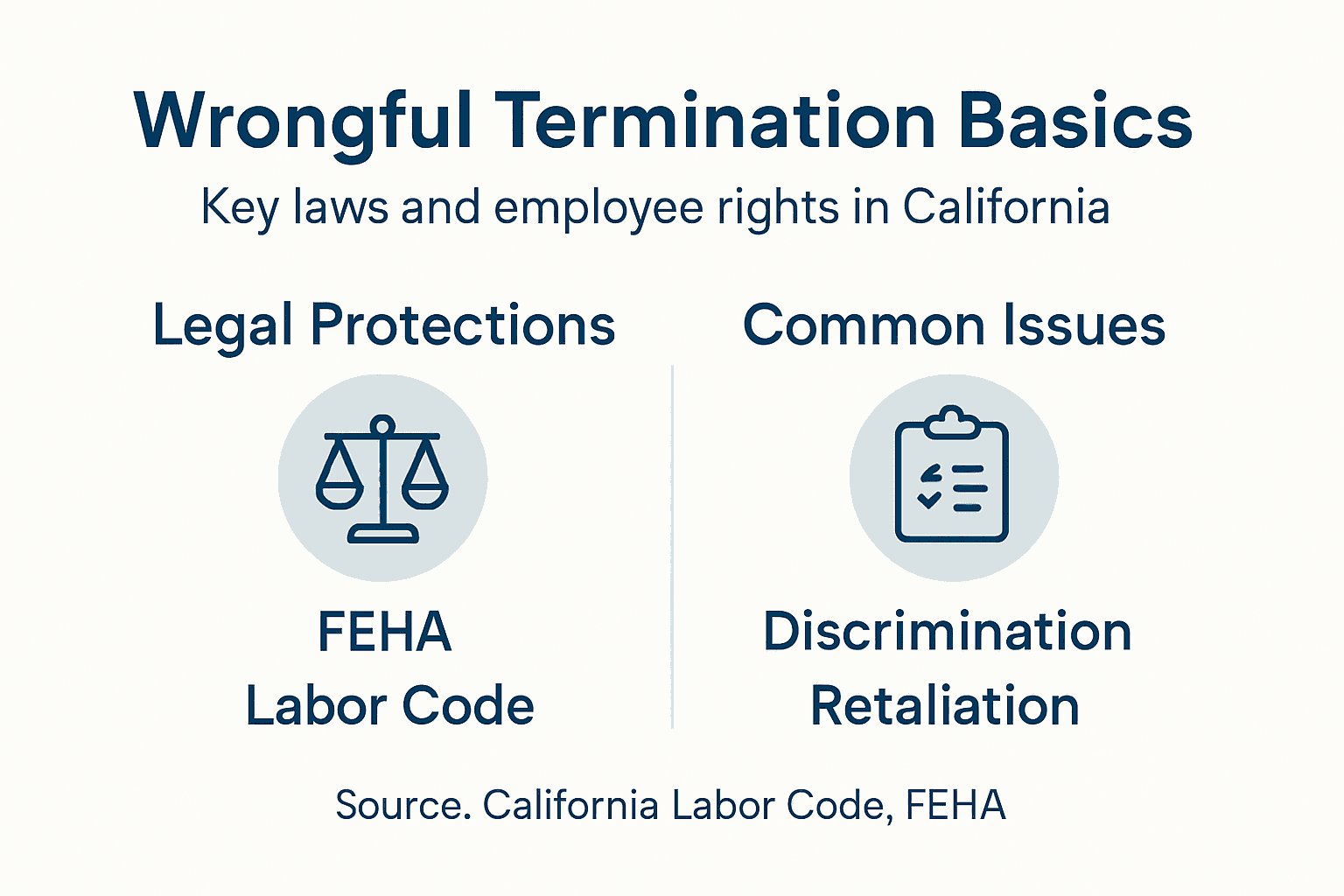
For quick reference, here’s a summary of major California employee protections and their practical impacts:
| Legal Protection | What It Covers | Real-World Impact |
|---|---|---|
| FEHA | Discrimination/Retaliation | Enables lawsuits for unfair dismissal |
| California Labor Code | Safety, wages, contracts | Protects pay, workplace safety |
| Whistleblower Laws | Reporting law violations | Shields whistleblowers from firing |
| Reasonable Accommodation | Disability or medical needs | Requires job modifications for health |
Pro tip: Familiarize yourself with your specific workplace rights and document any potential violations to protect your legal interests.
Recognizing Signs of Unlawful Firing
Unlawful termination can be subtle, making it critical for employees to understand the nuanced signs of illegal dismissal. Wrongful termination occurs when an employer fires an employee for reasons that violate fundamental employment laws, legal protections, or public policy standards.
Key indicators of potential unlawful firing include:
- Termination immediately after reporting workplace misconduct
- Firing coinciding with disclosure of a protected medical condition
- Dismissal following complaints about discriminatory practices
- Retaliation for participating in workplace investigations
- Sudden termination after requesting reasonable accommodations
- Inconsistent or fabricated performance explanations
Courts evaluate these patterns carefully. In Pugh v. See’s Candies, Inc. (1981) 116 Cal.App.3d 311, the court established that once an employee demonstrates a prima facie case of wrongful termination, the burden shifts to the employer to provide a legitimate, non-discriminatory reason for the termination, which the employee may then challenge as pretextual.
Workplace harassment often precedes unlawful termination, and workplace harassment patterns can provide crucial evidence of discriminatory intent. Employers frequently attempt to mask illegal firing by creating false performance narratives or manufacturing disciplinary records.

Documentation is your strongest defense against unlawful termination. Employment records can reveal patterns of discrimination, showing whether your dismissal resulted from legitimate business reasons or prohibited motivations. Keep detailed records of performance evaluations, communication with supervisors, and any incidents that might suggest discriminatory treatment.
Pro tip: Preserve all workplace communications, emails, and performance documents, as these can become critical evidence if you need to challenge an unlawful termination.
Your Rights and Next Steps if Fired
Facing termination is challenging, but California law provides robust protections for employees who believe they have been wrongfully dismissed. Employee rights extend beyond the initial firing, offering multiple avenues for addressing potentially illegal employment practices.
Immediate steps to protect your legal interests include:
- Requesting a written explanation for your termination
- Collecting and preserving all employment documentation
- Identifying potential witnesses to workplace incidents
- Avoiding confrontational interactions with former employers
- Reviewing your employment contract and personnel files
- Maintaining a chronological record of employment events
Employees experiencing potential wrongful termination can prove workplace harassment by systematically documenting discriminatory behaviors and patterns. This documentation becomes crucial evidence if you decide to pursue legal action against your employer.
California offers several legal remedies for wrongful termination, including potential reinstatement, back pay, compensation for emotional distress, and punitive damages. Legal consultation becomes critical in evaluating the strength of your case and determining the most appropriate course of action. An experienced employment attorney can help assess whether your termination violated state or federal employment laws.
Pro tip: Consult with an employment lawyer as soon as possible after termination to preserve your legal rights and understand your potential options.
Protect Your Rights After an Illegal Termination in Pasadena
If you suspect your termination in Pasadena was illegal, you are not alone. Unfair dismissal can be overwhelming, especially when it involves discrimination, retaliation, or violation of your employment rights under California Labor Code or FEHA. Wrongful termination is a serious legal matter that may require experienced legal guidance to evaluate your options and protect your rights.
California United Law Group, P.C. handles Wrongful Termination & Retaliation cases and can provide legal guidance to evaluate your situation. Our team represents employees facing Discrimination & Harassment claims. To learn more about your options and whether you may have a viable claim, contact us through our website at https://calunitedlaw.com/. Prompt consultation is important to preserve your legal rights, as statutes of limitations may apply.
Frequently Asked Questions
What constitutes wrongful termination in California?
Wrongful termination in California occurs when an employer fires an employee for illegal reasons that violate state or federal employment laws, public policy, or employment contracts.
How can I tell if I was unlawfully terminated?
Signs of unlawful termination include being fired immediately after reporting workplace misconduct, dismissal after disclosing a protected medical condition, or sudden termination following a request for reasonable accommodations.
What are my rights if I believe my termination was illegal?
If you believe your termination was illegal, you have the right to request a written explanation for your dismissal, collect relevant employment documentation, and consult with an employment attorney to evaluate your case and options.
What protections does the Fair Employment and Housing Act (FEHA) provide?
The Fair Employment and Housing Act (FEHA) prohibits discrimination based on protected characteristics, mandates reasonable accommodations, and offers protections against harassment and retaliation in the workplace.
Disclaimer: The answers provided above are for general informational purposes only and do not constitute legal advice. Each employment situation is unique and requires individual legal analysis based on specific facts and circumstances.“