
Clocking out after another long shift and wondering if your paycheck truly reflects every extra hour on the floor is a common reality for many healthcare professionals in Glendale. With complex schedules and urgent patient needs, missing out on premium overtime compensation can impact your financial security. Understanding how both Federal and California overtime laws apply to your role helps you guard your earnings, recognize wage violations, and make informed decisions about protecting your rights.
Table of Contents
- Defining Overtime Pay for Healthcare Workers
- California Overtime Laws and Key Exemptions
- Common Wage Violations in Glendale Healthcare
- Recognizing and Reporting Overtime Denial
- Legal Remedies for Unpaid Overtime Wages
Key Takeaways
| Point | Details |
|---|---|
| Overtime Compensation Rules | Healthcare workers are entitled to overtime pay, calculated at 1.5 times their standard hourly wage for hours worked over 40 in a week. California law also mandates premium pay for daily overtime work. |
| Exemptions | Certain healthcare employees, such as salaried administrators, may not qualify for overtime pay based on their job duties and salary levels. Understanding classification is crucial to ensure fair compensation. |
| Common Wage Violations | Healthcare workers often face wage theft, such as unpaid overtime and misclassification as independent contractors. Documenting hours worked is essential for safeguarding rights. |
| Legal Remedies | Workers can file wage claims or pursue civil litigation to recover unpaid overtime wages. Keeping detailed records is vital for strengthening their claims. |
Defining Overtime Pay for Healthcare Workers
Healthcare workers in Glendale, like many professionals, are entitled to fair compensation for extra hours worked. The Fair Labor Standards Act (FLSA) establishes critical guidelines for overtime pay that directly impact medical professionals.
Under federal law, overtime pay is calculated when employees work more than 40 hours in a single workweek. For healthcare workers, this typically means receiving premium compensation at a rate of 1.5 times their standard hourly wage. The specific overtime rules can vary depending on job classification and employment status.
Key characteristics of overtime pay for healthcare workers include:
- Applies to hours worked beyond 40 in a workweek
- Calculated at minimum 1.5 times regular hourly rate
- Mandated by the Department of Labor’s Wage and Hour Division
- Not automatically applied for weekend or holiday shifts
- Requires timely payment for extra hours worked
Not all healthcare workers qualify for overtime. Exempt employees, such as certain salaried administrators or specialized medical professionals, might not receive additional compensation. The determination depends on job duties, salary level, and specific employment classification.
Overtime Calculation Example
If a registered nurse earns $30 per hour and works 50 hours in a week:
- Standard 40 hours paid at regular rate: $1,200
- 10 overtime hours paid at 1.5x rate: $450
- Total weekly compensation: $1,650
Pro tip: Keep detailed time records and understand your specific employment classification to ensure you receive proper overtime compensation.
California Overtime Laws and Key Exemptions
California has robust overtime regulations that provide stronger protections for workers compared to federal standards. Overtime regulations in California are particularly complex, offering more comprehensive coverage for employees across various industries.
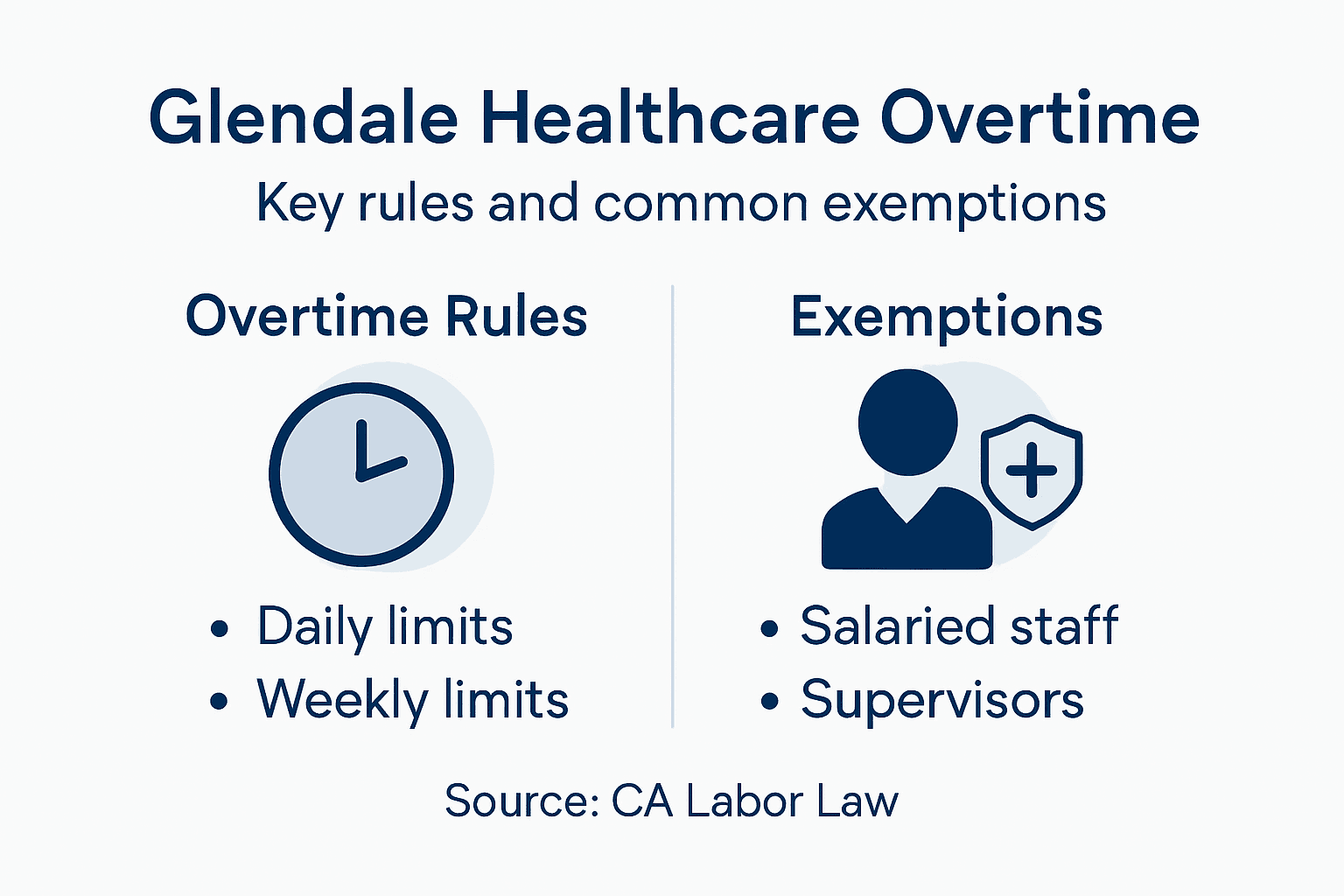
Under state law, nonexempt employees aged 18 and older are entitled to premium overtime compensation in multiple scenarios. These scenarios include working more than eight hours in a single day, more than 40 hours in a workweek, and specific consecutive workday situations.
Key overtime compensation rules in California include:
- 1.5x pay for hours worked beyond 8 in a single day
- 1.5x pay for hours worked beyond 40 in a workweek
- Double time for hours worked beyond 12 in a single day
- Double time for work on the seventh consecutive day in a workweek
Exemption Classifications
Not all employees qualify for overtime pay. California follows specific exemption guidelines that determine overtime eligibility based on job duties and salary levels. Exempt employees typically include:
- Executive-level professionals
- Administrative staff with decision-making authority
- Specialized professionals with advanced degrees
- Outside sales representatives
- Computer software professionals
To qualify for exempt status, employees must meet stringent criteria:
- Perform primarily intellectual or creative work
- Exercise independent judgment
- Earn a salary at least twice the state minimum wage for full-time employment
California’s overtime laws are designed to protect workers and ensure fair compensation for extended work hours.
Overtime Calculation Complexities
Calculating overtime in California involves more than simple hourly rates. Employers must consider daily and weekly hours, job classifications, and specific industry regulations when determining appropriate compensation.
Pro tip: Maintain detailed time records and understand your specific employment classification to protect your wage rights and identify potential overtime violations.
Here’s a comparison of federal and California overtime laws relevant to Glendale healthcare workers:
| Overtime Law Aspect | Federal (FLSA) | California Law |
|---|---|---|
| Daily Overtime Threshold | Not required | After 8 hours/day |
| Weekly Overtime Threshold | After 40 hours/week | After 40 hours/week |
| Overtime Rate | 1.5x hourly wage | 1.5x or 2x hourly wage |
| Double Time Provision | Not provided | After 12 hours/day or 7th consecutive day |
| Exemption Criteria | Job duties, salary basis | Stricter job duty and salary test |
| Protections Level | Minimum standard | More comprehensive |
Common Wage Violations in Glendale Healthcare
Healthcare workers in Glendale face numerous potential wage violations that can significantly impact their financial well-being. California’s labor enforcement mechanisms provide critical protections for workers facing unfair compensation practices.

Wage theft in the healthcare industry takes multiple forms, often targeting vulnerable workers who may not fully understand their legal rights. Systemic wage violations can include failing to pay proper overtime, misclassifying employees, and underpaying minimum wage requirements.
Common wage violations affecting Glendale healthcare workers include:
- Refusing to pay overtime for hours worked beyond 40 per week
- Misclassifying employees as independent contractors
- Failing to compensate for mandatory training or meeting times
- Neglecting to pay for time spent preparing medical equipment
- Manipulating time records to reduce total compensation
- Denying meal and rest break compensation
Specific wage violation patterns in healthcare settings often involve:
- Pressuring nurses to work through unpaid breaks
- Requiring staff to arrive early without compensation
- Expecting employees to complete paperwork off the clock
Healthcare workers are particularly vulnerable to wage theft due to complex scheduling and high-stress work environments.
Minimum wage regulations for healthcare workers have expanded in recent years, providing additional protections for medical support staff and lower-wage healthcare roles. These regulations aim to address historical compensation disparities and ensure fair payment across different healthcare positions.
Impact of Wage Violations
Wage violations can result in substantial financial losses for healthcare workers. A single missed overtime payment or improperly classified work hour can represent hundreds of dollars in lost compensation annually.
Pro tip: Document every hour worked, including preparatory and administrative tasks, and retain copies of all timekeeping records to protect yourself against potential wage violations.
Below is a summary of frequent wage violation types and their typical financial impact on Glendale healthcare workers:
| Violation Type | Typical Impact | Example Outcome |
|---|---|---|
| Unpaid Overtime | Lost overtime wages | $100s lost per pay period |
| Misclassification | No overtime eligibility | Fewer benefits, reduced pay |
| Off-the-Clock Work | Unaccounted labor hours | Uncompensated administrative tasks |
| Break Denial | Missed rest/meal pay | Lost 30 minutes+ daily pay |
Recognizing and Reporting Overtime Denial
Healthcare workers in Glendale must be vigilant in identifying potential overtime violations. Wage claim mechanisms provide critical pathways for workers to address compensation discrepancies and protect their legal rights.
Recognizing overtime denial requires understanding the nuanced ways employers might illegally withhold proper compensation. Systemic overtime violations often manifest through subtle practices designed to minimize additional wage payments for healthcare professionals.
Key indicators of potential overtime denial include:
- Working more than 40 hours per week without time-and-a-half pay
- Being classified as exempt without meeting strict legal requirements
- Experiencing pressure to work off-the-clock
- Receiving compensatory time instead of overtime wages
- Having time records systematically altered
- Being told overtime must be pre-approved to be paid
Reporting procedures for overtime violations involve multiple steps:
- Document all hours worked meticulously
- Collect pay stubs and time records
- Review employment classification
- Contact appropriate labor enforcement agencies
Accurate record-keeping is your strongest defense against wage theft.
Overtime pay regulations provide clear guidelines for identifying potential violations. Healthcare workers should pay special attention to how their total compensation is calculated, including understanding how bonuses, shift differentials, and other compensation factors impact overtime rates.
Reporting Mechanisms
Workers have several options for addressing potential overtime violations, including filing complaints with the California Labor Commissioner’s Office, consulting with employment attorneys, and submitting formal wage claims.
Pro tip: Create a contemporaneous log of all hours worked, including preparatory and administrative tasks, with specific dates, times, and descriptions to strengthen potential wage violation claims.
Legal Remedies for Unpaid Overtime Wages
Healthcare workers in Glendale have multiple legal pathways to recover unpaid overtime wages. Wage claim procedures offer structured mechanisms for addressing compensation violations and seeking financial recovery.
The legal remedies landscape provides several options for healthcare professionals experiencing overtime wage theft. These strategies range from administrative claims to formal legal actions designed to recover lost compensation and hold employers accountable.
Key legal remedies for unpaid overtime include:
- Filing a wage claim with the California Labor Commissioner’s Office
- Pursuing civil litigation against the employer
- Seeking liquidated damages in addition to back wages
- Requesting penalties for willful wage violations
- Pursuing class action lawsuits for systematic wage theft
- Obtaining legal representation from employment attorneys
Filing a wage claim involves critical steps:
- Gather comprehensive documentation of hours worked
- Complete official wage claim forms
- Submit evidence of unpaid overtime
- Attend settlement conference
- Participate in potential administrative hearing
Timely documentation is crucial in successfully recovering unpaid overtime wages.
California workers’ rights protections ensure employees cannot be retaliated against for pursuing legitimate wage claims. The legal system provides multiple layers of protection for workers seeking to recover their rightful compensation.
Potential Financial Recovery
Successful wage claims can result in comprehensive financial remedies, including recovering back wages, potential liquidated damages, and legal cost reimbursements. Healthcare workers might recover significantly more than the original unpaid overtime.
Pro tip: Maintain meticulous, contemporaneous records of all worked hours, including dates, times, and specific tasks, to strengthen your potential wage recovery claim.
Protect Your Rights as a Glendale Healthcare Worker Facing Overtime Denial
If you are a Glendale healthcare worker struggling with unpaid overtime or suspect your employer is denying you rightful compensation, you are not alone. The article highlights critical challenges such as misclassification, off-the-clock work, and complex California overtime laws that leave many medical professionals vulnerable to wage violations. You deserve fair pay for every hour worked including those extra shifts and overtime hours that federal and California labor codes protect.
California United Law Group, P.C. specializes in helping employees navigate complicated wage and hour disputes under California Employment Law. Our experienced team understands the nuances of wage claim procedures and can guide you through recovering unpaid wages and protecting your employment rights. Don’t wait until lost wages add up to significant financial strain. Learn more about your rights at California Employment Law and explore your options with our dedicated attorneys. Reach out today at California United Law Group to take your first step toward justice and fair compensation.
Frequently Asked Questions
What is considered overtime pay for healthcare workers?
Overtime pay for healthcare workers is typically calculated when an employee works more than 40 hours in a single workweek, with premium compensation usually set at 1.5 times their standard hourly wage.
How do California laws differ from federal laws regarding overtime for healthcare workers?
California laws provide stronger protections for workers, including premium pay for hours worked over 8 in a single day, double time for hours over 12 in a day, and specific rules for consecutive workdays, which are not included in federal regulations.
What should I do if I believe I’m not getting paid overtime?
If you believe you are not receiving proper overtime pay, document all hours worked and gather pay stubs. You can then contact the California Labor Commissioner’s Office to file a wage claim or consider consulting with an employment attorney for assistance.
Are there exemptions to overtime pay for healthcare workers?
Yes, certain healthcare workers may be classified as exempt from receiving overtime pay based on their job duties and salary levels, such as executive-level professionals, administrative staff, and specialized professionals with advanced degrees.
Recommended
- Employment Lawyer Glendale – Los Angeles Employment Lawyers | California United Law Group, P.C.
- Wage & Hour – Los Angeles Employment Lawyers | California United Law Group, P.C.
- Employment Lawyer Burbank – Los Angeles Employment Lawyers | California United Law Group, P.C.
- Employment Lawyer Los Angeles County – Los Angeles Employment Lawyers | California United Law Group, P.C.
- Unpaid Overtime Claims in Anaheim Hospitality – Employee Rights and Employer Duties | Serendib Law Firm