
This article is for informational purposes only and does not constitute legal advice. Every case is unique and results depend on specific facts and circumstances.
Facing repeated hazards on the job in Pasadena while your concerns are ignored can make you feel trapped between your safety and your paycheck. Unsafe working conditions are not just frustrating—they can create a hostile atmosphere that legally amounts to a forced resignation, known as constructive discharge. If your employer’s actions leave you no real choice but to quit, understanding your labor rights enables you to explore legal remedies available under California law.
Table of Contents
- What Constitutes A Forced Resignation
- Types Of Unsafe Working Conditions In Pasadena
- California Laws On Constructive Discharge
- Employee Rights And Employer Duties
- Legal Steps To Take After Quitting
Key Takeaways
| Point | Details |
|---|---|
| Definition of Forced Resignation | A forced resignation occurs when intolerable working conditions created by the employer compel an employee to quit, often referred to as constructive discharge. |
| Employee Rights | Employees have the right to safe working conditions and can challenge forced resignations through legal claims for constructive discharge if conditions are unbearable. |
| Documentation Importance | It’s crucial to document evidence of intolerable conditions and complaints before resigning to support any potential legal claims later. |
| Legal Remedies | California treats forced resignations similarly to wrongful termination, allowing employees to pursue damages under constructive discharge law. |
What Constitutes a Forced Resignation
A forced resignation happens when your employer creates conditions so intolerable that you feel compelled to quit. This isn’t about being frustrated with your job or having a difficult manager—it’s about illegal, systematic mistreatment that leaves you no realistic choice but to resign.
The legal term for this situation is constructive discharge. California courts recognize that resignation under duress occurs when an employee quits due to intolerable working conditions created by the employer. The key question is whether a reasonable person in your position would feel forced to resign.
In the seminal case of Turner v. Anheuser-Busch, Inc. (1994) 7 Cal.4th 1238, the California Supreme Court established that constructive discharge occurs when an employer either intentionally creates or knowingly permits working conditions so intolerable or aggravated that a reasonable employer would realize a reasonable person in the employee’s position would be compelled to resign. The Court emphasized that this is an objective standard, not based on the employee’s subjective feelings.
What separates a forced resignation from normal workplace stress:
- Illegal conduct by the employer (harassment, discrimination, retaliation)
- Severe and pervasive violations that persist despite complaints
- Unsafe working conditions that threaten your health or safety
- Threats or intimidation from management or coworkers
- Systemic mistreatment that makes the job fundamentally unbearable
Common situations that constitute forced resignations include being ordered to work in unsafe conditions despite requesting accommodations, facing daily harassment based on a protected characteristic like race or age, or experiencing retaliation after reporting illegal activity.
The critical distinction: Were you fired, or did you resign? Under constructive discharge law, you resigned because conditions became untenable—but California treats this similarly to being terminated without cause, giving you legal claims you wouldn’t normally have.
Creating intolerable working conditions to push you out may constitute constructive discharge. If you can prove the legal elements, constructive discharge is treated as wrongful termination, potentially allowing you to pursue remedies similar to those available in termination cases.
Not every bad day at work qualifies. Courts examine whether a reasonable person would have no reasonable alternative except to resign. As the Turner court held, the conditions must be sufficiently extraordinary and egregious to overcome the normal motivation of a competent, diligent, and reasonable employee to remain on the job. Factors considered include the severity and pervasiveness of the conditions, whether the employee provided notice to management, and the employer’s response to complaints.
Pro tip: _Document everything before resigning—emails, dates, witnesses, what happened. This evidence proves the conditions were genuinely intolerable and supports your claim later.
Here is a comparison of forced resignation, voluntary resignation, and termination to clarify how each situation affects employee rights:
| Aspect | Forced Resignation | Voluntary Resignation | Termination |
|---|---|---|---|
| Definition | Employee quits due to intolerable conditions | Employee quits by choice | Employer ends employment |
| Legal Rights | May claim wrongful termination or damages | Fewer legal remedies available | May file for unemployment, wrongful termination if unlawful |
| Employer Conduct | Often involves illegal or hostile actions | No employer misconduct required | May be for cause or at-will |
| Required Documentation | Evidence of conditions and complaints | Notice letter optional | Performance reviews, warnings |
Types of Unsafe Working Conditions in Pasadena
Unsafe working conditions in Pasadena span a wide range of hazards that put your health and safety at risk. These aren’t minor inconveniences—they’re violations that California law takes seriously and that may justify your resignation.

Physical hazards are among the most dangerous. These include exposure to hazardous chemicals without proper protection, machinery without safety guards, fall hazards on elevated surfaces, and inadequate ventilation in enclosed spaces. Construction, manufacturing, and warehouse jobs in Pasadena often involve these risks.
Ergonomic and repetitive motion injuries damage your body over time. Workstations designed without proper support, tasks requiring constant repetitive movements without breaks, and insufficient rest periods between shifts all qualify as unsafe conditions. Your employer must provide ergonomic accommodations when you request them.
Common unsafe conditions in Pasadena workplaces:
- Chemical exposure without personal protective equipment (PPE)
- Fall hazards from unprotected heights or unstable surfaces
- Machinery hazards lacking proper guards or safety devices
- Poor ventilation causing respiratory issues
- Lack of training on dangerous equipment or procedures
- Inadequate staffing forcing overwork and fatigue
- Unsafe building conditions like structural damage or electrical hazards
- Temperature extremes without protective measures
California’s Occupational Safety and Health Act (Cal/OSHA) requires employers to provide a safe workplace free from recognized hazards. Employers who knowingly permit unsafe conditions after receiving notice may face liability for constructive discharge if those conditions become intolerable.
Biological and infectious hazards matter too. Healthcare workers, custodial staff, and others exposed to bloodborne pathogens or infectious materials face serious risks. Your employer must provide appropriate precautions and protective equipment.
Works-related violence and threats create psychological but equally valid unsafe conditions. Facing violence or credible threats from coworkers or the public, without employer intervention, qualifies as an intolerable working environment.
For constructive discharge purposes, unsafe conditions do not need to have caused actual injury. However, they must be sufficiently intolerable that a reasonable person would feel compelled to resign. Safety violations alone do not automatically establish constructive discharge without meeting the legal standard of intolerability.
Pasadena employers must comply with Cal/OSHA regulations. When they fail to address hazards after complaints, the working environment becomes constructive discharge territory.
Pro tip: File a written safety complaint with your employer and keep a copy before resigning—this creates a documented record that conditions were hazardous and that you gave the employer a chance to fix it.
California Laws on Constructive Discharge
California law treats constructive discharge as a form of wrongful termination. When your employer creates conditions so intolerable that you’re forced to resign, the law recognizes this as firing you—even though you technically quit.
The legal framework is straightforward but requires specific proof. Constructive discharge occurs when an employer creates intolerable working conditions that effectively force an employee to resign. This is treated as wrongful termination under labor laws, and you can pursue the same remedies as if you were fired.
What California courts require to prove constructive discharge:
- Objectively intolerable conditions that no reasonable person could endure
- Employer knowledge or intent to create or maintain those conditions
- Your good-faith effort to resolve the situation before resigning
- Resignation as the only reasonable option available to you
- The employer had actual knowledge of the intolerable conditions (you must have provided notice to someone in authority)
The notice requirement is critical. As explained in Turner, employees must notify someone in a position of authority about the intolerable conditions before resigning. This gives the employer an opportunity to remedy the situation and prevents employers from being held liable for conditions of which they had no knowledge.
The conditions must be severe enough that a reasonable person would feel compelled to quit. Minor frustrations, policy disagreements, or typical workplace stress don’t qualify. California focuses on whether conditions were genuinely unbearable.
Employer awareness matters significantly. Your employer doesn’t need to intentionally create unsafe conditions—they just need to know about them and fail to fix them despite your complaints. Ignoring safety reports or harassment complaints satisfies this requirement.
California law recognizes that employers who deliberately create intolerable conditions to force resignations are attempting to circumvent wrongful discharge liability. As the Turner court noted, ‘the doctrine of constructive discharge addresses such employer-attempted end runs around wrongful discharge and other claims requiring employer-initiated terminations.’ Standing alone, constructive discharge is neither a tort nor a breach of contract, but a doctrine that transforms what is ostensibly a resignation into a firing.
If you prove constructive discharge, you’re entitled to remedies similar to wrongful termination claims.
If you can prove constructive discharge under the legal standard established in Turner v. Anheuser-Busch, the law treats your resignation as a termination. However, you must establish that the conditions were objectively intolerable, that the employer had actual knowledge of them, and that you had no reasonable alternative except to resign.
The burden is on you to document that conditions were intolerable and that you complained first. Courts examine whether you gave your employer notice and opportunity to fix the problem before you resigned.
Pro tip: Keep detailed records of unsafe conditions, complaints to management, dates, and responses before resigning—this documentation is critical to proving constructive discharge in California.
Employee Rights and Employer Duties
You have fundamental legal rights as a Pasadena employee, and your employer has corresponding duties to protect you. Understanding this balance is essential to recognizing when forced resignation becomes illegal.
Your employer must maintain lawful workplace conduct. They cannot create, condone, or ignore conditions that are hostile, unsafe, or discriminatory. This duty extends beyond physical safety—it covers harassment, discrimination, retaliation, and wage violations.
Key employee rights in California:
- Right to safe working conditions free from hazards and threats
- Right to report violations without fear of retaliation
- Right to reasonable accommodations for disabilities or religious beliefs
- Right to equal treatment regardless of protected characteristics
- Right to fair wages and breaks as required by law
- Right to challenge forced resignations through constructive discharge claims
Employers have a legal obligation to investigate complaints promptly. When you report unsafe conditions, harassment, or discrimination, your employer must take the complaint seriously and take corrective action. Ignoring your report doesn’t make the problem disappear legally—it strengthens your case.
Employees pressured to resign have rights to challenge the forced resignation, often under constructive discharge claims. Your employer cannot legally force you to resign through coercion or unlawful treatment. The law specifically prohibits retaliatory actions against employees who report violations.
Retaliation is a serious legal violation. Your employer cannot punish you for reporting safety issues, discrimination, or wage violations. Retaliation includes termination, demotion, reduced hours, negative performance reviews, or any adverse action taken because you complained.
California courts have recognized that discriminatory treatment can accumulate over time to create intolerable conditions. In Brome v. California Highway Patrol (2020) 44 Cal.App.5th 786, the court held that each individual incident need not be sufficient standing alone to force a resignation; rather, the accumulation of discriminatory treatment over time can amount to intolerable working conditions.
Employers have a legal duty to maintain a workplace free from discrimination, harassment, and unsafe conditions. Creating or knowingly permitting intolerable conditions may constitute constructive discharge.
At-will employment doesn’t mean your employer can treat you unlawfully. California recognizes exceptions when employers violate public policy, discrimination laws, or safety regulations.
Pro tip: Before resigning, send a written complaint to your employer documenting the illegal conditions or conduct—this creates proof that you gave them notice and opportunity to comply with their legal duties.
Legal Steps to Take After Quitting
Once you’ve resigned due to forced conditions, immediate action is critical. The steps you take in the first days and weeks after quitting significantly impact your legal claim’s strength.
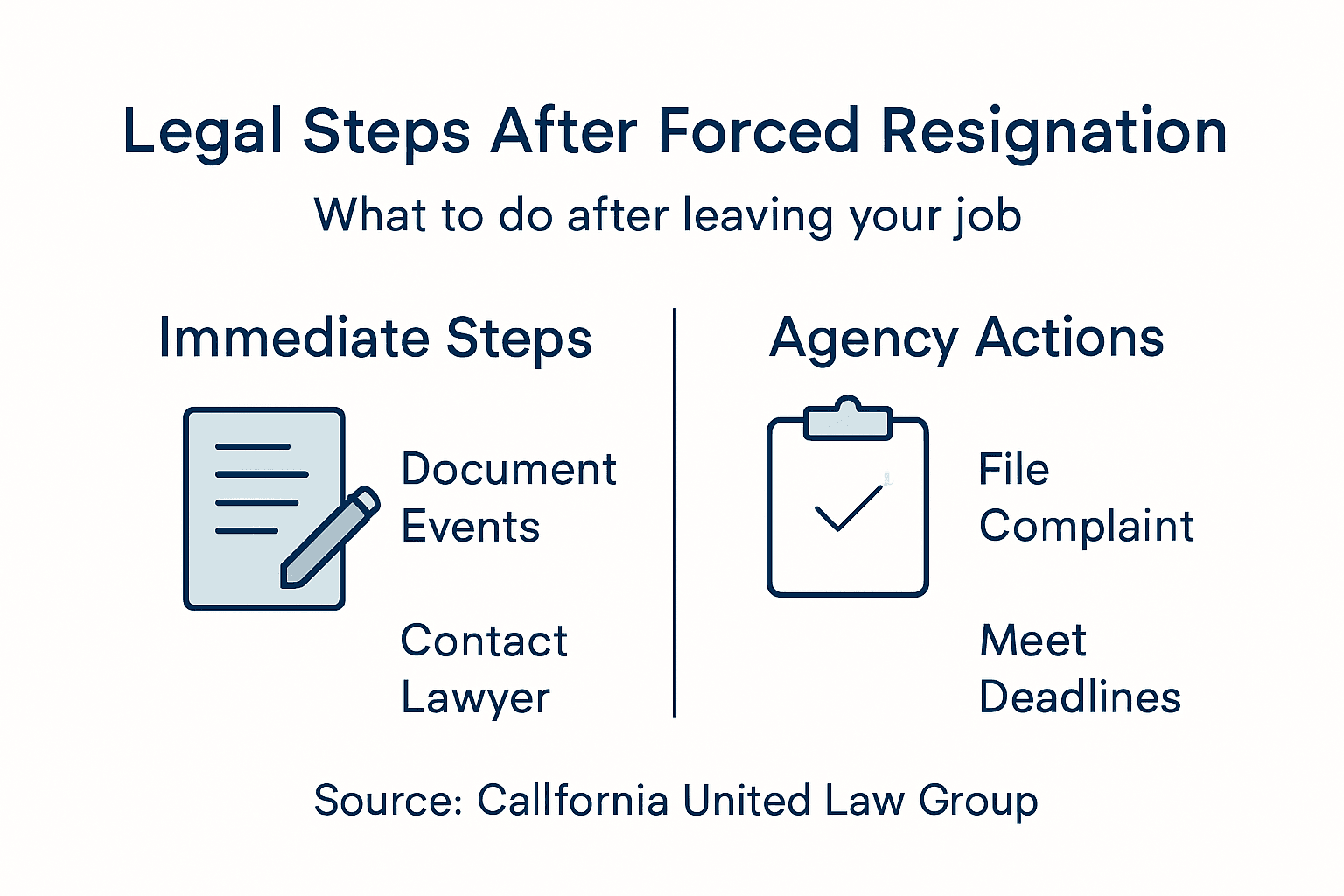
Start by documenting everything thoroughly. Gather emails, text messages, performance reviews, safety reports, and any written communication showing the intolerable conditions or your complaints. Collect names and contact information for potential witnesses who experienced or observed the mistreatment.
Actions to take immediately after resigning:
- Compile all evidence including communications, dates, and witness details
- Write a detailed account of events leading to your resignation while memories are fresh
- Preserve your resignation letter and any employer responses
- Gather documentation of complaints you made before resigning
- Obtain copies of any safety reports or incident records you filed
- Save medical records if unsafe conditions caused health issues
Consult with an employment lawyer promptly. After quitting due to forced resignation, employees should document all relevant evidence such as communications and witness accounts showing intolerable conditions. An attorney can assess whether you have a viable constructive discharge claim and explain your options.
You may need to file complaints with government agencies. Depending on the reason for resignation, you might file with California’s Civil Rights Department (CRD), formerly known as the Department of Fair Employment and Housing (for discrimination and harassment claims), Cal/OSHA (for safety violations), or the Department of Labor (for wage issues).
Statutory deadlines apply to legal claims, so acting quickly matters. Specific deadlines vary by claim type. For example, FEHA claims generally must be filed with the Civil Rights Department within three years of the last discriminatory act. Other claims may have different limitation periods. Consult with an attorney promptly to ensure you do not miss critical deadlines. Following established legal procedures and preserving records improves your chances of successful claims for constructive discharge or discrimination.
This table summarizes which California agencies address common claims arising from forced resignation scenarios:
| Claim Type | Relevant Agency | Typical Outcome |
|---|---|---|
| Discrimination | Civil Rights Department (CRD) | Investigation, possible settlement |
| Safety Violations | Cal/OSHA | Inspection, fines, corrective orders |
| Wage Issues | Dept. of Labor Standards Enforcement | Recovery of unpaid wages, penalties |
| Retaliation | Civil Rights Department (CRD) | Restoration of rights, damages |
Acting promptly after resignation is important to preserve evidence and meet applicable statutes of limitations. Delays may weaken your case and some legal deadlines cannot be extended.
Your employment lawyer will guide you on whether to pursue settlement negotiations, administrative complaints, or litigation based on your specific situation and evidence strength.
Pro tip: Within days of resigning, send yourself a detailed email documenting everything that happened, including dates, people involved, and what was said—this creates a timestamped record that strengthens your credibility later.
Protect Your Rights After a Forced Resignation in Pasadena
If you were forced to quit your job in Pasadena because of intolerable or unsafe working conditions you are not alone and you have legal options. Facing a constructive discharge situation means your employer may have violated your rights under California law including protections against wrongful termination harassment and retaliation. Understand that you deserve justice and support during this difficult time.
The experienced Pasadena employment attorneys at California United Law Group P.C. specialize in handling cases like yours. We help employees hold employers accountable for illegal workplace conduct and unsafe environments. Acting quickly and with the right legal team can make a difference. Visit our Pasadena category page to learn how we fight for employees forced out unfairly. To understand claims of unlawful termination see our Wrongful Termination page. When you are ready to take the next step get trusted advice from California United Law Group.
If you believe you were constructively discharged, consulting with an experienced employment attorney can help you understand your legal options and whether you may have valid claims under California law.
Important California Constructive Discharge Cases
California courts have developed constructive discharge law through several key decisions:
Turner v. Anheuser-Busch, Inc. (1994) 7 Cal.4th 1238 – The California Supreme Court established the foundational test for constructive discharge, holding that employers must either intentionally create or knowingly permit working conditions so intolerable that a reasonable person would have no reasonable alternative except to resign. The Court emphasized that single, trivial, or isolated acts are generally insufficient, and conditions must be unusually aggravated or amount to a continuous pattern.
Brome v. California Highway Patrol (2020) 44 Cal.App.5th 786 – The court clarified that discriminatory treatment can accumulate over time, and each individual incident need not be sufficient standing alone to force a resignation.
Vasquez v. Franklin Management Real Estate Fund, Inc. (2013) 222 Cal.App.4th 819 – The court confirmed that whether conditions were sufficiently intolerable to justify resignation is normally a question of fact for the jury.
These cases demonstrate that constructive discharge claims require substantial evidence of objectively intolerable conditions and employer knowledge.
Frequently Asked Questions
What is a forced resignation?
A forced resignation occurs when an employer creates intolerable conditions that compel an employee to quit. This situation often involves illegal conduct like harassment or unsafe working conditions, leading to what is legally termed constructive discharge.
What are the signs that I may have been forced to resign?
Signs of a forced resignation include experiencing ongoing harassment, unsafe working conditions, or threats and intimidation from management. If you feel you had no reasonable option but to quit due to these factors, you may have a case for constructive discharge.
What legal rights do I have if I was forced to resign?
If you were forced to resign and can prove the elements of constructive discharge, you may be able to pursue claims similar to wrongful termination. Success depends on whether you can establish that working conditions were objectively intolerable, that your employer had actual knowledge of them, and that you had no reasonable alternative except to resign. California law treats constructive discharge similarly to wrongful termination, allowing you to seek remedies if your resignation was due to intolerable conditions.
What steps should I take after quitting if I believe I was forced to resign?
Immediately document any evidence related to your resignation, including emails, messages, and witness information. It’s also important to consult with an employment lawyer to assess your case and discuss potential legal actions and filing complaints with relevant agencies.