
Facing workplace violations can leave Culver City employees feeling anxious about possible retaliation and uncertain about their legal options. When threats, harassment, discrimination, or unsafe conditions arise, knowing your rights is crucial. Federal and state laws protect workers from retaliation for reporting workplace misconduct, empowering you to stand up for yourself and pursue a safer, fairer environment. This article clarifies what actually counts as a workplace violation and explains the legal protections you have when your rights are compromised.
Table of Contents
- What Counts As Workplace Violations In Culver City
- Legal Protections Against Retaliation Or Firing
- Key Laws Governing Employee Whistleblowers
- Culver City Civil Service And Appeal Processes
- Common Retaliation Tactics And How To Respond
- Practical Steps If You Face Workplace Retaliation
Key Takeaways
| Point | Details |
|---|---|
| Understanding Workplace Violations | Familiarize yourself with various types of workplace violations, such as physical violence, harassment, and wage theft, to recognize and address them effectively. |
| Legal Protections Against Retaliation | Employees can report workplace violations safely, knowing they are protected against wrongful termination and retaliatory actions. |
| Documentation is Crucial | Always keep detailed records of incidents, communications, and any retaliatory actions, as this documentation can be vital in legal proceedings. |
| Know Your Rights | Being informed about your rights and the proper channels to report misconduct empowers you to take action against workplace violations. |
What Counts As Workplace Violations In Culver City
Workplace violations in Culver City represent serious legal concerns that can impact employee rights and organizational safety. These violations encompass a broad range of inappropriate behaviors and systemic issues that compromise professional environments. Workplace violence prevention requires understanding the multiple dimensions of potential misconduct.
Workplace violations in Culver City can be categorized into several critical areas:
- Physical violence or threats
- Verbal harassment
- Discriminatory practices
- Sexual harassment
- Wage theft
- Unsafe working conditions
- Retaliatory actions against reporting employees
Employers have legal obligations to maintain safe, respectful work environments. This means implementing comprehensive policies that protect employees from various forms of misconduct. Federal and state labor laws mandate specific protections for workers, ensuring they can report violations without fear of professional retaliation.
Specifically, workplace violations might include scenarios like:
- Consistent verbal abuse by supervisors
- Unequal pay based on gender or race
- Refusing reasonable workplace accommodations
- Creating hostile work environments
- Ignoring safety protocol violations
Understanding these violations empowers employees to recognize inappropriate workplace behaviors and take appropriate legal action when necessary. Workers have the right to a safe, respectful professional environment free from unlawful harassment, discrimination, and recognized workplace hazards under California and federal law.
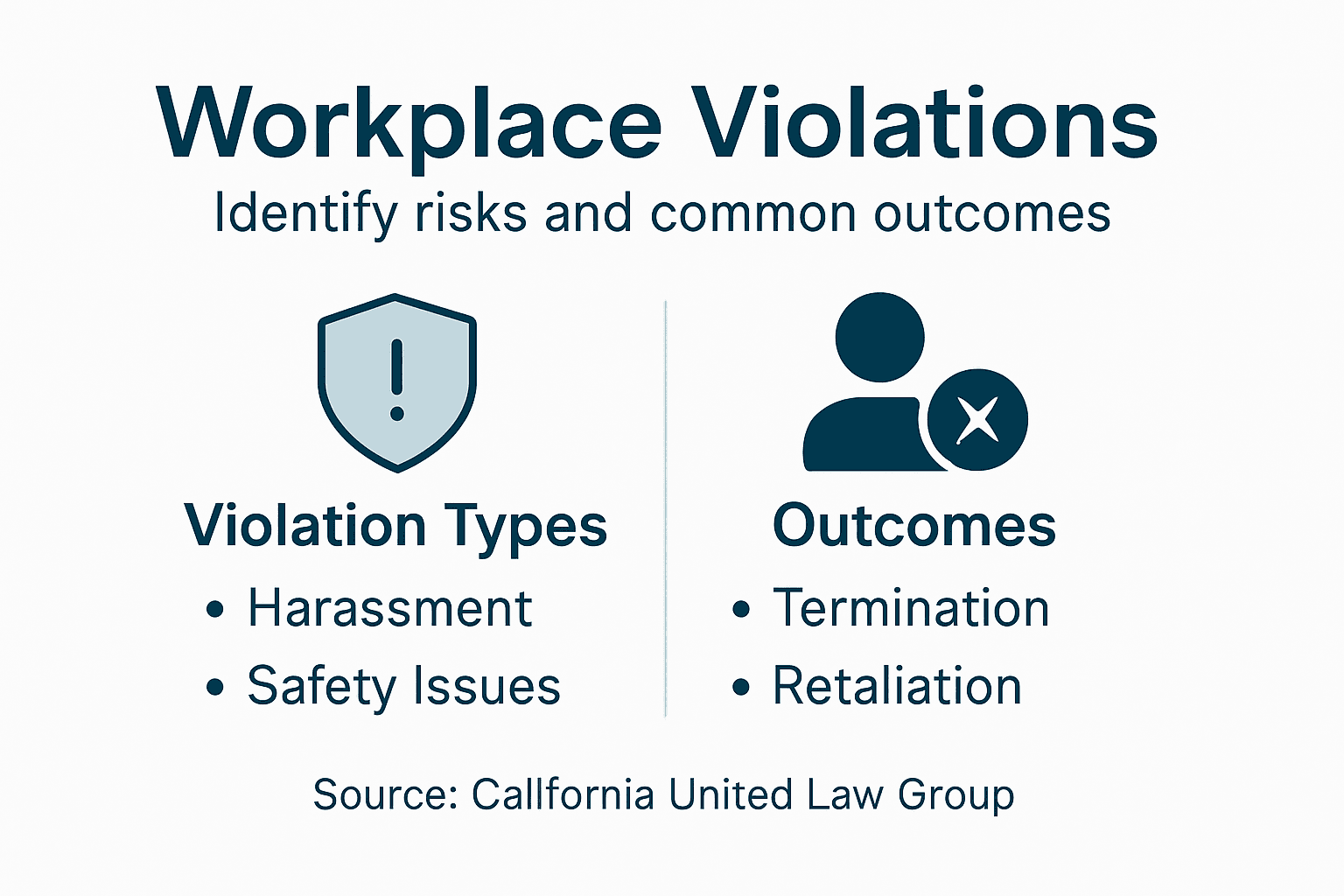
Here’s a summary of common workplace violations and their potential impacts on employees:
| Violation Type | Typical Outcome | Employee Risk |
|---|---|---|
| Physical aggression | Injury or trauma | Job safety compromised |
| Verbal harassment | Emotional distress | Hostile atmosphere |
| Wage violations | Financial loss | Unfair compensation |
| Unsafe work conditions | Accident likelihood | Health hazards |
| Retaliation | Job insecurity | Rights infringement |
Pro tip: Always document any workplace violations with detailed notes, including dates, times, and specific incidents, as this information can be crucial for potential legal proceedings.
Legal Protections Against Retaliation Or Firing
Employees in Culver City have robust legal protections against workplace retaliation, providing legal remedies and recourse if they experience adverse actions after reporting violations. Legal protections against retaliatory firing provide critical safeguards for workers who speak up about workplace misconduct.
Federal and state laws offer comprehensive protections for employees, including:
- Protection from wrongful termination
- Safeguards against demotion or reduced hours
- Legal recourse for reporting safety violations
- Compensation for retaliatory actions
- Protection for whistleblowing activities
The Department of Labor enforces multiple legal protections designed to shield employees from retaliation. Federal retaliation laws specifically prohibit employers from taking adverse actions against workers who:
- Inquire about workplace conditions
- Assert their legal rights
- File official workplace complaints
- Participate in workplace investigations
- Report potential safety or discrimination issues
Specifically, retaliation can manifest in various forms, including termination, demotion, reduced work hours, pay cuts, or creating a hostile work environment. Workers who experience such actions after reporting workplace violations may have legal grounds to challenge their employer’s conduct if they can demonstrate that the protected activity was a substantial or contributing factor in the adverse employment action.

Pro tip: Always keep detailed documentation of any workplace incidents, communications, and potential retaliatory actions, as these records can be crucial evidence in legal proceedings.
The table below compares main legal protections available to employees facing workplace retaliation:
| Protection Type | Description | Enforcing Agency |
|---|---|---|
| Wrongful termination defense | Guards against illegal firing | Equal Employment Opportunity Commission |
| Compensation for retaliation | Allows monetary recovery | Department of Labor |
| Whistleblower safeguards | Ensures anonymity and safety for reports | OSHA |
| Grievance appeal options | Enables challenging adverse actions | Civil Service Commission |
Key Laws Governing Employee Whistleblowers
Employee whistleblowers in Culver City benefit from comprehensive legal protections designed to shield them from potential workplace retaliation. Whistleblower protection laws provide critical safeguards for workers who expose workplace violations, ensuring they can report misconduct without fear of professional consequences.
The Department of Labor enforces multiple federal statutes that protect whistleblowers across various domains:
- Workplace safety regulations
- Discrimination reporting
- Environmental protection standards
- Financial fraud detection
- Wage and hour law compliance
- Consumer product safety
Under these legal frameworks, OSHA’s Whistleblower Protection Program covers over 20 distinct federal laws that defend employees who raise legitimate workplace concerns. These protections extend to workers reporting issues such as:
- Unsafe working conditions
- Potential health hazards
- Discriminatory practices
- Financial misconduct
- Regulatory violations
Critical legal protections prevent employers from taking retaliatory actions against whistleblowers, including termination, demotion, harassment, or creating hostile work environments. Employees who experience adverse actions after reporting violations can file formal complaints and seek legal remedies to protect their professional rights and interests.
California courts have reinforced these protections in numerous decisions. In Hager v. County of Los Angeles (2014) 228 Cal.App.4th 1538, the court clarified that whistleblower protection extends beyond just the first employee who reports a violation. More recently, in People ex rel. Garcia-Brower v. Kolla’s, Inc. (2023) 14 Cal.5th 719, the California Supreme Court adopted a broad interpretation of Labor Code section 1102.5, holding that employees are protected when disclosing unlawful activity to employers or agencies even if the recipient already knows about the violation.
Pro tip: Maintain detailed, contemporaneous documentation of all workplace communications and potential violations, as these records can serve as crucial evidence in whistleblower protection claims.
Culver City Civil Service And Appeal Processes
Note: The following section applies specifically to Culver City municipal employees who are covered by the city’s civil service system. Private sector employees have different administrative processes and should consult with an attorney about the appropriat0e agencies for their claims.
Culver City’s civil service system provides critical protections for municipal employees facing potential disciplinary actions or workplace disputes. Civil service procedures are designed to ensure fair treatment, merit-based employment, and transparent administrative processes.
The city’s civil service framework includes several key components:
- Merit-based appointment and promotion systems
- Comprehensive disciplinary review processes
- Formal grievance and appeal mechanisms
- Protection against discriminatory workplace actions
- Independent oversight by the Civil Service Commission
Civil Service Commission members play a crucial role in maintaining administrative fairness by:
- Hearing employee appeals
- Reviewing suspension and termination cases
- Investigating workplace grievances
- Recommending policy amendments
- Ensuring procedural integrity
Employees facing potential disciplinary actions have specific rights within this system, including the ability to challenge suspensions, demotions, or terminations through formal administrative hearings. The commission can subpoena witnesses, review evidence, and make binding recommendations that protect employee rights while maintaining organizational accountability.
Pro tip: Document every interaction and keep comprehensive records of workplace communications, as these can be critical evidence during civil service appeal processes.
Common Retaliation Tactics And How To Respond
Workplace retaliation can take many subtle and overt forms designed to intimidate employees who report workplace violations. Workplace retaliation tactics represent systematic efforts by employers to discourage workers from exercising their legal rights and exposing organizational misconduct.
Common retaliation tactics include:
- Sudden job termination
- Unexpected performance demotions
- Reduction in work hours or pay
- Exclusion from critical meetings
- Professional isolation
- Unwarranted disciplinary actions
- Harassment or intimidation
Employees facing potential retaliation should respond strategically by:
- Documenting every incident meticulously
- Reporting actions to appropriate agencies
- Preserving communication records
- Seeking legal consultation
- Understanding their protected rights
Under federal and California employment protection laws, employees who engage in protected activities—such as reporting violations of law, discrimination, or unsafe conditions—have legal remedies if they experience retaliatory actions. Under Labor Code section 1102.5, employees must have a reasonable belief that the information they disclose involves a violation of law.
California courts recognize that retaliation claims are inherently fact-specific. As the court stated in Yanowitz v. L’Oreal USA, Inc. (2005) 36 Cal.4th 1028, a series of retaliatory acts may collectively constitute an adverse employment action even if no single act alone would be actionable. Additionally, in McCoy v. Pacific Maritime Assn. (2013) 216 Cal.App.4th 283, the court emphasized that determining retaliation is a jury question, as these actions are ‘inherently fact-driven.’
Pro tip: Create a contemporaneous log of all workplace interactions, including dates, witnesses, and specific details, as this documentation can become critical evidence in potential legal proceedings.
Practical Steps If You Face Workplace Retaliation
Confronting workplace retaliation requires strategic and deliberate action to protect your professional rights and personal career trajectory. Workplace retaliation protocols provide critical guidance for employees navigating challenging professional environments where their rights have been compromised.
Immediate steps to address workplace retaliation include:
- Gathering and preserving all relevant documentation
- Identifying potential witnesses
- Recording specific dates and details of retaliatory actions
- Maintaining a contemporaneous incident log
- Securing digital and physical evidence
- Avoiding direct confrontational interactions
Employees should respond through structured, professional channels:
- Notify human resources in writing
- Review company anti-retaliation policies
- File formal internal complaints
- Consult with employment law professionals
- Prepare potential external agency complaints
Federal employment protection guidelines emphasize the importance of understanding your rights and maintaining professional composure throughout the process. These protections ensure employees can challenge workplace misconduct without fear of additional professional repercussions.
Pro tip: Create a secure, chronological digital folder with all relevant communications, storing copies both electronically and in a physical location to prevent potential evidence loss.
Protect Your Rights After Reporting Workplace Violations in Culver City
Facing retaliation or wrongful termination after reporting workplace violations can feel isolating and overwhelming. You deserve a workplace where safety and fairness come first. If your employer has fired you or taken adverse actions after you reported unsafe conditions or misconduct, know that legal protections exist to defend your rights. Terms like “retaliation,” “wrongful termination,” and “whistleblower protection” are critical to understand in this fight.
California United Law Group, P.C. specializes in representing employees experiencing retaliation and wrongful termination in California. Our skilled team is dedicated to standing up against employer retaliation under California Labor Code and FEHA claims. Don’t let intimidation or unfair treatment threaten your livelihood. Learn more about your rights and how we can help at Wrongful Termination & Retaliation – Los Angeles Employment Lawyers | California United Law Group, P.C.. Take control of your situation today by contacting us through our main site California United Law Group, P.C… Your career and peace of mind deserve immediate protection.
Frequently Asked Questions
What are the legal protections for employees who report workplace violations?
Employees who report workplace violations are protected by federal and state laws, which include safeguards against wrongful termination, demotion, and retaliation for reporting misconduct. These laws ensure that workers can report issues without fear of adverse actions from their employers.
What should I do if I experience retaliation after reporting a violation?
If you experience retaliation, document every incident meticulously, keep records of communications, and report the actions to your human resources department. You may also seek legal consultation and consider filing a complaint with the relevant governmental agency.
Can employers legally fire an employee for reporting violations?
No, employers cannot legally fire an employee for reporting workplace violations. This constitutes retaliation, which is prohibited under various employment laws. Employees have the right to report misconduct without fear of losing their job.
How can I document workplace violations effectively?
To document workplace violations effectively, maintain a detailed log of incidents, including dates, times, specific behaviors, and any witnesses. Keeping a record of communications and any formal complaints submitted can also strengthen your case if legal action becomes necessary.
Recommended
- Employment Lawyer Culver City – Los Angeles Employment Lawyers | California United Law Group, P.C.
- Employment Lawyer Burbank – Los Angeles Employment Lawyers | California United Law Group, P.C.
- Wrongful Termination in California: What You Need to Know – Los Angeles Employment Lawyers | California United Law Group, P.C.
- Was Your Termination Illegal in Pasadena? California Law Explained – Los Angeles Employment Lawyers | California United Law Group, P.C.
- Wrongful Demotion California: You Need To Know This
- Experienced Cypress Employment Law Attorneys
LEGAL DISCLAIMER: This article is provided for general informational and educational purposes only and does not constitute legal advice for any specific case or situation. Legal outcomes are inherently uncertain, and California United Law Group, P.C. cannot and does not guarantee any specific result or outcome. While no promises can be made about the success of any case, the firm is dedicated to working diligently to pursue the best possible outcome for each client.
Reading this article does not create an attorney-client relationship between you and California United Law Group, P.C. For advice about your specific situation, please contact an attorney directly. The information in this article may be considered attorney advertising in some jurisdictions.
California United Law Group, P.C.
453 South Spring Street, Suite 321
Los Angeles, California 90013
(310) 744-1449