
TL;DR:
- Most Pasadena pay discrimination claims are individual and less systemic than Google’s cases.
- California laws protect employees through equal pay requirements, pay transparency, and anti-retaliation measures.
- Workers should document roles, gather proof, and consult legal help if facing unfair pay or retaliation.
Google’s high-profile pay discrimination settlements have put workplace wage fairness in the national spotlight. If you work in Pasadena, you may be asking whether your employer could be doing the same thing. The short answer is: pay gaps can exist anywhere, but the scale and evidence behind local cases look very different from what happened at Google. This article separates fact from concern, walks you through California’s legal protections, and gives you practical steps to take if you believe you are being paid unfairly in your Pasadena workplace.
Table of Contents
- How widespread are pay gaps in Pasadena compared to Google?
- The law: What protections exist for Pasadena employees?
- Recent Pasadena cases: What do local settlements reveal?
- How to recognize and address a potential pay gap
- Perspective: Why pay gap lawsuits rarely look like Google’s and what Pasadena employees should focus on
- Get legal help if you suspect wage unfairness in Pasadena
- Frequently asked questions
Key Takeaways
| Point | Details |
|---|---|
| No systemic pay gap proof | There is no public evidence that Pasadena employers have pay gaps on the scale of Google’s cases. |
| California equal pay laws | California law requires equal pay for substantially similar work regardless of gender, race, or ethnicity, with civil enforcement mechanisms available to employees. |
| Document and act early | Employees concerned about pay gaps should record evidence and seek legal advice as soon as possible. |
| Local cases are confidential | Most Pasadena pay gap or discrimination settlements are isolated and settled privately, unlike large national cases. |
How widespread are pay gaps in Pasadena compared to Google?
Now that you know the issue is in the spotlight, let’s examine if Pasadena mirrors the big cases making headlines.
The Google cases were remarkable in scope. Google paid millions in settlements for pay disparities affecting Latino, Indigenous, Pacific Islander, Black, and women employees. A separate racial bias lawsuit resulted in a $50 million settlement for Black employees. These were systemic findings, backed by data across thousands of workers.
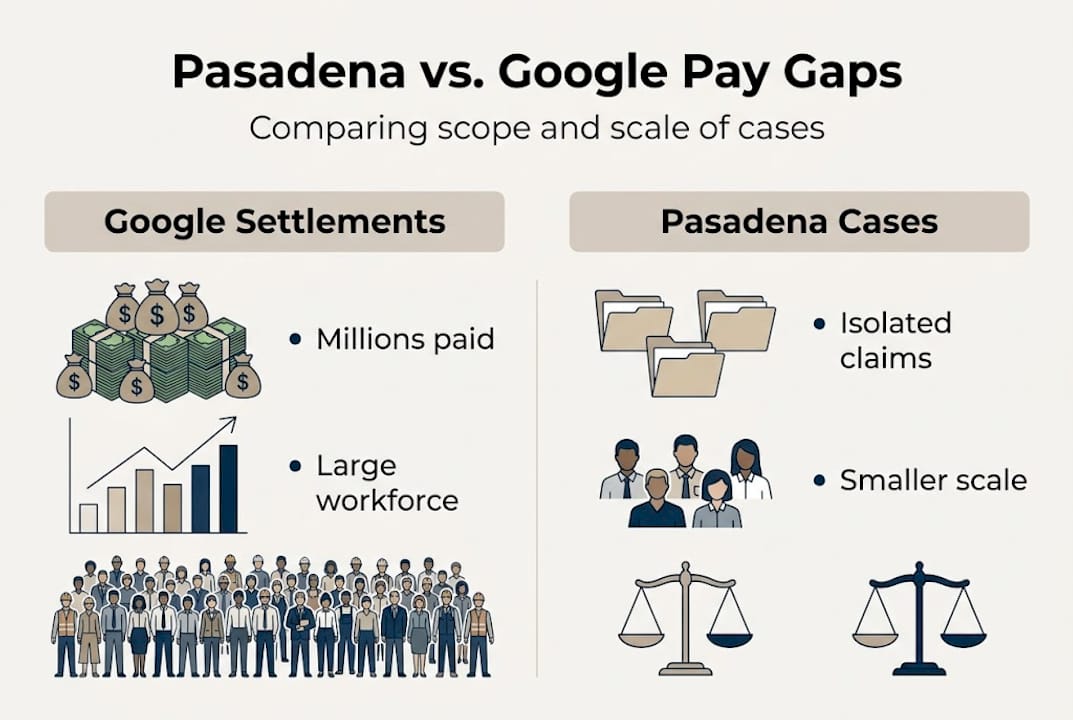
Pasadena’s landscape is different. Local discrimination claims tend to be isolated, individual, and far smaller in scale. There is no verified, public empirical data showing systemic pay gaps at Pasadena employers comparable to what Google’s internal records revealed.
Here is a look at how the two situations compare:
| Factor | Google settlements | Pasadena cases |
|---|---|---|
| Scale | Thousands of employees | Individual claimants |
| Evidence | Internal pay data, audits | Personal documentation |
| Public disclosure | Extensive | Mostly confidential |
| Settlement amounts | Tens of millions | Undisclosed or smaller |
| Type of claim | Systemic pay disparity | Retaliation, discrimination |
Types of discrimination claims reported in Pasadena include:
- Gender discrimination (including demotion and sexist treatment)
- Age discrimination (particularly in healthcare settings)
- Retaliation for reporting workplace concerns
- Disability-related disputes in tech and research environments
A female JPL worker settled allegations of sexist treatment and retaliation, which is a serious individual claim but not evidence of a Google-scale systemic pay gap. This distinction matters. A settlement does not automatically mean a company-wide pay problem exists. It means one employee’s claim was resolved.
“Pasadena discrimination settlements are isolated and not equivalent in scale or evidence to Google’s systemic pay gaps.”
If you are curious how similar dynamics play out at large entertainment employers, our breakdown of pay gaps at Disney and Warner Bros. in Burbank offers useful context.
The law: What protections exist for Pasadena employees?
If pay gaps in Pasadena aren’t as proven as Google’s, what laws protect employees here?
California has some of the strongest pay equity laws in the country. California law requires equal pay for substantially similar work, and legal claims hinge on comparisons between employees doing comparable jobs, regardless of job title.

Here is a summary of key protections:
| Law or protection | What it does |
|---|---|
| California Equal Pay Act | Requires equal pay for substantially similar work |
| FEHA (Fair Employment and Housing Act) | Prohibits pay discrimination based on protected characteristics |
| Salary history ban | Bars employers from asking about or using prior salary to set pay |
| Pay scale transparency | Employers with 15 or more employees must include the pay scale in any job posting and must provide the pay scale for an employee’s current position upon request. |
| Retaliation protections | Employees cannot be punished for discussing or challenging pay |
What counts as “substantially similar work”? Courts look at:
- Skill level required for the role
- Effort involved in performing the job
- Responsibility assigned to the position
- Working conditions
California and federal courts have shaped how these factors apply in practice. In Jones v. Tracy School District (1980) 27 Cal.3d 99, the California Supreme Court confirmed that the California Equal Pay Act entitles employees to equal pay for equal work, and that courts look to federal precedent in construing its provisions. More recently, in Allen v. Staples, Inc. (2022) 84 Cal.App.5th 188, the California Court of Appeal held that to prove a prima facie case of wage discrimination, a plaintiff must establish not only that she was paid lower wages than a comparator for equal work, but that she selected a proper comparator — meaning the comparison must be to someone doing genuinely equivalent work, not just a similar job title. On the issue of salary history, the Ninth Circuit in Rizo v. Yovino (9th Cir. 2020) 950 F.3d 1217 held that an employer cannot justify paying a female employee less by pointing to her prior salary — a practice California has also banned by statute. And notably, under California law, a pay equity plaintiff does not need to prove the employer intended to discriminate. As the court held in Green v. Par Pools, Inc. (2003) 111 Cal.App.4th 620, there is no discriminatory intent requirement to sustain a California Equal Pay Act claim.
To build a California Equal Pay Act or FEHA pay equity claim based on gender, race, or ethnicity, you generally need:
- Proof of your job functions and responsibilities
- Records of your total compensation (base pay, bonuses, equity)
- Evidence of what peers in comparable roles earn
- Documentation of any complaints you raised internally
Salary history is a key issue. Google’s settlements showed how relying on prior pay to set new salaries can lock in and amplify existing gaps. California’s ban on salary history questions helps prevent this cycle. If an employer asks about your previous salary during hiring, that is a red flag and is unlawful under California Labor Code section 432.3. Note, however, that if you voluntarily disclose your prior salary, an employer may consider it — though even voluntarily disclosed prior salary alone cannot legally justify a pay disparity.
Pro Tip: Keep your offer letters, promotion records, and pay stubs organized in one place. If you ever need to file a claim, this documentation is your strongest foundation.
An employment lawyer in Pasadena can help you assess whether your situation meets the legal standard for a claim. Understanding the employment lawsuit process in California is also a helpful first step before taking action.
Recent Pasadena cases: What do local settlements reveal?
Knowing your rights is one thing. How do real Pasadena cases stack up?
Recent Pasadena-area settlements tell a story of individual courage, not systemic exposure. A female JPL worker settled claims involving sexist treatment and demotion. A Kaiser employee sued for age discrimination in a separate case. These are meaningful legal actions, but they differ fundamentally from Google’s data-driven, company-wide findings.
Here is what recent Pasadena cases typically involve:
- Retaliation claims: Employees punished for speaking up about unfair treatment
- Gender discrimination: Demotions or hostile treatment tied to sex
- Age discrimination: Older employees pushed out or passed over
- Disability accommodation failures: Employers not meeting legal obligations
Three important distinctions to understand:
Retaliation means your employer punished you for a protected activity, like reporting discrimination. Discrimination means you were treated worse because of a protected characteristic. Pay gap claims specifically involve wage differences that cannot be explained by legitimate factors like experience or performance.
Settlements in Pasadena are almost always confidential. No public data on systemic pay disparities in Pasadena settlements is available, which makes it hard to draw broad conclusions. A settlement also does not prove wrongdoing. It means both sides agreed to resolve a dispute.
The lesson here is that magnitude matters. Google’s cases moved the needle because of volume and statistical evidence. Most Pasadena cases are resolved quietly, with limited public impact. That does not make them less valid for the individuals involved.
Pro Tip: Document patterns, not just one-off incidents. A single bad performance review is hard to argue. A pattern of being passed over for promotions while less-qualified peers advance is a much stronger foundation for a claim.
For more on how employment cases in Pasadena unfold, or to understand how disability accommodation cases are handled locally, we have resources that walk you through both.
How to recognize and address a potential pay gap
Learning from cases is useful, but what can you do if you suspect you are underpaid?
The City of Pasadena hosts pay equity events like HERstory 2026, designed to educate employees about their rights and connect them with advocacy resources. These are worth attending, but your personal action plan matters just as much.
Here are the steps to take if you suspect a pay gap:
- Compare your role carefully. Look at job descriptions for colleagues in similar positions. Focus on responsibilities, not just titles.
- Gather your documentation. Collect offer letters, pay stubs, performance reviews, and any written feedback you have received.
- Research pay ranges. California employers must provide pay scale information upon request. Use that right.
- Talk to HR thoughtfully. Frame your concern around job responsibilities and market data, not personal grievances. Keep notes of every conversation.
- Consult a legal professional. If HR does not resolve the issue, or if you face retaliation for raising concerns, speak with an employment attorney before taking further steps.
Pro Tip: Look for patterns among coworkers, not just your own situation. If multiple people in your demographic group are paid less for similar work, that pattern is far more compelling than a single comparison.
Lessons from Burbank pay gap cases show that employees who documented early and sought legal advice quickly were better positioned to resolve disputes. Knowing how to prove workplace harassment in California also applies here, since retaliation for raising pay concerns follows similar evidentiary rules.
Perspective: Why pay gap lawsuits rarely look like Google’s and what Pasadena employees should focus on
Having covered practical steps, let’s get real about why outcomes in Pasadena likely look quite different from those in national headlines.
Google’s settlements required extensive evidence across thousands of employees, including internal pay audits and statistical analysis. That kind of evidence takes years to build and requires access to data most employees never see.
Most Pasadena employers will never face that level of scrutiny, not because they are necessarily doing everything right, but because the evidence is harder to aggregate and cases are resolved before patterns become public.
What this means for you: do not wait for a watershed moment. Your situation matters now, even if it never makes headlines. The employees who get results are those who document consistently, understand their legal rights, and connect with knowledgeable support early.
Local cases around disability accommodation show the same pattern. Quiet, individual resolutions happen far more often than public trials. That is not a failure. It means the system can work for you, if you engage with it properly.
Get legal help if you suspect wage unfairness in Pasadena
If you are ready to take action, connecting with a Pasadena employment attorney is a smart step.
👉 At California United Law Group, P.C., we represent Pasadena employees facing pay discrimination, retaliation, and wage disputes. We offer confidential consultations so you can understand your options without pressure. Whether you are at the early documentation stage or ready to escalate, we are here to help.
Explore your rights under wage and hour laws and learn how a Pasadena employment lawyer can evaluate your specific situation. You do not have to navigate this alone. We have helped employees across California take meaningful steps toward fair pay. Every case is different, and past outcomes do not guarantee similar results in your matter, but we are here to help you understand your options.
Frequently asked questions
Have pay gaps been proven at Pasadena employers like they were at Google?
There is no public evidence of large-scale, systemic pay gaps at Pasadena employers similar to those proven at Google. Local cases tend to be isolated, confidential settlements without statistical disclosures.
What should I do if I think I’m being paid unfairly compared to coworkers in Pasadena?
Start by documenting your pay and responsibilities, then compare your role with colleagues doing similar work. California law requires equal pay for substantially similar work, so if internal HR steps fail, consult a local employment lawyer.
Are salary history questions still legal for Pasadena job applicants?
Generally, no. California Labor Code section 432.3 prohibits employers from asking about or relying on an applicant’s salary history. However, if an applicant voluntarily discloses their prior salary, an employer may consider it — though prior salary alone can never legally justify a pay disparity under the California Equal Pay Act.
Does the City of Pasadena offer pay equity resources or events?
Yes. The City of Pasadena hosts events like HERstory 2026 designed to educate employees about pay equity rights and connect them with advocacy support.