
TL;DR:
- California law requires all private employers in Torrance to reimburse necessary work expenses.
- Employees should keep detailed records and follow proper procedures to secure reimbursement.
- California law prohibits retaliation against employees who assert their expense reimbursement rights, and legal actions — including complaints with the Labor Commissioner and civil lawsuits — are available remedies.
Many employees in Torrance assume their employer has the final say on whether to pay back work-related costs. Some believe local city rules apply, or that reimbursement is simply a company perk rather than a legal right. That assumption is wrong, and it costs workers real money. City of Torrance follows California state law on this issue, not any separate local ordinance. That means every private-sector employee in Torrance is protected by the same statewide standard. Understanding exactly what that standard requires, and what to do when your employer ignores it, is what this article is about.
Table of Contents
- How California law governs expense reimbursement in Torrance
- Examples of covered work expenses and common real-world issues
- The employer’s obligations: Process, documentation, and deadlines
- Consequences: What if your Torrance employer fails to reimburse you?
- Why employees often overlook their reimbursement rights: Our take
- Get help: Protect your reimbursement rights now
- Frequently asked questions
Key Takeaways
| Point | Details |
|---|---|
| California law controls | All Torrance private employers must follow statewide expense reimbursement laws. |
| Typical reimbursable expenses | Common claims include cell phones, mileage, home office supplies, and uniforms. |
| Clear steps if denied | Document your costs, know your rights, and pursue remedies if reimbursement isn’t provided. |
| Legal help is available | Employees can reach out for legal guidance if they face reimbursement issues or retaliation. |
How California law governs expense reimbursement in Torrance
After clarifying the initial confusion, let’s look at the law that actually regulates expense reimbursement for employees in Torrance.
California Labor Code §2802 requires employers to reimburse employees for all necessary expenditures or losses incurred as a direct result of performing their job duties. California courts have repeatedly affirmed this obligation. The California Supreme Court has explained that the purpose of §2802 is “to prevent employers from passing their operating expenses on to their employees.” (Gattuso v. Harte-Hanks Shoppers, Inc. (2007) 42 Cal.4th 554, 562.) This principle applies to all forms of necessary work expenditures, from vehicle use to personal devices. This is not optional. It is a binding legal obligation that applies to every private employer in the state, including every business operating in Torrance.
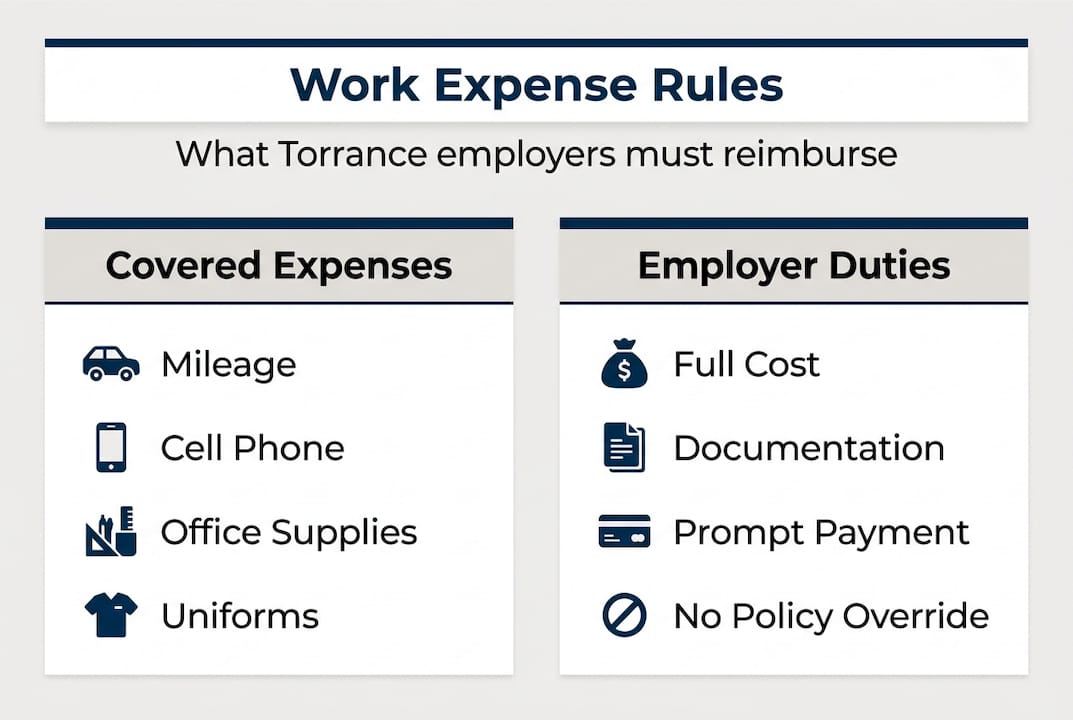
The City of Torrance has no separate city-specific reimbursement mandates for private employers. That means your employer cannot point to a local loophole to avoid paying you back. The state standard is the standard, full stop.
So what counts as a “necessary” expense? Labor Code §2802 requires that expenses be ‘necessary’ — meaning costs that are a direct consequence of performing your job duties. While the statute does not use the phrase ‘reasonable and necessary,’ reasonableness can become relevant when calculating the exact amount owed; for example, courts may consider whether an employee’s choice of vehicle or phone plan was reasonable in determining how much the employer must pay back. Here are common examples:
- Mileage and vehicle costs when you drive your personal car for work errands or client visits
- Cell phone use when your employer requires or expects you to use your personal phone for work calls, emails, or apps
- Home office supplies and internet if you work remotely and need equipment or connectivity to do your job
- Uniforms or required clothing that your employer requires you to wear and that cannot be worn as everyday attire
- Note: Under California’s Industrial Welfare Commission Wage Orders, employers who require uniforms must furnish them and pay for their upkeep — the obligation runs to the employer to provide, not merely to reimburse.
- Tools and equipment your employer requires but does not provide
- Required training costs that you pay out of pocket
- Business meals when they are a genuine job requirement
Key point: The law does not require you to prove that your employer explicitly told you to spend money. If the expense was a direct consequence of performing your job duties, it likely qualifies — even if no one instructed you to incur the cost.
Pro Tip: If you are unsure whether a specific expense qualifies, consult an employment lawyer in Torrance before assuming your employer is off the hook. Many employees give up valid claims simply because they did not know the law covered their situation.
One important nuance: the reimbursement must cover the actual cost to you. If your employer offers a flat stipend that does not fully cover your real expenses, you may still have a claim for the difference.
Examples of covered work expenses and common real-world issues
Now that you know what the law says, let’s explore what those “necessary” expenses actually look like in practice.
Some expense categories are clear-cut. Others land in gray areas where employers and employees frequently disagree. Knowing the difference helps you recognize when you have a legitimate claim.
Common reimbursable expense categories:
- Personal cell phone used for work calls, messaging apps, or email
- Courts have made clear that cell phone reimbursement is always required when employees must use personal phones for work — even if the employee’s plan already covers the cost. In Cochran v. Schwan’s Home Service, Inc. (2014) 228 Cal.App.4th 1137, 1144, the Court of Appeal held that to allow otherwise “would be passing [the employer’s] operating expenses on to the employee,” a result §2802 was designed to prevent. Employers must therefore pay some reasonable percentage of the employee’s cell phone bill whenever work-related use is required or expected.
- Mileage driven in your personal vehicle for work purposes — California law recognizes several calculation methods, including the IRS standard mileage rate, which many employers use and which courts have accepted as a lawful means of satisfying the reimbursement obligation
- Home internet and office supplies when working remotely
- This principle has been extended to remote work. In Thai v. International Business Machines Corp. (2023) 93 Cal.App.5th 364, 370–371, the court held that expenses employees incur while required to work from home are reimbursable if they were a “direct consequence” of the employee’s job duties — the key question is whether the expense arose from performing the job, not how the employee came to be working from home.
- Work-required software subscriptions paid personally
- Parking and tolls incurred during work travel
Gray areas that often lead to disputes:
| Expense type | Typically reimbursable? | Why it’s contested |
|---|---|---|
| Personal cell phone (partial use) | Yes, proportional amount | Employers dispute what percentage is work-related |
| Home office internet | Yes, if remote work is required | Employers argue it’s a personal expense |
| Uniforms | Yes, if not everyday wear | Employers claim general clothing is personal |
| Required training | Yes, if employer-mandated | Employers sometimes classify it as voluntary |
| Business meals | Yes, if job-required | Employers dispute whether meals were truly necessary |
Class actions are frequent for systemic failures to reimburse, particularly involving cell phones, home office costs, and mileage. When an employer has a blanket policy of not reimbursing these costs, it often affects dozens or hundreds of employees at once, which is why group lawsuits are so common in California.
A real-world example: A customer service team is required to use a personal cell phone to respond to clients after hours. The employer never reimburses any portion of the phone bill. Each employee may have a small individual claim, but collectively, the unpaid amounts add up fast.

It is also worth noting that issues around employer disability accommodations can sometimes intersect with expense reimbursement, particularly when an employee needs specific equipment or tools as part of a workplace accommodation.
Pro Tip: Track every work-related expense in a simple spreadsheet. Note the date, amount, purpose, and whether your employer was aware. This habit alone can make or break a future claim.
The employer’s obligations: Process, documentation, and deadlines
Understanding which expenses qualify is only half the battle. Here’s how the actual reimbursement process works.
California law does not prescribe a single rigid reimbursement process, but employers are expected to have a clear, accessible system. Here is what a compliant process typically looks like:
- Submit a written request. Put your reimbursement request in writing, even if your employer accepts verbal requests. Email works well because it creates a record.
- Attach supporting documentation. Include receipts, mileage logs, phone bills, or any other evidence that shows the expense was real and work-related.
- Follow your employer’s stated policy. If your company has a reimbursement form or portal, use it. Following their process protects you if a dispute arises later.
- Request a response in writing. If your employer approves or denies your claim, ask for that decision in writing.
- Escalate if ignored. If you receive no response within a reasonable time, follow up formally and document that follow-up.
Important: California law does not set a specific deadline for employers to reimburse, but courts have found that unreasonable delays can themselves constitute a violation. “Reasonable” typically means within the same pay period or shortly after.
Documentation and policies are frequently at the center of reimbursement disputes. Employers who lack written policies, or who apply them inconsistently, face greater legal exposure.
As an employee, your best protection is a paper trail. Save every receipt. Keep a mileage log if you drive for work. Screenshot any work-related communication that required you to use personal resources. These records support your claim and demonstrate that you acted in good faith.
Understanding the full lawsuit process for employees is also helpful context, even if you hope to resolve things without litigation. Knowing your options gives you leverage in conversations with HR.
Consequences: What if your Torrance employer fails to reimburse you?
But what should you do if your employer doesn’t pay you back for work expenses, or tries to punish you for asking?
California law provides employees with meaningful legal remedies when employers fail to meet their reimbursement obligations. Here is a breakdown of what you can pursue and what your employer risks:
Your available legal actions:
- File a complaint with the DLSE (Division of Labor Standards Enforcement, also called the Labor Commissioner). This is a free administrative process.
- File a civil lawsuit in California court to recover unpaid reimbursements, interest, and attorney’s fees.
- Join or initiate a class action if the employer’s failure to reimburse affects multiple employees in the same way.
| Remedy | What you can recover |
|---|---|
| Unpaid reimbursements | The full amount owed |
| Interest | Accrued from the date the expense was incurred |
| Attorney’s fees | Paid by the employer if you win |
| Civil penalties | May be available under California’s Private Attorneys General Act (PAGA) for systemic violations affecting multiple employees |
Class actions are common for systemic failures to reimburse, and California courts have consistently upheld employees’ rights to full recovery under Labor Code §2802.
One of the most important protections you have is the right against retaliation. Your employer cannot legally fire you, demote you, cut your hours, or otherwise punish you for asserting your reimbursement rights. If that happens, you have a separate workplace retaliation claim on top of the original expense dispute.
Signs your employer may be retaliating:
- Sudden negative performance reviews after you submitted a reimbursement request
- Reduced hours or responsibilities shortly after you complained
- Being excluded from meetings or opportunities you previously had access to
- Verbal warnings or write-ups that seem disconnected from your actual work
If you recognize any of these signs, document them immediately and review the employment lawsuit process to understand your next steps.
Why employees often overlook their reimbursement rights: Our take
These risks highlight a bigger issue: why do so many employees miss out on the reimbursements they are legally entitled to?
In our experience, it comes down to three things. First, many workers simply do not know the law exists. They assume reimbursement is a favor their employer can grant or withhold. Second, fear of retaliation keeps people quiet. Even when employees know their rights, they worry that asking will cost them their job or their standing at work. Third, the amounts often feel too small to fight over individually, even though they add up over months or years.
What we have seen work is this: employees who keep simple records and raise the issue directly with HR, citing the law by name, often resolve disputes without ever needing a lawyer. Awareness plus documentation is a powerful combination. When that is not enough, having employment law help in your corner changes the conversation entirely. Your employer’s legal team knows the law. You deserve someone who knows it just as well.
Get help: Protect your reimbursement rights now
If you need help securing your reimbursement or navigating workplace laws, here’s where to turn.
At California United Law Group, P.C., we represent employees across California, including Torrance, in wage and expense disputes. We know how to build strong claims under Labor Code §2802 and how to hold employers accountable when they ignore the law. Whether you need guidance on your employment law rights, want to understand your wage and hour protections, or are ready to explore the lawsuit process overview, we are here to help. 👉 Contact us today for a consultation and find out exactly where you stand.
Frequently asked questions
Does California law require all Torrance employers to reimburse for work expenses?
Yes, all Torrance private-sector employers must reimburse reasonable work-related expenses under California Labor Code §2802, which applies statewide with no local exceptions.
What are examples of work expenses Torrance employees should be reimbursed for?
Common examples include mileage, cell phone use, home office supplies, uniforms, and required training costs, all of which are recognized reimbursement topics under California law.
Can my employer have a policy that restricts reimbursement in Torrance?
No, state law cannot be bypassed by employer policy, meaning any internal rule that denies legally required reimbursements is unenforceable.
What should I do if my employer refuses to reimburse my expenses?
Document all requests and expenses, then consider contacting a California employment attorney or filing a complaint with the DLSE, since employees can seek remedies for unpaid work expenses under Labor Code §2802.
How long do I have to file a work expense reimbursement claim in California?
Generally, claims under Labor Code §2802 must be brought within three years of the date on which the unreimbursed expense was incurred, under California’s statute of limitations for statutory liabilities. Because the clock starts running when each expense is incurred, delays can limit how far back your recovery may reach. If you believe you have a claim, consult an employment attorney promptly to protect your rights.