
Feeling overlooked at work because of your age can be frustrating, especially after years of loyal service in California manufacturing. Some workers in Torrance report seeing younger employees favored for training, promotions, or projects, leaving experienced team members feeling undervalued. Federal and California laws clearly protect employees 40 and over from age discrimination, and understanding your rights makes it possible to address unfair treatment and seek justice if necessary.
Table of Contents
- Defining Age Discrimination In Manufacturing
- Common Signs Of Age Bias At Work
- California Legal Protections For Older Employees
- Employee Rights And Reporting Processes
- Preventing Workplace Discrimination And Retaliation
Key Takeaways
| Point | Details |
|---|---|
| Understanding Age Discrimination | Age discrimination in manufacturing affects workers over 40 years old and is legally prohibited under the Age Discrimination in Employment Act. |
| Identifying Discriminatory Practices | Subtle forms of age discrimination can include exclusion from training opportunities and negative comments about age. |
| California’s Strong Protections | California law offers extensive safeguards against age discrimination, applying to employers with five or more employees. |
| Rights and Reporting Mechanisms | Employees have the right to report discrimination without fear of retaliation and should document incidents to support their claims. |
Defining Age Discrimination in Manufacturing
Age discrimination in manufacturing represents a systemic issue impacting workers over 40 years old, creating significant workplace challenges. The Age Discrimination in Employment Act establishes legal protections for employees facing unfair treatment based solely on their age.
Under federal law, manufacturing employers cannot discriminate against workers 40 and older in critical employment areas such as:
- Hiring practices
- Promotion opportunities
- Compensation decisions
- Job assignment selections
- Training program access
- Performance evaluations
- Termination processes
Manufacturing workplaces frequently encounter subtle forms of age discrimination that can be challenging to identify. These discriminatory practices might involve:
- Consistently passing over older workers for advanced training
- Creating job requirements that disproportionately exclude experienced workers
- Making negative comments about an employee’s age or energy level
- Pushing older employees toward early retirement
- Replacing older workers with younger, lower-paid employees
Workplace age discrimination extends beyond direct statements and can manifest through systematic patterns of exclusion or marginalization. Employers cannot implement policies that appear neutral but intentionally disadvantage older workers.
Age discrimination undermines the valuable expertise and institutional knowledge that experienced manufacturing workers provide.
The legal framework protects workers at companies with 20 or more employees, ensuring that age cannot be a determining factor in employment decisions. Employees experiencing potential discrimination have important rights and potential legal recourse.
Pro tip: Document every instance of potential age-based differential treatment, including specific dates, conversations, and witnesses, which can strengthen potential legal claims.
California courts have recognized that age discrimination can manifest in subtle ways beyond direct statements about age. In Reid v. Google, Inc. (2010) 50 Cal.4th 512, the California Supreme Court emphasized that FEHA’s protections apply broadly to ensure employees over 40 are not subjected to differential treatment based on their age. Similarly, federal courts have held that circumstantial evidence demonstrating a pattern of favoring younger workers can support age discrimination claims under the ADEA. See O’Connor v. Consolidated Coin Caterers Corp. (1996) 517 U.S. 308.
Common Signs of Age Bias at Work
Age discrimination in manufacturing settings often manifests through subtle yet pervasive workplace behaviors that can significantly impact older workers’ professional experiences. Workplace age bias research reveals complex patterns of systematic exclusion and marginalization.
Manufacturing environments frequently demonstrate age bias through several recognizable patterns:
- Consistently bypassing older workers for high-visibility projects
- Limiting professional development and training opportunities
- Making stereotypical comments about technological adaptability
- Excluding experienced workers from strategic decision-making
- Creating job requirements that disproportionately disadvantage older employees
Interpersonal dynamics play a critical role in age discrimination. Older workers often experience social isolation, subtle communication shifts, and microaggressions that undermine their professional standing. Workplace discrimination indicators suggest these interactions can range from seemingly innocuous comments to more deliberate exclusionary practices.
Courts have recognized that age discrimination policies can deprive employers of experienced workers’ valuable knowledge and skills.
Some specific manifestations of age discrimination include hearing inappropriate jokes about energy levels, being perceived as less innovative, or facing implicit assumptions about technological competence. Managers might subtly communicate preference for younger workers through hiring language, performance evaluations, and promotional opportunities.

Pro tip: Keep a confidential, dated log of specific instances of potential age-based differential treatment, which can provide crucial documentation if legal action becomes necessary.
California Legal Protections for Older Employees
California provides robust legal safeguards for workers aged 40 and older, offering comprehensive protection against age-based workplace discrimination. Fair Employment and Housing Act establishes stringent regulations that shield older workers from discriminatory practices in manufacturing and other industries.
The California Court of Appeal has clarified that FEHA’s broader protections extend to smaller employers specifically to provide greater safeguards than federal law. See Guz v. Bechtel National, Inc. (2000) 24 Cal.4th 317 (discussing FEHA’s application and the McDonnell Douglas burden-shifting framework in age discrimination cases).
The state’s legal protections encompass multiple critical employment domains:
- Prohibiting age-based hiring discrimination
- Preventing unequal compensation practices
- Protecting against wrongful termination
- Ensuring equal training and promotion opportunities
- Blocking harassment based on age
- Safeguarding workers from retaliatory actions
Workplace discrimination laws in California extend significant protections that surpass federal standards. Employers with five or more employees must comply with these regulations, which cover various aspects of employment including job postings, interview processes, and workplace interactions. Age discrimination enforcement ensures that workers have multiple avenues for addressing potential violations.
Legal protections are not just rules, but fundamental rights ensuring fair treatment for experienced workers.
Specifically, California law prohibits employers from including age preferences in job advertisements, asking age-related questions during hiring, or making employment decisions primarily based on an employee’s age. These protections apply across all stages of employment, from recruitment through retirement.
Pro tip: Maintain a detailed, confidential record of any potential age discrimination incidents, including dates, witnesses, and specific comments or actions, which can provide crucial evidence if legal action becomes necessary.
Here’s a comparison of federal versus California age discrimination safeguards:
|
Legal Protection Area |
Federal Law (ADEA) |
California Law (FEHA) |
|---|---|---|
|
Employer size covered |
20+ employees |
5+ employees |
|
Scope of protections |
Basic coverage for hiring, firing, compensation |
Broader coverage including job ads, harassment, retaliation |
|
Enforcement options |
EEOC complaint |
State agency complaint, civil lawsuit |
|
Notable features |
No age preferences in ads, protects 40+ |
Extra safeguards during recruitment, extends to smaller companies |
This comparison provides general information only. The applicability of these laws depends on specific factual circumstances of each case.
Employee Rights and Reporting Processes
Employees facing age discrimination have critical legal rights and multiple channels for addressing workplace injustices. Discrimination reporting procedures provide structured mechanisms for workers to challenge unfair treatment and seek legal remedies.
Employees experiencing potential age discrimination can pursue several strategic reporting options:
- File a complaint with the Equal Employment Opportunity Commission (EEOC)
- Submit a report to California’s Fair Employment Practices Agency
- Document specific incidents of discriminatory behavior
- Consult with an employment law attorney
- Request internal investigation through human resources
- Gather supporting evidence and witness statements
Workplace protection laws guarantee that workers cannot face retaliation for reporting discriminatory practices. Employers are legally prohibited from taking adverse actions against employees who file good-faith discrimination complaints, including termination, demotion, or harassment.
Employees have legal protections against retaliation when reporting discrimination in good faith, as established by both FEHA and ADEA.
Specifically, manufacturing workers in Torrance should understand that detailed documentation strengthens potential legal claims. This includes recording dates, specific comments, witnesses, and any tangible evidence demonstrating age-based differential treatment.
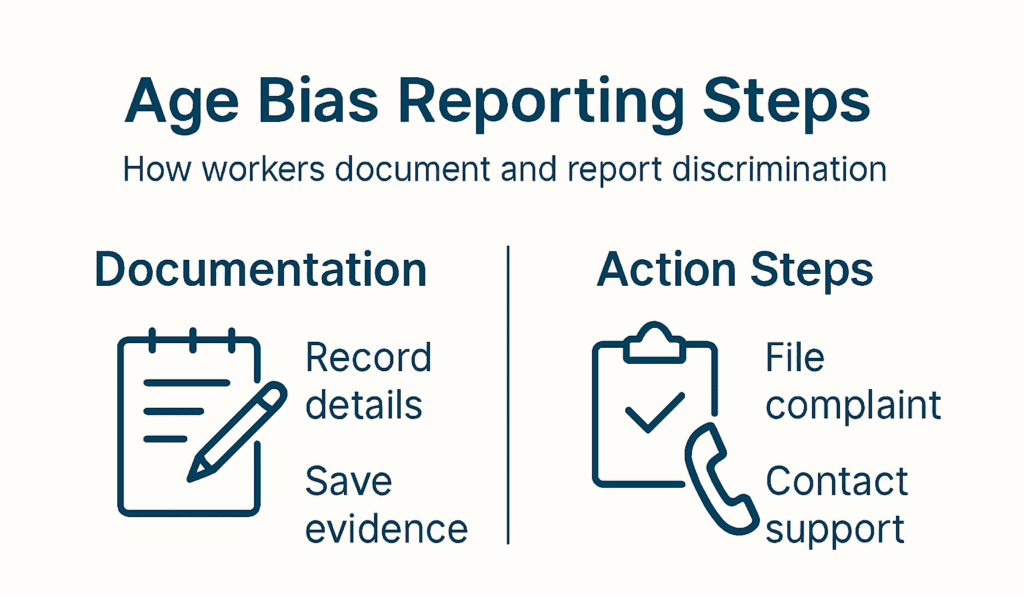
Pro tip: Create a contemporaneous, private digital or physical log of discriminatory incidents, including exact dates, specific language used, and potential witnesses, which can provide crucial evidence if legal action becomes necessary.
The following table summarizes key steps to report and address age discrimination:
| Step | Purpose | Example Action |
|---|---|---|
| Document incidents | Build evidence for claims | Record dates, remarks, witnesses |
| Consult legal counsel | Understand legal options | Contact employment attorney |
| File external complaint | Launch formal investigation | Submit report to EEOC or state agency |
| Request internal review | Encourage workplace accountability | Ask HR for investigation |
Preventing Workplace Discrimination and Retaliation
Torrance manufacturing employers must proactively establish comprehensive strategies to prevent workplace discrimination and protect employee rights. Promising practices for preventing harassment provide critical guidelines for creating a fair and inclusive work environment.
Effective anti-discrimination strategies include:
- Developing clear, comprehensive nondiscrimination policies
- Conducting regular employee training sessions
- Establishing transparent reporting mechanisms
- Creating a zero-tolerance culture for discriminatory behavior
- Implementing consistent and fair investigation procedures
- Protecting employees who report discrimination
- Maintaining detailed documentation of workplace interactions
Workplace culture transformation requires more than just policy creation. Employers must actively foster an environment of respect, understanding, and equal opportunity for workers of all ages and backgrounds. This involves creating communication channels that allow employees to voice concerns without fear of retaliation.
California law requires employers to take proactive steps to prevent workplace discrimination under FEHA.
Manufacturing companies in Torrance should implement comprehensive training programs that educate managers and employees about age discrimination, unconscious bias, and the importance of inclusive workplace practices. These programs should emphasize the value of diverse workforce experiences and challenge stereotypical assumptions about worker capabilities.
Pro tip: Develop a confidential, anonymous reporting system that allows employees to share concerns about potential discrimination without fear of professional consequences.
Understanding Your Legal Options for Age Discrimination Claims
If you believe you have experienced age discrimination in a Torrance manufacturing workplace, California United Law Group, P.C. can help you understand your legal options under federal and California law. Our employment attorneys have experience representing employees in discrimination and harassment matters.
We also handle wrongful termination and retaliation claims. To discuss your situation, contact California United Law Group, P.C.
IMPORTANT DISCLAIMER: The outcome of any legal matter depends on the specific facts and circumstances of each case. Prior results do not guarantee a similar outcome. This article provides general information only and does not constitute legal advice. Consult with an attorney to discuss your specific situation.
ATTORNEY ADVERTISING NOTICE
This article is provided for informational purposes only and does not constitute legal advice. The information presented is general in nature and may not apply to your specific circumstances. No attorney-client relationship is created by reading this article. Results in legal matters depend on the unique facts of each case, and past results do not guarantee or predict future outcomes. For legal advice specific to your situation, please consult with a qualified employment attorney.
Frequently Asked Questions
Is age discrimination common in manufacturing workplaces?
Age discrimination is a significant issue in manufacturing, particularly affecting workers aged 40 and older. Subtle forms of bias and systemic exclusion can often go unnoticed, but they contribute to an unwelcoming environment for older employees.
What legal protections exist against age discrimination in manufacturing?
Employees aged 40 and older are protected by the Age Discrimination in Employment Act (ADEA) at the federal level, as well as the Fair Employment and Housing Act (FEHA) in certain states, which provide broader protections against unfair treatment based on age.
How can employees identify age discrimination in their workplace?
Signs of age discrimination may include consistently being overlooked for training opportunities, receiving negative comments about one’s age, and being excluded from high-visibility projects or decision-making roles. Keeping a detailed record of such incidents can help in identifying patterns of discriminatory behavior.
What should I do if I believe I am experiencing age discrimination at work?
If you suspect age discrimination, you may wish to document specific incidents, consult with an employment law attorney to understand your legal options, and consider whether filing a complaint with the EEOC or relevant state agency is appropriate for your situation. An attorney can help you evaluate the strength of your potential claim based on your specific circumstances.
Recommended
- Employment Lawyer Torrance – Los Angeles Employment Lawyers | California United Law Group, P.C.
- Employment Lawyer El Monte – Los Angeles Employment Lawyers | California United Law Group, P.C.
- What Counts as Workplace Harassment in California? – Los Angeles Employment Lawyers | California United Law Group, P.C.
- Employment Lawyer Long Beach – Los Angeles Employment Lawyers | California United Law Group, P.C.